Is Adoption A Feminist Issue?

As a feminist and a woman with an adoptive father, I take high interest in adoption-focused commentary. Generally it comes from segments of the right wing without adoptive experiences within their own families. Generally it pisses me off.

Typically the focus is on love. Can love between adoptive and biological families be just as real? From my vantage point (I was raised with equal love from my biological mother and adoptive father), the answer is a strong yes. I find it downright insulting when people insinuate to me personally, or generally within the news media, that something emotional exists between biological parents and biological children that can’t be created in any other way.

I don’t deny that adoptive families can lead to complex emotions and realities. I have struggled to negotiate what not knowing a biological parent means to me. I have felt loss. I have felt shame. I have felt sorrow. I have gone through grief. It has been alienating at times. It is very personal. Every adoptive situation is. Where I’ve landed, at least for now, is a pretty cool place: I feel exceedingly blessed knowing that not two, but three, have actively considered themselves to be my parent. There are three family branches that seem to be equally proud of (and, as needed, exasperated with) me in ways that only families care, regardless of who has the genes and who has been a part of my day-to-day life.

I recently learned a dear friend is an adoptive mother. Her daughter will soon meet her birth mother for the first time. We had a wonderful conversation, riveted by one another’s perspective. For me, it was a relief to hear from the other side, ask questions and share thoughts without fear of somehow hurting those personally invested in how I feel about the facts of my life. I realized, listening to her, how similar adoptive childhood and parenthood can silently feel. It’s not easy, but in the end family is what we declare it to be.

A publication I tend to agree with, the Minnesota Women’s Press, has two features on adoption in the current issue. Feminist Lens On Adoption is written by a transnational adoptee who decided against adoption on feminist grounds after learning of her own infertility, and Love and Loss is written by an adopted mother of a transnational daughter. I am extremely upset with the presentation of these articles together without a third, positive viewpoint.

The first article brings up two great points from a feminist lens. First, transnational adoptees experience intensified ambiguity. Moreso, the notion of “a better life” often carries white supremacist overtones. Though all of my parents are white like me, I can’t begin to imagine how much more complicated my personal experience would feel if culture and color were thrown into the mix. I cannot speak for the transnational adoptee experience, just as they can’t really speak for same-culture experience. Though some issues are the same, others are very different.

Second, many transnational (and heterocultural) adoptions are forced by a lack of resources. It is absolutely shameful that parents who otherwise desire to raise their biological children feel forced to sell them for money, or give them up due to one-child policies, or give them to someone else who has the resources to raise a child. Harkening back to one of those feminist issues that just won’t seem to go away: Empowering care is a human right disgracefully neglected on national and international levels.

I followed up that article with Love and Loss, a column by the editor. The mother of a young transnational adoptive daughter, she wrote that she recently explained “It was the best thing that ever happened to Mommy and Daddy. But it might not be that way for you.” Those comments don’t bother me. But the following sentence really, really does: “Adoption is about loss.”

In my own experience, adoption is a gain, the biggest gain of my life, not a loss. It followed a loss, certainly, but I don’t know that we can globalize that to every adoption, especially those within the U.S. In many cases you have women who choose not to have abortions, willing throughout their pregnancies to give a very big gift to a couple they’ve chosen. I can’t understand how to frame that as loss. I feel pain for others who must be reading this article and feeling similarly written out of the publication.

Taken in tandem, these articles seem to take the issue of transnational adoption and globalize it to all adoption. Because there are strong feminist critiques of the transnational adoption space, there must be feminist critiques for all adoptions. (Though this conclusion is only drawn in the editor’s column.) Of course adoption is a feminist issue, but one that is complicated and must be viewed from the experiences and positions of different women without allowing one to speak for all. That’s what feminism is supposed to do.

This piece was originally published in 2008 on a previous personal blog that is no longer available online. Rather than make edits I will acknowledge the consternation I feel while considering how much I have or have not grown as a writer during these past five years. There are also views stated that I would broaden today. Regardless I am publishing this piece now, as I realize that I may wish to write more about adoption and feminism and identity  from my new, present-day lens as a pregnant woman.

This Needs To Be Said: Americans Look Like Everyone

Who didn’t watch the news coverage of the senseless terrorist bombings in Boston with a mixture of horror and sadness? After coverage shifted from deaths and injuries to the Federal Bureau of Investigation releasing photographs of the suspects, some news anchors suggested that you couldn’t tell by the pictures if they were American or not.

Clearly, this needs to be said: Americans look like everyone.

Americans come in every skin color, hue, and shade that pigment and sunlight know how to put together.

Americans are girls, women, boys, and men. There is not a gender identity or sexual orientation that doesn’t look American – in military uniform, in scouting uniform, or in casual clothes.

Americans have faith. Americans don’t have faith. The Constitution contains a declaration of faith that “Congress shall make no law respecting an establishment of religion, or prohibiting the free exercise thereof.” This means that Atheists, Christians, Jews, Muslims, and EVERYONE get to look like themselves and look like Americans at the same time.

And American hairstyles, oh so many variations! Sometimes hair is curly, nappy, straight, short, long, or not there for you to see under a traditional head covering.

Americans are short, tall, skinny, fat, and every shape and size that life is able to put together. Americans have ability and disability. There are more than 11 million people here who already look like Americans and are waiting on documents to back them up. Good people are working on that, because diversity is our strength, not our weakness, and it’s freaking amazing gorgeous.

Americans look like everyone. There is not a single American who doesn’t look like an American, because the bottom line is that diversity – which includes so much more than the most privileged white men whom journalists are used to talking to on television – is what America looks like.

Difference, and diversity, and standing up for diversity are what make us look like Americans.

Standing against racism, and sexism, and homophobia, and xenophobia, and ableism are what make us look like Americans.

It is laws and assumptions that separate us on the basis of our skin, on the contents of our underwear, on the accent in our voice that look, frankly, un-American.

sar_logo-150x150

This post is part of the YWCA Stand Against Racism blog carnival – we invite you to join the dialogue! Post your comment below, share your story and follow the conversation on Twitter with the hashtag #StandAgainstRacism.

Shulamith Firestone, Sheryl Sandberg And #femfuture (Oh My)

“Sisterhood is powerful. It kills. Mostly sisters.”  – Ti-Grace Atkinson

Ti-Grace Atkinson

Madness, rivalry, wobbling (and ultimately collapsing) on two legs alone — reading Susan Faludi on the life and death of radical feminist Shulamith Firestone is no trip to the Thomas Kinkade kiosk. One theme I’d like to unpack, which is oddly prescient, has to do with fighting feminists, a topic that gets a lot of attention and little resolution.

There’s actually a simple solution. Ready?

Don’t be an asshole.

No really, don’t be an asshole.

I consider myself to be a cultural feminist, by which I mean that practicing feminist values is an inextricable ingredient of my fight for political and social equality and justice for women and girls. By practicing feminist values, I refer to an orientation to elevate the softer voices in a room, to treat others with accommodation and inclusion and respect, not a “dos and don’ts feminism” that focuses on feminism as a means of correcting the behavior of feminists and/or women. Dos and don’ts feminism, I believe, suggests that we can choose our way out of systematic discrimination against women, if only by not wearing that slutty thing or taking his last name or, if you’ve been listening to the gun lobby, buying a gun. This, in my opinion, leads to judgement and stigma and is the antithesis of inclusive feminism.

A feminist framework of power must in my opinion be culturally feminist, built upon principles of inclusion — let’s empower everyone — rather than dominance, or an approach that says let’s have the loudest voice and shout the others down. At its core, being an asshole is a particularly disagreeable way of exerting dominance over others. And, disgustingly, it happens within the women’s movement all the time. Oftentimes this takes the form of attacking feminist women who in good faith try something new with the goal of helping women advance, like Sheryl Sandberg and the authors of #femfuture, a new report with ideas about how to make online feminism more sustainable.

Do Sheryl Sandberg or the authors of #femfuture perfectly represent my views? No, they don’t. I’m sure they don’t represent yours perfectly, either. And I’m also pretty damn sure that insisting they do or you’ll shout them down in a sea accusations about why they personally are “problematic” in lieu of offering additional perspectives about the problem they attempt to tackle is not productive. In a movement built upon inclusion, everything is a starting point. (I don’t mean to minimize some good concerns that inclusion could be increased — in both works it could, which would improve them very much — but am calling for feminists with additional perspectives to proactively add their voices to the topics at hand rather than declaring the intentions of the speakers to exclude them.)

Within the feminist community, please, let’s not let problematic be the enemy of progress. And let’s focus on the progress.

Faludi’s piece references Trashing: The Dark Side of Sisterhood, a piece by Jo Freeman that I have read and reread several times over the years.  One of the best conclusions is:

Isn’t it time we stopped looking for enemies within and began to attack the real enemy without?

My Morning With The Morning After Pill

You can be a good person, you can be responsible and you can still find yourself, without warning, in an uncomfortable and stigmatized situation.

One night after having sex with someone I was dating, I saw the condom broke. Not like a little. Totally shredded. This scared the hell out of me but I played it cool.

“Are you okay,” he asked. I brushed it off.

“I’m fine,” I lied. “Don’t worry about this.”

Sometimes in a moment of crisis the safest thing to do is not let others know you see it as a moment of crisis. This was one of those moments.

As he slept through the night, I kept my body motionless, bored my eyes into the dark ceiling that seemed ready to suffocate me and FREAKED OUT. “I can’t believe this just happened to me. How could this happen to me? How could I let this happen to me?” The whole gamut of denial and fear and shame.

A calmer synopsis:

At the time I did not want to become a parent, and my life circumstances wouldn’t have made it possible for me to be the kind of parent I want to be today. We, in the context of that relationship, were not suited to be parents together. It wasn’t a bad relationship. It was a decent relationship. But it did not include a shared desire to build a family together. We didn’t even discuss those issues. Some people are scandalized by those who have sex with no intention of getting married and having children, but I didn’t and don’t think there’s anything wrong with adults in their twenties, which we were, who have consensual sex. It’s normal.

This happened at a time when if you needed emergency contraception fast, which I did, your options were to call your doctor, try an emergency room or go to Planned Parenthood. The easiest and quickest thing was what I wanted. Hyper after a sleepless and terrified night, I called Planned Parenthood within minutes of opening, and did not waste any time to have breakfast, drink coffee, shower, brush my teeth or do anything else before going to to pick up some Plan B. I walked up to the front desk, showed them my driver’s license to prove my age, paid what I could afford and that was that.

In the car ride home I wept. I beat myself up for finding myself alone with a box of Plan B in a relationship where I felt most comfortable doing what needed to be done in silence. Alone. I thought of all the horrible things said by sexual fundamentalists who want to make or keep illegal every sex act that doesn’t produce a baby, and I started to internalize them. Emergency contraception is abortion and abortion is murder, they say. Never mind that there’s no science to back that up. When you feel really alone and really scared it’s easy to beat yourself up with others’ words, even ones that are incorrect and you find offensive.

Home at last. It was not even nine in the morning, I was wearing clothes from the day before and I felt like I had been walking up a difficult mountain for weeks. I kept crying in my apartment. I didn’t want to be someone who had irresponsible sex. I was trying to be responsible this time, I swear. I didn’t want to be someone who took emergency contraception without telling her boyfriend. This situation was built for other people — not me — other people. I was, as now, an ardent feminist and an advocate for emergency contraception. This was just not a situation I had been anticipating that morning. I didn’t want it. I wanted to be at work in a boring meeting. I wanted to erase and start over.

Drinking a glass of water to calm down, I read the instructions in the box. I opened the box. I told myself I would go to the bathroom, and then I would take it. I breathed. And, in the bathroom, in those moments before I was going to take the pill I wanted to scream at, I discovered that my period had started.

This story is very personal, but I’ve decided to write about it because in hindsight I’ve gained perspectives on a few themes within this story that I feel need to be said at this point in time.

First, this week’s court decision overturning the Obama administration’s order to, against the recommendation of the Food and Drug Administration, block over-the-counter access to emergency contraception for women of all ages is an important milestone for public health. As someone who has gone to get the morning after pill the morning after, I can tell you that time is not a resource to be wasted when you need to avoid a pregnancy effective now. Time is agony. Further, situations can be such that you don’t want to talk to anyone about it, even a pharmacist.

Second, I read what I just wrote and while I was beating the crap out of myself at the time, I think that what I did was incredibly mature. While I was in my twenties then, I think this holds true for women of all ages, including women in high school. Getting emergency contraception as quickly as you can when have already had unprotected sex and don’t want to be pregnant is taking control of your health, your life, your future. Teen pregnancy prevention was supposed to be a bipartisan cause. No one, including the president of the United States, should be looking at young women who know they need emergency contraception as anything but incredibly mature.

Third, I think it’s okay to acknowledge that it’s normal to have a wide range of feelings about reproductive health care. Sexuality and reproduction are intensely personal matters. I felt very sad at the time, and I was a reproductive rights advocate then. I’m one now. Having felt intense feelings nowhere near “I am woman, hear me roar” when preparing to take emergency contraception doesn’t make me any less of a feminist or a strong woman. It’s okay to talk about tough times as tough times. Tough times happen to good people, and acknowledging tough times as they are can help make all of us better people.

Fourth, I’m quite pregnant as I type this today. In fact I’m looking over a huge bubble in my abdomen, holding my future daughter. In contrast to some of the negative self-talk I engaged in then, it is so crystal clear to me at this time that preventing pregnancy is nothing like ending a pregnancy. They should not be talked about as equivalent, and shame on the mainstream media for often allowing this confusion to continue. Having used contraception regularly until I decided to become pregnant is one of the best gifts I’m giving my future daughter, because now I’m ready to have her and give her the best life I can.

If she ever needs emergency contraception and chooses to tell me about it, I will be so proud of her. Sexuality and sexual health can be really hard, sometimes. If she ever cries to me I will not judge her, but support her. I think about these things when reflecting on my morning with the morning after pill.

Why I Am Not Posting Pregnancy Photos To Facebook

I am a pregnant woman. Never in my adult life have I had fewer rights under the law, more intrusive comments and questions from people in the public space. I don’t need to be objectified any more than I already am. This is not a body for you to glance at, scroll down, expand the window, draw your own conclusions about and “Like.”

That is why I am not posting pregnancy photos to Facebook.

We, as a culture, live in public. I, as a human being, made a strategic decision to live in public several years ago. I believe that a woman telling her story has the power to change society.

That is why I rely strongly on personal narrative, because I want you to know I’m proud to be pregnant and pro-choice, I’m proud to be pregnant and an eating disorder survivor, and I want you to be proud to be whoever you are and tell your stories without shame — whether you relate to my experiences or not.

So why am I drawing the line at pregnancy photos?

Because I want to share my pregnancy in the way I experience it and choose to share it, not in a way for others to see it and choose to interpret it.

Because carrying a wanted pregnancy is an act of immense love and sacrifice that is, at its core, an astonishing and sacred experience of beauty. For me. This time.

Others’ experiences are, I’m sure, different.

I am fortunate to have, to be able to have, a loving spouse with whom to share doubts, fears, glee, joy and stomach troubles during these most private of times.

I am offended to imagine breaking the spell of our intimacy as a couple and family, and my integrity to sense of self as seen fit to share by posing, anticipating others looking at me and calling it “cute.”

A number of friends have begged for photos. I know you mean well. I know you want to share this time with me. I am happy to “Like” your pregnancy photos if you choose to share them with me. I encourage you to be happy that I am sharing this time in my life on my level.

If you are itching to honor me during this time, or do something quick online to lift my spirits because I’m pregnant and my back hurts, I will point you directly to the Meet the Press website where you can, in solidarity, share your alarm that recently they had one token woman against reproductive rights and four men discussing the new six-week abortion ban in North Dakota, the most restrictive abortion law on the books. By presenting reproductive rights as a matter of public morality, mainly as judged by men, rather than the lived and incredibly visceral experiences of individual women, the mainstream media is colluding in the massive infringement of my civil and human rights.

When the silencing of people like me in mainstream media and public policy is so extreme, it is hard for me to get excited about the voyeurism of cutesy pregnancy mania on social media. It is hard for me to believe the pressure to perform for the camera and the pressure to keep my mouth shut about my human rights are not interconnected.

Maybe if we all get together socially and “Like” one other’s pregnancies it will be okay. But it’s not. One of us might find ourselves pregnant and in the wrong place at the wrong time. And then, in the name of someone else’s abstract notions of morality enforced by the state, one of us might die. Or have a forced C-section. Or be incarcerated or detained because we were pregnant.

I refuse to be a smiling snapshot of this awful era for pregnant women. Opting out is my act of difference. Speaking out is my act of defiance.

Good Feminists, Let’s Not Try To “Speak For All Women” Anymore

No one can “speak for all women.” It’s time to let this verbal contortion go without blame, shame, recrimination — let’s us this feminist community take this rhetorical device and flush it sweetly and swiftly like a live spider, somehow misplaced indoors, that doesn’t need to be throttled to the death by our bare hands.

Not everyone does it, but many do. I have done it myself. See, there! Before you think I’m attacking you and ruffle up your collar, you can just smile and say I’m a hypocrite. Except I’m not attacking you, and I’m not a hypocrite. I’m evolving. If this topic affects you, you are capable of it, too.

Changes within feminism are cause for celebration, proof that the struggle for women’s human rights, is a living, breathing thing. It is honor, not rebuke, to our feminist foremothers and fathers to adapt our calls for justice to the times, to make them more inclusive for more people, to update our tactics, to think freely for ourselves and trust our ability and others’ ability to do so.

Indeed, speaking your own truth with confidence — embracing the confidence to know that you are the foremost authority on yourself — is a feminist act, a radical act in a society that continues to second-guess women and girls and tell them at every corner to jettison their judgement for what they should be doing better, which is usually BE MORE SEXY or BE MORE VIRGINAL or BE LESS BITCHY or FORGET ABOUT CHILDCARE AT WORK AND EQUITABLE PARTNERSHIPS AT HOME, YOU JUST NEED TO LEARN HOW TO MANAGE YOUR SCHEDULE AND BUY THESE NEAT CLOSET ORGANIZERS or STOP BEING SUCH A FUCKING SLUT (the magazine headlines put most of this a little more nicely, but the substance more or less holds).

To think freely, to take up space, to believe you have a right to your own truths in a world still so toxic toward women is a compliment to Alice Paul and every feminist who came before you.

Having spent a lot of time in feminist spaces and perusing feminist media dominated by the “speaking for all women” bug, I can attest to having seen first-hand how, as I said in another post reflecting on Betty Friedan and The Feminine Mystique, people can speak profoundly well for themselves, and do themselves and others a disservice when they try to speak for others at the same time. I have seen how, through probably no intent of the speakers, “speaking for all women” smashes what should be kaleidoscopic perspectives of women’s lives. Specifically, I’ve seen how the self-imposed and unproductive pressure to “speak for all women” tends to:

  • Discount or stand in opposition to the actual lived experiences of non-dominant groups within the in-group (if they’re even there), especially women of color, women of faith, women in other countries and cultures, younger women, younger parents — working within a religion means you are “oppressed,” teen motherhood is a “tragedy,” the classic lie that “young women take feminism for granted”
  • Redirect diversity efforts from expanding perspectives/strategies/work to focus only on representational diversity (important, but not sufficient in itself) — “we need a [black woman/young woman/immigrant woman] to sit on this panel or sign this letter we’ve already put together”
  • Trash women who do their part to move feminism forward within their realm of expertise — last night I went to a networking and mentoring event for undergraduate college women, many not so sure of themselves, and the first introduction to Sheryl Sandberg from the panel was an apology: “I know she gets criticism, but …”
  • Shift focus to “choices,” an insistence upon picking at and policing women’s personal lives rather than acknowledging we’re blamed for our second-class status no matter what we do, a dos and don’ts feminism if you will — suggestions that the fate of feminism (or at least your enlightenment) rests on whether you get married or change your name 
  • Lead some speakers to apologize for who they are and taking up space — “I’m not a younger woman, but I’m really supportive of younger feminists … am I still allowed to help?,” and other concerns that not being exactly like others around you means you “can’t be a feminist”
  • Shame feminists who are trying to get by as much as all the other women on the planet — whether that means wearing revealing clothing, not caring about your clothing, or enduring life events that are no fault of your own, including having low self-esteem, dealing with abusive relationships, being underpaid
  • Discourage the evolution of ideas and leadership within the women’s movement — if you can’t speak for everyone, well then you should just sit down and listen to someone who does it anyway (see concerns above, this is exactly why we need more voices, not fewer!)

So okay, what can we do next? Speak for ourselves. Speak for women. Acknowledge that speaking for women means also helping to lift up the voices of women with different races, sexualities, abilities, different perspectives, different views. It’s all feminist fair game if the discussion rests on revealing our own individual truths and moving forward societal actions that expand justice for other women — under this definition, we can quickly discard the few on the fray who suggest that taking away reproductive rights from women and awarding them to church and state is feminist, or that what we need isn’t the Violence Against Women Act, but more gun proliferation.

Change is good. Believing in yourself and your right to be present is awesome. So is listening to others without judgement or pressure to be more like you. Diversity is strength. Honesty is revolutionary. Good feminists, let’s not try to “speak for all women” anymore.

Podcast On Pregnancy, Eating Disorders, Body Image And Feminism

I did a new podcast with Fully Engaged Feminism on pregnancy, eating disorders, body image and feminism.

I first spoke out about my experience with Pregnancy After An Eating Disorder on this blog late last year, and in response the lovely feminist writer Amy Choi interviewed me for Feministing and added her insights.

I’m not done speaking out. I’m not going to shut up. When I first started researching resources for pregnant women who have struggled with eating disorders or body image issues, I found very little. There is a bit of medical management information for those who are pregnant or trying to get pregnant, and actively have an eating disorder today. But little about pregnancy after an eating disorder, or even negative self-image struggles.

I’m not shutting up because I know there are tons of women out there like me — women who are in recovery, who don’t need medical support to manage the pregnancy, who don’t see much out there on the Internets acknowledging our existence. Some of us want to know how to stop the old Body Image Beelzebubs from coming back. Some of us want to know how to tell them to be quiet. Some of us don’t need a “how-to,” necessarily, but simply want an acknowledgement that body shame is a) real and b) sure becomes a focal point during pregnancy.

Given the lack of information out there, I intend to keep speaking up and sharing my experiences, and encourage others who feel comfortable to do the same. Sometimes we need to create the thing we wish already existed.

Anyway, check out the new podcast. We had a terrific time and I’m so grateful to Laura for having me on. She also made a sick good pan of vegan brownies and taught me how to make a podcast. Gratitude.

A Preliminary Observation On Lean In

Encouraging women to believe in themselves and their own power? Yes. In what universe should we not?

From my own experiences as a manager and mentor, as well as employee, I can tell you some of the best returns on human capital investment I’ve seen come from encouraging younger women to believe in their worth. That they deserve to be in the room. That they should air differing perspectives. That they must be treated (and compensated) fairly.

Needless to say, I’m really looking forward to reading Sheryl Sandberg’s new book, Lean In. I want women to be openly ambitious. No, I don’t think ambition alone is going to end sexism, along with racism, homophobia, class privilege, ableism and other discriminations that interact with  sexism to hold women down. But it is a necessary ingredient.

In the short term I would like to make the preliminary observation over how perplexing it is to see that the feminist blogosphere and feminist publications have been lit up with a “controversy” over whether or not Sandberg’s book is “good for women.” Meanwhile, the cover of Time magazine asks if we shouldn’t hate Sandberg because she is successful. And a few nights ago Bill Maher had four men and one woman discussing the book. It was its own joke. No one said the punchline.

As someone who has held a variety of big feminist titles, something I started doing from a pretty young age, I’ve had a number of young women ask me how I did it, because they want to “lead feminism.”

My primary piece of advice for anyone who wants to “lead feminism” is to take your ambition and “lean in” to the real world. Generational shifts, owing to the work of older feminists, have made a strong feminist leader’s options much larger than running a women’s organization, which is always going to be more insular in reach.

Go lead a business. Go become a creative director. Go run for public office. Go become a school principal. Go follow whatever your heart tells you to do, but go out into the real world, and do it where women feminists are not the only leaders. I wish we saw more feminists on Bill Maher, discussing women in the workplace with a broader group, than we are seeing discussing, in many cases, themselves within a smaller group.

NRA President David Keene’s Rape Joke Isn’t Funny

“We [the NRA] could be serial rapists and have a higher favorable rating than Congress.”

David Keene, NRA President

When will the rape jokes stop?

Wednesday, National Rifle Association (NRA) President David Keene spoke at Harvard and popped a rape joke in defense of his increasingly indefensible organization.

Why doesn’t he compare their favorability rating to Congress anymore? Let’s not draw attention to the NRA’s slipping numbers. Let’s have a laugh about rape and “government” instead.

This comment has gone virtually unnoticed.

This is exactly what rape culture looks like.

Rape culture hides in plain sight.

Rape is not a punchline.

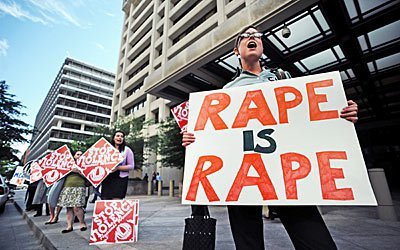
Rape is rape.

Rape happens every day. Someone, often a woman or a girl, is sexually assaulted in the United States every two minutes.

She may be screaming right now. She may be crying as quietly as she can. She may be closing her eyes and praying to live through this.

Can you hear her?

Rape is violence. Dismissing gun violence with rape violence is missing the entire point. All violence against women must end.

Rape culture feeds gun culture and gun culture feeds rape culture.

Rape culture and gun culture are part of the same culture of dominance and violence — and men exercising power without sharing it equally and equitably with women.

Strangers are not the danger, and let’s be real, the face of the stranger our culture says to be afraid of is an African American man who, like a woman of any ethnic background, rarely gets to contribute to public policy debates about guns, rape, violence and, for that matter, everything else under the law.

Racism has never lessened the epidemic of violence in this country.

Racism is a form of violence in itself.

Racism feeds more violence.

Racism is used to stoke fears by those who make piles and piles of money

from racism

and sexism

and violence.

The faces to be afraid of are the white men who lead our country almost totally by themselves while insisting there’s nothing wrong with that.

While not passing the Violence Against Women Act.

While not doing something about the fact that women are more likely to be shot by an intimate partner than a stranger.

While not doing something about the fact that women are more likely to be sexually assaulted by someone they know.

While parading out a woman who will say that guns are fashionable, which they are not.

While parading out a woman who will say that guns will protect a woman from rape, which they do not.

While parading out a woman who will say that they have a “second amendment right to choose” that means everyone — women, men, criminals — is eligible buy a gun without a background check, or military-style weapons, or military-style ammunition.

A rape joke is not going to make this go away.

A rape joke makes it worse.

Shame on the National Rifle Association.

Shame on gun culture.

Shame on rape culture.

rape-is-rape

Nobody Told Me L. Ron Hubbard Was Obsessed With Abortion!

I recently read L. Ron Hubbard’s Dianetics. Like so many of my dear readers, I follow the life progression of Tom Cruise with interest and enjoy, from time to time, reading a good piece on Scientology. So I thought it would be instructive to go to the source and see how this all got started.

Dianetics is the foundation of what became Scientology. The premise is fairly simple: The mind, according to L. Ron Hubbard, is an organ capable of working without error so long as we have “cleared” it of “engrams,” which are imprints from traumatic experiences in our past. Through a process called “auditing” it is possible to “clear” these “engrams” and rock on with a flawless life. Most of this I more or less knew before reading Dianetics.

What I didn’t know before reading is that L. Ron Hubbard was obsessed with abortion and had such strange attitudes about pregnant women. According to Dianetics everyone but “clears” are weighted down with “engrams” that cause them to act and think irrationally — and I estimate based on my reading that L. Ron Hubbard thinks fully a third or more of these damaging “engrams” we’re all carrying around come from the nefarious activities of pregnant women.

The way he tells it, pregnant women of his era sat around and “attempted abortion” by pounding their abdomens, begging to be beaten by their husbands and cursing the fetus throughout pregnancy. This is not a rarity, but positioned as something that pretty much all pregnant women do. Further a woman being miserable during, for example, morning sickness, will cause her child to be messed up throughout adult life unless those “engrams” are cleared. There are recurring pronouncements about sexual encounters during pregnancy, from masturbation to frustrating frigid games with a husband to illicit sex with a lover, messing up a person’s entire life. During childbirth, it is important not to speak so a baby is not further imprinted and damaged.

This is not one line in the book. It is all over the book. L. Ron Hubbard was obsessed with abortion and pregnant women. As a reproductive justice advocate, I’m shocked I didn’t know until now he thought pregnant women were to blame for so many of the problems in the universe. What is most disturbing is how many others — not just science fiction authors like L. Ron Hubbard — people like politicians, religious authorities and community leaders are respected when they say, repeatedly, equally bizarre things about pregnant women today.