Podcast On Pregnancy, Eating Disorders, Body Image And Feminism

I did a new podcast with Fully Engaged Feminism on pregnancy, eating disorders, body image and feminism.

I first spoke out about my experience with Pregnancy After An Eating Disorder on this blog late last year, and in response the lovely feminist writer Amy Choi interviewed me for Feministing and added her insights.

I’m not done speaking out. I’m not going to shut up. When I first started researching resources for pregnant women who have struggled with eating disorders or body image issues, I found very little. There is a bit of medical management information for those who are pregnant or trying to get pregnant, and actively have an eating disorder today. But little about pregnancy after an eating disorder, or even negative self-image struggles.

I’m not shutting up because I know there are tons of women out there like me — women who are in recovery, who don’t need medical support to manage the pregnancy, who don’t see much out there on the Internets acknowledging our existence. Some of us want to know how to stop the old Body Image Beelzebubs from coming back. Some of us want to know how to tell them to be quiet. Some of us don’t need a “how-to,” necessarily, but simply want an acknowledgement that body shame is a) real and b) sure becomes a focal point during pregnancy.

Given the lack of information out there, I intend to keep speaking up and sharing my experiences, and encourage others who feel comfortable to do the same. Sometimes we need to create the thing we wish already existed.

Anyway, check out the new podcast. We had a terrific time and I’m so grateful to Laura for having me on. She also made a sick good pan of vegan brownies and taught me how to make a podcast. Gratitude.

A Preliminary Observation On Lean In

Encouraging women to believe in themselves and their own power? Yes. In what universe should we not?

From my own experiences as a manager and mentor, as well as employee, I can tell you some of the best returns on human capital investment I’ve seen come from encouraging younger women to believe in their worth. That they deserve to be in the room. That they should air differing perspectives. That they must be treated (and compensated) fairly.

Needless to say, I’m really looking forward to reading Sheryl Sandberg’s new book, Lean In. I want women to be openly ambitious. No, I don’t think ambition alone is going to end sexism, along with racism, homophobia, class privilege, ableism and other discriminations that interact with  sexism to hold women down. But it is a necessary ingredient.

In the short term I would like to make the preliminary observation over how perplexing it is to see that the feminist blogosphere and feminist publications have been lit up with a “controversy” over whether or not Sandberg’s book is “good for women.” Meanwhile, the cover of Time magazine asks if we shouldn’t hate Sandberg because she is successful. And a few nights ago Bill Maher had four men and one woman discussing the book. It was its own joke. No one said the punchline.

As someone who has held a variety of big feminist titles, something I started doing from a pretty young age, I’ve had a number of young women ask me how I did it, because they want to “lead feminism.”

My primary piece of advice for anyone who wants to “lead feminism” is to take your ambition and “lean in” to the real world. Generational shifts, owing to the work of older feminists, have made a strong feminist leader’s options much larger than running a women’s organization, which is always going to be more insular in reach.

Go lead a business. Go become a creative director. Go run for public office. Go become a school principal. Go follow whatever your heart tells you to do, but go out into the real world, and do it where women feminists are not the only leaders. I wish we saw more feminists on Bill Maher, discussing women in the workplace with a broader group, than we are seeing discussing, in many cases, themselves within a smaller group.

NRA President David Keene’s Rape Joke Isn’t Funny

“We [the NRA] could be serial rapists and have a higher favorable rating than Congress.”

David Keene, NRA President

When will the rape jokes stop?

Wednesday, National Rifle Association (NRA) President David Keene spoke at Harvard and popped a rape joke in defense of his increasingly indefensible organization.

Why doesn’t he compare their favorability rating to Congress anymore? Let’s not draw attention to the NRA’s slipping numbers. Let’s have a laugh about rape and “government” instead.

This comment has gone virtually unnoticed.

This is exactly what rape culture looks like.

Rape culture hides in plain sight.

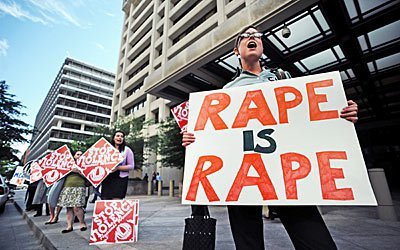
Rape is not a punchline.

Rape is rape.

Rape happens every day. Someone, often a woman or a girl, is sexually assaulted in the United States every two minutes.

She may be screaming right now. She may be crying as quietly as she can. She may be closing her eyes and praying to live through this.

Can you hear her?

Rape is violence. Dismissing gun violence with rape violence is missing the entire point. All violence against women must end.

Rape culture feeds gun culture and gun culture feeds rape culture.

Rape culture and gun culture are part of the same culture of dominance and violence — and men exercising power without sharing it equally and equitably with women.

Strangers are not the danger, and let’s be real, the face of the stranger our culture says to be afraid of is an African American man who, like a woman of any ethnic background, rarely gets to contribute to public policy debates about guns, rape, violence and, for that matter, everything else under the law.

Racism has never lessened the epidemic of violence in this country.

Racism is a form of violence in itself.

Racism feeds more violence.

Racism is used to stoke fears by those who make piles and piles of money

from racism

and sexism

and violence.

The faces to be afraid of are the white men who lead our country almost totally by themselves while insisting there’s nothing wrong with that.

While not passing the Violence Against Women Act.

While not doing something about the fact that women are more likely to be shot by an intimate partner than a stranger.

While not doing something about the fact that women are more likely to be sexually assaulted by someone they know.

While parading out a woman who will say that guns are fashionable, which they are not.

While parading out a woman who will say that guns will protect a woman from rape, which they do not.

While parading out a woman who will say that they have a “second amendment right to choose” that means everyone — women, men, criminals — is eligible buy a gun without a background check, or military-style weapons, or military-style ammunition.

A rape joke is not going to make this go away.

A rape joke makes it worse.

Shame on the National Rifle Association.

Shame on gun culture.

Shame on rape culture.

rape-is-rape

Nobody Told Me L. Ron Hubbard Was Obsessed With Abortion!

I recently read L. Ron Hubbard’s Dianetics. Like so many of my dear readers, I follow the life progression of Tom Cruise with interest and enjoy, from time to time, reading a good piece on Scientology. So I thought it would be instructive to go to the source and see how this all got started.

Dianetics is the foundation of what became Scientology. The premise is fairly simple: The mind, according to L. Ron Hubbard, is an organ capable of working without error so long as we have “cleared” it of “engrams,” which are imprints from traumatic experiences in our past. Through a process called “auditing” it is possible to “clear” these “engrams” and rock on with a flawless life. Most of this I more or less knew before reading Dianetics.

What I didn’t know before reading is that L. Ron Hubbard was obsessed with abortion and had such strange attitudes about pregnant women. According to Dianetics everyone but “clears” are weighted down with “engrams” that cause them to act and think irrationally — and I estimate based on my reading that L. Ron Hubbard thinks fully a third or more of these damaging “engrams” we’re all carrying around come from the nefarious activities of pregnant women.

The way he tells it, pregnant women of his era sat around and “attempted abortion” by pounding their abdomens, begging to be beaten by their husbands and cursing the fetus throughout pregnancy. This is not a rarity, but positioned as something that pretty much all pregnant women do. Further a woman being miserable during, for example, morning sickness, will cause her child to be messed up throughout adult life unless those “engrams” are cleared. There are recurring pronouncements about sexual encounters during pregnancy, from masturbation to frustrating frigid games with a husband to illicit sex with a lover, messing up a person’s entire life. During childbirth, it is important not to speak so a baby is not further imprinted and damaged.

This is not one line in the book. It is all over the book. L. Ron Hubbard was obsessed with abortion and pregnant women. As a reproductive justice advocate, I’m shocked I didn’t know until now he thought pregnant women were to blame for so many of the problems in the universe. What is most disturbing is how many others — not just science fiction authors like L. Ron Hubbard — people like politicians, religious authorities and community leaders are respected when they say, repeatedly, equally bizarre things about pregnant women today.

Fate Of Feminism Doesn’t Depend On Whether You Get Married Or Change Your Name

Girl meets boy, girl falls in love, girl gets married, girl changes her name. This is a feminist perspective on why it’s okay to do the last two things and not be some kind of feminist failure.

Before we get started, let’s acknowledge the boundaries of this discussion: many people can’t get married because the state won’t let them. And research suggests marriage is increasingly becoming reserved for heterosexual couples with money. There’s a hefty dollop of heterosexual and class privilege lurking in this debate, begging a larger question of what the policing of heterosexual women with money is designed to achieve.

Still, if you’re a woman in love with a man and have crossed some class barriers, let’s be clear that the fate of feminism doesn’t depend on whether you get married or change your name.

The primary beef is here: Asking women what they are going to do with their names when they marry is an invasive and sexist double-standard that is not applied to men. Even asking the question of a woman, and not a man, strikes me as prurient and sexist. Applying value or judgement to what one woman does with her name after marriage — whether that’s retaining a current name, applying a hyphenated name, making up a new last name or taking the partner’s name — continues this invasive and sexist practice of assuming that a woman’s name is up for public comment. If you’re going to ask this question or make grand pronouncements about what a name choice means for society, or a family, or a commitment, or a child, or internalized sexism, then focus 100 percent on men and what they are doing in heterosexual marriages. Women have done our time and frankly could use a breather.

Marriage is an institution with historical roots in the property transfer of women (and often girls) from fathers to husbands. There is no denying this inherently sexist lineage. However, my feminist argument is that the institution of marriage has evolved from the property transfer of women to include same-sex marriage in some states (a feminist victory, albeit incomplete), many egalitarian marriages practiced by couples (a feminist victory, albeit incomplete and not entirely supported by jurisprudence) and more. To write off a woman marrying a man as capitulating to the patriarchy is hogwash. Might it be for some women? Maybe, for both the women and men involved, in some marriages. But an automatic assumption focused solely on her is ridiculous.

So too, as feminist thinking about marriage evolves should feminist thinking about last names evolve. A woman who changes her last name upon marriage is not stupid, or an automaton, or subservient to please him, or a symbol of the failure of feminism, or a threat to the future of feminism. Even suggesting that she is — rather than focusing on men or couples — continues to elevate an invasive and sexist double-standard. Women aren’t “too dumb” or “too weak” to be equal. Women are not the cause of our inequality. Women’s choices are not the cause of our inequality. Of course our choices are influenced by our inequality, and interplay with our inequality, but to focus on what women are doing or not doing instead of focusing on how our society systematically discriminates against women and privileges men (often, with the sheer absence of “choices” about names, work and life because they are assumed to be accommodated without comment) — this just doesn’t have the power to fix the problem. In fact it can serve as a distraction from calling for larger changes that do have the power to fix the problem.

So this is my feminist love letter on Valentine’s Day to YOU, women who married or are thinking about marrying men, and happen to have a last name that everyone loves to chat about (while leaving his untouched). Kindly smile and tell everyone to butt out. You are not public property and you don’t deserve this intrusion in your personal life.

P.S. — My husband decided to continue using his name when we married. I am so proud of him.

Quick Update On My Street Harassment Story

Friday, I was out for a walk when a man exposed himself to me. Immediately after that happened I had a disappointing interaction with the police who didn’t want to take a report when I tried to offer one. With the other options exhausted, I sent an email to their general query address and then immediately posted it on my blog to keep the pressure up. Here is an update:

Due to a great woman I didn’t even know (!) on Twitter reposting the story on a neighborhood police listserv, I was contacted Sunday by the police and was able to file a report. Huge success. I want to take this moment to thank the Twitter feminist community for prodding me into action almost right away. Without your encouragement, I’m not sure I would have moved forward so quickly (and felt the duty to keep going when the police started giving me bad answers).

I also want to acknowledge what posting this story did, because I’m more disturbed than when this whole disgusting subculture first flashed in my face. I heard over, and over, and over from people I know that don’t necessarily get into the feminist work I do. The number of women I know, many of them who were girls at the time, who have experienced a man exposing himself somewhere in a public space is overwhelming. It is far greater than I would have suspected. 

This leads me to put in a plug for a great local group, and a great national group, working to fight street harassment. At the local level here in Washington, D.C., Collective Action for Safe Spaces is just amazing. They have recently succeeded in working with Metro to put policies in place for harassment awareness and reporting on public transit. If you know how long it takes to get an escalator replaced around here, it’s nothing short of amazing they drove this culture change. At the national level, Hollaback! is a non-profit working to end street harassment. It has sprung up groups around the world, one of which is the local group just mentioned. Bonus: Both are largely led by younger feminists (love that stuff). If you are interested in engaging further with this issue I urge you check out these links.

So here are my top three takeaways from the incident:

  • Gratitude for the online feminist community, both as a support system as well as a means to making a needed action occur. Thank you.
  • A preach! If something happens to you that’s not right, speak up. It works.
  • Anger and awareness: The experience of street harassment and exposure is worse than I imagined. I’m ready to keep pushing.

Final Public Service Announcement: If persons expose themselves to you, make sure you’re safe and then call 911 right away.

Street Harassment Email Just Sent To DC Police: Feedback About Exposure Complaints

Dear Metro Police,

One hour ago, just after 5 p.m. while it was still daylight, a man exposed himself to me as I was crossing the P Street bridge on foot, heading east from Georgetown into Dupont Circle. He was wearing a blue jacket and masturbating and looking straight at me.
I tried to start crossing the bridge as quickly as I could, in hopes of seeing a police car, and about halfway down saw two women walking in the opposite direction. I stopped them and told them not to walk on that side of the bridge (north side) by the man at the end. I explained he had just exposed himself to me. At that point the man looked back and while I was talking to the women and a man who had been walking close behind them, hopped on a bicycle, and went in the direction of Rose Park. I tried not to look at him, but I do remember he was caucasian, likely in his 40s or early 50s and of medium height.
I did not see a police car, so went to your website to file an online complaint from a nearby coffee shop. The online complaint form does not accommodate situations like this, seeming to focus instead on property violations. Then, I followed the instruction to call the non-emergency line to file a report. When I did they told me I would have to call 911, even though I explained there was no emergency and I was alright. When I called 911 and explained the incident I was told the police couldn’t do anything about it and wouldn’t file a report, I had to call while I was still there (and so was he).
Based on what I have just experienced, I am requesting you consider the following and revisit your processes:
What woman walking alone would stay near a man who has exposed himself to her and is masturbating? Among other issues, it seems like common sense safety to immediately leave.
Why does an exposer need to be onsite for the police to do anything, include file a report? This sends a message that it’s an open season for street harassment. I’m truly surprised the person I spoke with on the phone didn’t want to take the information I listed above.
Why does your online complaint form not accomodate non-emergency harassment complaints? This is a barrier to reporting. Harassment is often shrouded in embarrassment, disgust, shame – I would think the Internet could help you fight this crime.
Why does your non-emergency line tell callers to dial 911 for non-emergency police reports? This is another barrier to reporting. While I’m angry this incident occurred at all, I’m okay and I felt uncertain whether to go through with dialing 911 for a non-emergency situation.
What are you going to do to better address street harassment in the District of Columbia? How are you going to revise your policies and then make sure word gets out so people know them? It is hard to see how the current policy could be considered intuitive to those of us who are just trying to walk from point A to point B.
I am several months pregnant and most upsetting to me is knowing that this same thing could happen to my future daughter while out for a walk or riding her bike, and the person on the other end of the line might tell her the same thing – the police won’t take a report and “we can’t do anything about it.”
If there is any way that I can be of assistance to you in making the streets safer for women in the District of Columbia, I will be happy to assist.
Sincerely,
Erin Matson

Keep Beloved: Banning Books About Rape And Slavery Won’t Help Affluent White Boys

Today’s Washington Post brought the headline “Fairfax County parent wants ‘Beloved’ banned from Fairfax County school system” above a photograph of a white woman with her arms crossed inside what appears to be a very tony home.

It seems last year Laura Murphy’s son had nightmares after reading Toni Morrison’s book Beloved, an important yet difficult story about race, rape and slavery. Now she wants the entire school system to ban the book. The article goes on to quote her son, Blake, presumably also white and affluent, on reading Beloved during his senior year at Lake Braddock High School in Virginia:

“It was disgusting and gross. It was hard for me to handle. I gave up on it.”

Quoting straight from the article:

Currently, students can opt out of books assigned in class that they find uncomfortable to read. But the policy should be stricter for books with mature themes, Murphy argues.

Laura Murphy tried and failed to get the book dropped entirely from the AP English curriculum, after bringing the matter to the superintendent, the school board and the taxpayers who subsidize their time. Today she is working to have  the entire state of Virginia change reading policies to mirror “family life” (sex ed) policies in which parents are able to receive notice before certain topics come up, and remove their children — some of whom may be legal adults — from the class.

And with that, it’s all here in this real-life story: Race, class, privilege, elitism, sexism, sexuality taboos, rape culture, male dominance, control, the power of omission, science taboos, ignorance, euphemisms, ‘family values,’ religious right policy frameworks, censorship, fear of ‘the other,’ teaching slavery in a former slave state, public education in the suburbs versus public education everywhere else, the promise of an elite Advanced Placement program most frequently realized by those who don’t have the largest issues paying for four years of college.

It is a perverse twist on a scene from Harper Lee’s To Kill A Mockingbird  that made me uncomfortable, and never left me, where the tattered books from the rich white children are sent off to the poor black children. In that I read a juxtaposition of good intentions and/or a ‘desecration is appropriate for certain people in certain contexts’ mentality on one side, and a longing for better conditions on the other. And no difference in essential humanity between the two, just unquestioned customs and the accident of what body you were born in.

What I’m saying is that as a child in an affluent, primarily white suburban public school system, I read To Kill A Mockingbird and began to think about race and racial privilege in a more critical way. It was life-changing. Continuing to push myself into more of that discomfort is a lifelong process. That lifelong process began by reading a difficult book about race in public school.

Rather than use the space of this post to ridicule Laura Murphy and Blake Murphy and those who believe censorship is a good idea, or that the real experiences of oppression should be sanitized, or that whitewashing history will help everyone to sleep better, I’m going to observe instead the power of the written word and specifically fiction to further realize the promise of a democratic society.

It is in reading the immersive stories of others that we learn empathy for those we are segregated from, those with less than us, those with different experiences than us, those with more resources than us. Emotions are important, yes, but this is what democracy and pluralism are all about. Rather than insist everyone be the same, we all need to know how to work together. Further, by learning about injustice, creating a language for injustice, having a framework to talk about injustice, we can help unravel the secrecy it requires to continue.

Toni Morrison is one of the best novelists alive today. For Beloved she was awarded a Pulitzer Prize. This bizarre story in Virginia feels almost like something she would write into one of her novels, so that we might embrace a little more fear and learn a little more compassion.

I Read Banned Books Woman Reading Image

Team Peggy: Super Bowl Ads Are So Sexist Because We Need More Women Creative Directors

As anyone knows, watching the Super Bowl ads are part of the sport itself. During these spots, it is typical to see the blatant sexism flag fly. Last night viewers on my Twitter feed took particular umbrage with an Audi spot depicting a surprise kiss sexual assault, and a moronic Go Daddy spot divvying up two sides of the business with a “sexy” woman and a “smart” man.

Glorifying male aggression and casting women as idiotic objects is stupid business — women make 85 percent of consumer decisions, and 91 percent say advertisers don’t understand them — Mad Men indeed.

As a former advertising creative myself (I was a copywriter), I can tell you the problem isn’t because agencies don’t have access to sophisticated research or smart people to make ads. The problem is that creative departments are overwhelmingly male. White male, to be exact.

A few numbers:

In 2010, 94 percent of Super Bowl ads created by advertising agencies were done under the supervision of white male creative directors. The remaining six percent were led by white women creative directors.

In 2011, the numbers didn’t get much better. The creative directors of the Super Bowl ads were 94 percent male and 93 percent white.

Less than ten years have passed since legendary creative director Neil French shared his opinion that women don’t make it to the top of creative departments because “they don’t deserve to.” This is quite contrary to what I saw in my experience as an advertising creative. The few women who make it into creative departments tend to work harder and produce better work than everyone else, because they have to to earn their spots.

First, advertising agencies tend to be so segregated by gender that it’s easy to guess that virtually any woman you see in an agency belongs to account or any department but creative. A friend, a woman, is one of the most talented and creative visual artists I have ever seen. Her talent is exploding; she is better than most of the admittedly talented men I have worked with. But instead she is an acclaimed account executive, meaning she works with clients. That is just what women do in advertising. We really haven’t progressed much far from the days when Peggy had to hope to get noticed. There are exceptions, but not enough.

Second, it is all in the hiring and the assignments. People tend to hire, mentor, place and promote people who look like them. In advertising creative departments this tends to play out in a similar fashion. This business relies upon camaraderie, the ability to “hang out and be cool,” and many times beer and games within the team. Not all, but many, creative areas in agencies have the feel of a frat house.

Now I know that some of my friends and other advertisers will read this and say this leaves out the women who are doing great work, and that is not my intention at all. I acknowledge and celebrate their work. But having been in that position, and having also left the industry, I know that I’m also in a space where I have the freedom to say things that maybe some of them can’t.

I will never forget a time when I saw some comps on the table that were going to a client who sold small project paints. The concept on top had a photograph of a glistening, practically naked woman with an arched back. Knowing the creative team (all men, like I said, they almost always are), I walked into one office, slammed it down on the desk and yelled: “What the fuck is this?”

Watching the ads last night it was very easy to tell there remain very few women — much less a critical mass — there to yell “What the fuck is this?” within the advertising industry’s glorified (and very fun, let me tell you it is a great job) creative departments, and even fewer in leadership roles that lend more power than peer pressure. It is reasonable to expect that correcting this problem would help profits go up, not a bad thing in a struggling economy.

New Birth Control Proposed Rule: What Just Happened?

Today, the Obama administration issued a new proposed rule regarding the contraceptive mandate under the Affordable Care Act. Many reproductive rights organizations are calling it a victory. Some advocates, not so much.

So what just happened?

1. The new proposed rule spurned lobbying led by the U.S. Conference of Catholic Bishops that would have made businesses eligible to opt-out of the contraceptive mandate. 

All along these men have been arguing that the owner of a Taco Bell, a craft store chain or any business should be able to dictate the terms of what private insurance companies will provide to beneficiaries. That didn’t happen today. No ifs, ands or buts. The Obama administration did not cave. This is probably why some reproductive rights organizations are calling the new proposed rule a victory.

2. The new proposed rule did slightly expand the religious exemption, at a minimum creating a new gray area that could cause some women to lose contraceptive coverage.

Prior to today, religious institutions (houses of worship) were exempt and religiously affiliated non-profits were not. In broad brush strokes this wording has not changed, but the details create cause for concern. Breaking this down:

Previous rule: Houses of worship are exempt. Private health insurance plans do not need to cover contraception, period.

New rule: No change.

Previous rule: Religiously affiliated institutions with a primarily secular purpose and population (including, for example, Catholic hospitals, religiously affiliated colleges) will offer a private health insurance plan that covers contraception, but the cost of contraception will be paid for only by the private health insurance company with no funds contributed by the objecting religiously affiliated institutions.

New rule: Religiously affiliated institutions may attempt to claim they are religious institutions just like houses of worship.

If the claim is accepted, private health insurance plans do not need to cover contraception, period.

If no claim is made, or if the claim is rejected, religiously affiliated institutions will offer a private health insurance plan that covers contraception, but the cost of contraception will be paid for only by the private health insurance company with no funds contributed by the objecting religiously affiliated institutions. So in essence it mimics the old rule, except with one new change: The college student or hospital employee or professor or beneficiary will receive a piece of paper informing them that the institution does not cover contraception, but their private health insurance company will.

3. Here are some additional points to consider about even a slight expansion of the exemption.

The U.S. Conference of Catholic Bishops and the greater “hey, you slut” anti-birth control community has proven itself to be extremely determined to continue the pre-Affordable Care Act practice of insurance companies discriminating against women by charging higher rates for contraception. It is reasonable to assume they will do everything they can to ensure as many colleges, hospitals and non-profits as possible are suddenly classified as churches or other houses of worship. It’s unclear in practice how they will do this, but one invitation ripe for strengthening their inevitable arguments could be discriminating in admissions or hiring against those who don’t share the religious beliefs of the university-wannabe-church, so that a larger percentage of the population is “religious.” Think about that for that for a second. And think about the federal dollars those schools and hospitals gleefully accept.

Most of this fight has centered around religiously affiliated hospitals and institutions. They are estimated to affect the private health insurance coverage of up to three million women. So while the likelihood that the “Mommy Wow! Your Hospital Is A Church Now” claims won’t fly in many cases is strong, the potential universe of those who could be affected in a worst-case scenario is huge.

The note to students and employees who keep their contraceptive coverage is weird. It’s weird and stigmatizing. It says to the 18 year-old women and men entering college, there’s something wrong with birth control and there’s something wrong with sexuality. We don’t do this to any other form of basic preventive care. We shouldn’t here, either.

Philosophically, it makes no sense to negotiate with the U.S. Conference of Catholic Bishops on the topic of contraception. Practically speaking, they discriminate against women so much they aren’t even allowed to take leadership. Further, 98 percent of Catholic women use contraceptives at some point – hewing to the 99 percent of the overall population. Morally speaking, they have decades of of rape and pedophilia crimes and cover-ups under their supposedly celibate robes. They have no standing to dictate public health and human rights on matters of sexuality.

Bottom line: The new proposed rule could have been worse, and thank goodness it isn’t. But we had made progress. As a country we need to keep moving forward and not backward. Eleven years ago I was a broke Georgetown University student with school-sponsored health insurance coverage, paying $110 out-of-pocket when I went to pick up my birth control prescription. Birth control is basic medical care — that $110 copay was discrimination against me as a woman. This wasn’t a theoretical conversation with Rush Limbaugh on one side and Planned Parenthood on the other. I wasn’t a slut. I just needed prescription contraception. It was me and my life. And today, with this new gray area and the inevitable Supreme Court case about the entire contraceptive mandate, it could once again be tons of other women and their lives.