Zen Was Hard Enough Before The Algorithm Swept In

I’ve been reading a curious mixture of titles about happiness and, separately, neuropsychology. The primary takeaway regarding happiness is to invest in community, purpose, and values, and otherwise not to be rattled by what life and/or people throw at you. It’s all so easy to type, but hard to do. And that’s because of neuropsychology.

We basically have three-part brains, and much of our ‘thinking’ (if we’re able to engage in executive functioning all, which we sometimes aren’t if we are too stressed in the short-term, or are dealing with unresolved trauma) is actually sculpted by what our bodies are doing and our emotions. Furthermore, we as humans are social. Our evolutionary success occurred in large part because we are driven to care deeply about one another, and also about fitting in with the group. Thus while community can be a buffer to support our optimal functioning in tough times, it can also be a barrier to optimal functioning by bringing on tough times. Conflict with others can be painful to the point of debilitating. As can fear of or actually being ostracized and not fitting in.

Simply put, there are times when it’s really hard to be a human, and that’s because of our humanity. This is a hard-wired issue baked in our brains.

For example, from recent readings, I loved this quote from Ichiro Kishimi and Fumitake Koga’s “The Courage to be Disliked: The Japanese Phenomenon that Shows You How to Change Your Life and Achieve Happiness”:

“When receiving praise becomes one’s goal, one is choosing a way of living that is in line with another person’s system of values.”

And while the observation is profound, it’s also profoundly hard for many of us to make changes in this area, because evolution has favored the characteristics of wanting to be liked. And that’s before you even get into things like the heightened pressures people of certain identities face to put the needs of others first.

And then that was before the algorithm stepped in! The algorithm rewards conflict and negative content, in large part because our brains evolved to pay close attention to and be triggered by conflict. So, not only does life influenced by social media mean that we seek praise and affirmation constantly (literally with “like” buttons), but also that we are even more rewarded for more extreme statements.

Yikes, man. It was hard enough to rise above in the first place. I know techno-panic is silly (after all, some said radios in cars would destroy everything), but the fundamentals of how our internal systems work and how the tech systems work has created the powder keg that’s blowing in real time. How do we Zen? Is it even possible without disconnecting?

Working Out Weekly With Older Women Changed My Life

The New York Times opinion page has declared “an aging face is the new punk rock.”

God, that made me feel alive.

I’m not doing anti-aging. It’s an anti-feminist conspiracy. Once, in the supermarket checkout, my tween daughter asked me to explain. I crumpled up with pride that she would ask. I opened my mouth. TEN WORDS OR LESS, she bellowed. Sob.

In any case, women of a certain age are not supposed to look old. Everyone knows that. Which is why it’s punk rock to buck the trend. As for me, you could say I’ve been waiting my whole life for my Bride of Frankenstein era. My growing gray stripes underscore my personality, and they are perfect.

Let me introduce my exercise instructor. Hope is a woman in her seventies. She sold off one fitness business to start a smaller one focused on healthy aging. Most of Hope’s clients are her age, more or less. Not me.

I adore working out with older women. Each week, Hope kicks my whole ass. No, I don’t know how to do all these partially limbed planks with a straight back for that amount of time. And what for with the leg circles? I’ve been doing them for years and they’re still torture! It’s a blessing her classes are on Zoom and my camera is off. I couldn’t stand to be seen with my modifications and generalized panting.

Throughout class, Hope openly talks about aging and what we can do to keep ourselves strong. She acknowledges when she’s having a bad balance or memory day. Most inspiringly, a few years ago she took a significant fall, and bounced back quickly. For most women (or men) at her age, a major fall is a disaster, and the beginning of a steep decline. Instead, Hope kept teaching classes, acknowledging her limitations and pushing forward anyway. She’s fine now.

I don’t know how or why we ever bought into this idea that women (or anyone) shouldn’t get old. When I was running Grandma’s Marathon last summer, there was a 65-year-old woman running on her birthday. I looked at her and thought, I want to do that.

I can’t overstate how inoculating I have found the experience of working out with retired women to be. It is a contrast to my work life, where I am mainly around younger people. But working out with older women doesn’t really make me feel old, or, for that matter, young. It makes me feel alive in the present, and alive with the knowledge that you can openly age and also be strong.

It’s Cool To Be A Happy Activist

I’m deeply worried about our country, our Constitution, democracy, and the rule of law. The level of anti-feminism is at an all-time high for my lifetime, and that scares the shit out of me–particularly for those in my daughter’s generation who growing up without prior context. I am an activist and I work for change. I write fiction and essays, occasionally poetry, and I focus on difficult topics.

And I’m happy as hell, personally.

I’m tired of the brooding/unhappy activist/writer archetype. It’s stale. It’s unnecessary. If we’re going to be transgressive against an oppressive culture, let’s also be transgressive against the narrative that those working for change are supposed to be killjoys. After all, that narrative is meant to make people dig their heads in the sand, to the benefit of the dictators and inequalities of the world.

My life is fulfilling; I’m doing work I care about; I believe in the power of social change and that it is something we can effect. I look at horrible things all day long at work, and still maintain this chipper attitude. This goes against the grain.

In a brilliant piece on his Substack, “Make the Refusal to Quit Go Viral,” Scot Nagakawa writes,

“People perform exhaustion in order to belong, and then, inevitably, they begin to feel what they perform.

This is not a criticism of anyone. The threats to democracy have been real and relentless. The exhaustion is genuine. But there is a difference between feeling something and making it the defining identity of a movement. When exhaustion becomes a tribal virtue – when to be tired is to signal that you understand the gravity of the moment, and to not be tired is to seem naive or privileged – we have given the authoritarian project something it badly wants.”

Trump’s Destruction Of American History Threatens Us All

It’s Black History Month. Acknowledge it while it’s still legal to do so! Sarcasm aside, any history of the United States that doesn’t grapple seriously with slavery, Jim Crow, and modern-day racism is simply not a history of our nation.

But in Donald Trump’s America, these facts aren’t welcome in our museums, our textbooks, or our universities.

Destroying access to history is an important piece of the authoritarian fascist project. To control the information we have is paramount to controlling the people–of all races and ethnicities.

So, too, is the destruction of historical structures, especially in Washington. The dictator doesn’t want a capital with a history of its own. He only wants a capital with his history. Thus everything is renamed after him, or for him. Now there’s even a banner with his scowling face outside the Department of Justice!

I can’t quite pinpoint why the destruction of the East Wing of the White House is so emotional for me. After all, I’m a person who has picketed outside the White House more times than I can count. I’ve done this for a range of issues, including but not limited to abortion rights, economic justice, LGBTQ rights, and the environment. A few tours or one-time meetings with lower level staffers aside, I’m not exactly a White House insider.

But, to see the White House treated like a set piece on the Las Vegas strip has me more upset than I can say.

Yesterday I was outside the White House. What has historically been known as The People’s House is in rough shape. Pennsylvania Avenue is blocked off, and there is massive construction in Lafayette Square. The fences and barricades keep getting higher. While I understand security needs evolve and change, what is happening is far beyond the realm of security.

There is a message, and the message is: This is mine. Not yours.

The destruction of American history is happening because the times we are living through are baldly un-American. To attempt to destroy history is to attempt to destroy our context to say, a dictatorship of one isn’t who we are.

Saturation Point: Instagram Posts That Have No Business Being Books

I’m quite active over on Goodreads, and am experimenting with bringing some of my book review stuff over here on this blog, too. Let me know if you like it, or if I’ve lost my whole mind. I’m also going to post this as a book review there.

I’ve reached saturation point with Instagram posts masquerading as whole-ass books. You know what I’m talking about, right? The endless self-help about setting boundaries, respecting your true inner-calling, and blah blah blah.

The discomfit has been rising in me for some time. Self-help used to be straight-forward hokey, like Susan Jeffers’ Feel the Fear … and Do It Anyway, which has a good message but also a whole lot of shameless copywriter tricks. You could see the exclamation points and know you were choking down a marketing platform, along with the timeless advice to get over yourself.

I’ve read many books of the Influencer Self-Help Variety before. It just so happened to be Pooja Lakshmin’s A Transformative Program for Redefining Wellness: Real Self-Care (Crystals, Cleanses, and Bubble Baths Not Included) that threw me over the edge. I feel bad about this, because in reading the book, I quickly come to like her as a person and more or less agree with her political inclinations.

And her basic point is spot-on:

“Self-care” as we know it is commodified and stupid (steamed vaginal eggs, anyone)? To retreat into floofy, femininey products or services for purchase won’t really get at the root causes of what you need. What you need is boundaries, girl! P.S. The world is an asshole to women. We’re expected to do everything, and enjoy putting others first. WTAF?

The problem is, the above can easily be accomplished in a short series of slides, or a quick video. Maybe an op-ed for those who hit it big time. And it is. All the time. By influencers. The author included. But the Penguin Life imprint slid in and decided to make this a pulp-and-cover thing, and got my library involved. Which is where I picked it up.

I have some regrets, because while Lakshmin’s basic message is sound, as a bound book it’s frustrating.

Instead of being straight-forward, hokey self-help, which back in the rugged, pre-social media days was at least honest about what it was doing (giving the author a platform for speaking engagements, where the money is!), it lulls into that luscious mix of glittering generalities and carefully negotiated vulnerability (with micro-doses of trauma dumping) that is associated with influencers. It speaks directly to you.

But also, it holds back. This is frustrating, because there is so much more that could be said. Lakshmin commits the error editor and author Susan Bell warns writers to stay away from–holding back your best material for another time. You’ve got to use your best material now. In this case, Lakshmin repeatedly alludes to having joined a female orgasm meditation cult because she bottomed out with stress, which ultimately wound up being the opposite of the real self-care she needed.

Holy batman, that’s such a good story! We could all learn something there! But instead of telling us that story, she alludes to it what feels like dozens times without ever trusting her readers enough to let us in. We receive an empty preach instead, with a small dose of “trust me, because I’ve been there.” Take us there, hon. We can handle it. We’d probably learn a lot.

Mostly, I found the book frustrating because it seemed an inevitable variant rejection of Lean In, and instead of getting interesting and embracing a dialectic, by which I mean resolving multiple seemingly opposing ideas to get at something deeper, it’s just backlash. In other words, instead of Sheryl Sandberg telling you to be the boss, whatever it takes, Lakshmin encourages you to tell off the boss, no matter how crummy that makes you feel, because you need to rest.

How do we get enough rest and build power? Seize power? How do we change the nature of power? Get comfy cozy with power? How can we do this when women are expected to do more, for less pay, or no pay, and 9/10 are not gonna simply ditch their family obligations? These are serious questions.

Too serious for an approach that mirrors content.

Writing For Democracy Because Our Lives Depend Upon It

“Should you decide that writing is your way to serve your country, or to defend it, you are almost always writing about the country it could become.” – Alexander Chee, How to Write an Autobiographical Novel

I can’t get this out of my head: In fourth grade, my class completed an assignment in which we were supposed to take pictures of our lives, and paste them to individual letter paper-sized trifolds branded by Pepsi. This was 1989/1990, so I took pictures of my bike, my friends, and my simple, sweet life.

Here’s what was interesting about it. The teacher collected them all, and then they went to Russia.

Several months later, we received other trifolds containing pictures of Russian youth. The girl who got mine sent me hers. Her house was small. She sat on a step with a bowl and a spoon. It looked cold, there.

But basically we were the same. I’m sure that was the point. I’m also sure selling Pepsi was the point.

Those were the years that Russia was liberalizing under Mikhail Gorbachev.

I can’t get this out of my head, because when I see pictures of old men being dragged into the winter cold without warrant or explanation, wearing only shorts that may as well be their underwear, pictures of a five-year-old boy being taken by masked agents, videos of protesters being shot, or sprayed in the face with toxic chemicals, or dragged, what I see doesn’t feel all that different from the imagery of Putin’s Russia, and its harsh, deadly crackdown on dissent.

Basically the United States has become the same as Russia or any other autocracy that is willing to harm its own people in the name of the supreme power of the supreme leader. That is the point of what Donald Trump is showing us in real time on the streets and in the schools of Minnesota. He’s showing us who he is. It’s not “like” a repressive government. It “is” a repressive government. And it is a danger to us all, no matter where we live, our citizenship status, and even our political beliefs.

But I also can’t get this out of my head, from “Requiem” by Russian poet Anna Akmatova:

In the terrible years of the Yezhov terror I spent seventeen months waiting in line outside the prison in Leningrad. One day somebody in the crowd identified me. Standing behind me was a woman, with lips blue from the cold, who had, of course, never heard me called by name before. Now she started out of the torpor common to to us all and asked me in a whisper (everyone whispered there):
“Can you describe this?”
And I said: “I can.”
Then something like a smile passed fleetingly over what had once been her face.
—-Leningrad, 1 April 1957

I believe writers of conscience have a patriotic duty to describe the subversion and destruction of our democracy, and its murderous impacts on real people, real lives, real neighbors. In doing this we are committing the ultimate patriotism.

So I don’t say casually, we have become quite similar to the Russia of today. Our country is run by a madman who doesn’t care who lives or dies, as long as he has ultimate power. We have a situation where it appears European leaders are more likely to hold American fascism to account than our own Congress and courts.

We are past the point of warning where we are headed. We are already there now. I write this knowing full well that our liberty to write words like this may be gone already, or retroactively declared gone at any point. And I refuse to give up that liberty. For me, or for you, whoever you are.

When the federal government lies, we have a moral obligation to speak the truth. I believe in the promise of a country operating under the rule of law. I believe in the power of love and community to overcome the horrible activities our government has weaponized against our own people. I have zero interest in our country igniting the world war our ‘MY COUNTRY, MINE’ president seems to want.

I believe in the importance of writing words, speaking words, sharing pictures. Whether they are exposing the harms of fascism in our country, or celebrating what a real government for the people is actually all about. We must fight for democracy everywhere, including the streets. And the page.

In Praise Of Minnesota Winters

Let me tell you about the lovely Minnesota winters. The deep, unsoothable itch of your skin. The knuckles and fingertips that crack open and bleed, staining your sheets. But the surface-level issues are nothing. I want to praise the way the inside of your nostrils hurt the moment you hit air. I want to offer my respects to the blinding nature of sun on snow. I want to feel the pride of having looked down on people from Chicago who bitch about winter as it comes to Illinois, because honestly?

They have no fucking idea.

“Ice Box of the Nation” is International Falls, Minnesota. The coldest temperatures in the nation are Minnesota. Period.

The people shooting people, teargassing clergy, intimidating Minnesota’s schoolchildren, arresting people regardless of citizenship status, demonizing the Somali community, driving immigrants and people of color into hiding, and terrorizing the whole damn state?

They have NO IDEA what is coming.

You can pop out of Texas. Florida. Oklahoma. Wherever they recruited you (jail? nothing would surprise) without caring that maybe you’re waving more red flags than a hurricane.

You think you’re tough. You can think you can wave your gun around to keep you warm. You know, you’ve got a little face cloth you wear because suddenly you’re into that. But these things won’t work.

There’s actually a severe weather advisory on its way. Because this is Minnesota, fools.

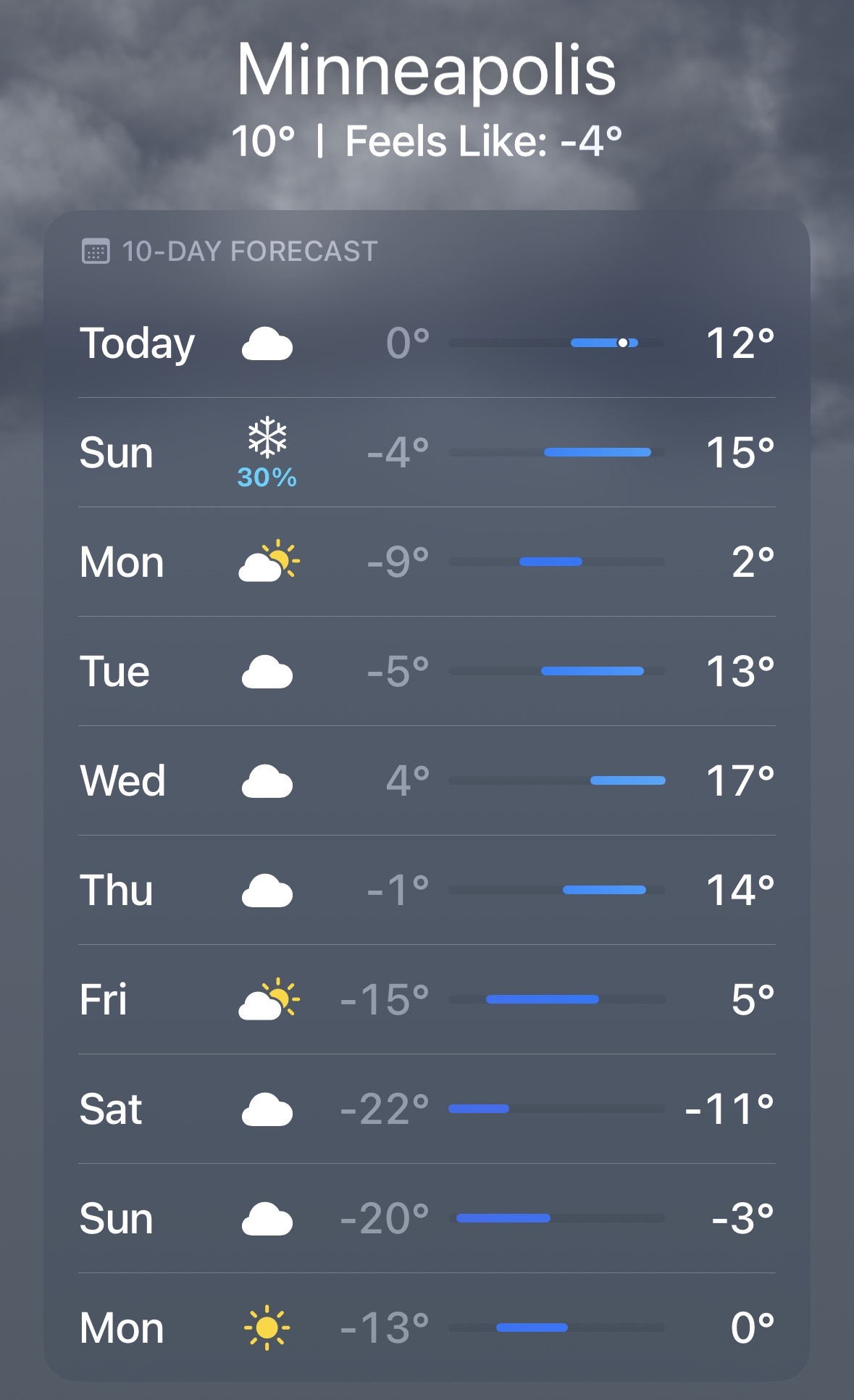
Starting tomorrow night, we’re talking about windchills as low as 34 below zero. This isn’t a matter of bundling up or keeping coffee in the car. But these arrogant folks? I guarantee you they think it is.

Napoleon tried to charge into the Russian winter. Didn’t work. Hitler did, too. We know how Operation Barbarossa turned out. There are some types of man versus nature that no weaponry can overcome.

While I don’t live there now, I’m born and raised Minnesotan. Spent my twenties there. I have always remained emotionally and psychologically Minnesotan. I’m incredibly proud of my community in these dark days. I know they are resilient, however much they are hurting and scared.

I also know they actually know how to deal with winter. Unlike, ahem, their invaders.

So this?

These are hard temperatures. Anyone serious knows windchill is the real game.

Yeah, baby, yeah.

Writing Memoir Will Warp Your Brain

I’m writing a memoir. I have been trained to think that’s self-indulgent and nauseating, but I’ve also been trained to hate myself because I’m a woman. I have figured out the latter is bullshit, so fuck it. I’m writing a memoir.

It is much harder than writing fiction.

True, fiction demands a higher level of engagement upfront: You have to figure out your characters, your plot, your narrative arc. But once you’re jamming, you can pretty much throw whatever sauce you want on the spaghetti. It’s fun to keep writing your characters in the face of new challenges that change them, but still leave them utterly, unmistakably themselves.

Writing memoir demands a different set of skills. I am prone to writing badly, and it’s quite easy to write badly when recounting what happened. Facts, facts, summary. Dull! Plus I have opinions about things. So many opinions. Too many opinions. (Husband: I’m sorry.) In any case, recounting facts and opinions is not creating emotion though action.

Writing memoir has warped the crap out of my brain. I have begun to deeply probe my actions, my beliefs, and the gaps between what I think I do and what I actually do. This is a big paraphrase, but Mary Karr advises to be gentle to others and go hard on the self. Writing memoir is all about self-accountability. This lens doesn’t go away when I step away from the computer.

But also, there is honesty and grace. To know oneself, to really embrace the warty self, brings a feeling of freedom and compassion. Isn’t it strange to be human? To have these flaws? To persevere anyway?