
I appeared as a panelist on this week’s episode of #WMN on HuffPost Live, and discussed backlash against Trevor Noah, the consequences of shutting down Planned Parenthood clinics in Indiana, a new “spa-like” abortion clinic in Maryland, and the TSA searching Black women’s hair. You can watch a video of the show here.
Dealing With Trolls And Assorted Hate Online
I have experienced a fair amount of trolling in my day. The trolling has occurred in my Twitter mentions, on Facebook, by email, in comment boxes, in paper mail, in voicemails, on blogs, and by call-ins to television and radio programs on which I have been a guest. It has been directed at me personally and organizations I’ve been affiliated with. Garbage like this can come with the territory when you’re a feminist, and especially when you’re a woman on the Internet.
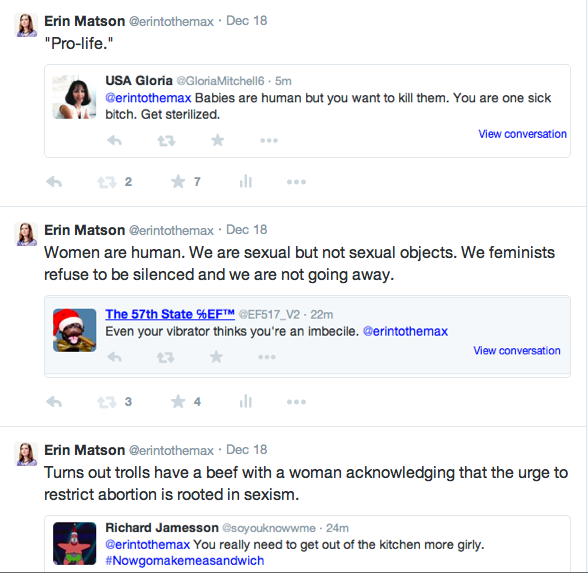
At its most garden variety, the trolling is a never-ending stream of comments on my sluttiness, my stupidity, and my appearance. The trolls can’t decide if I’m super ugly, or hot and have good “jugs.” The focus is never my actual appearance so much as baldly sexist attempts to reduce my worth to my appearance. Ah, and how could I forget — I am an advocate for reproductive health, rights, and justice — therefore I am a murderer!
Most of the time I ignore this stuff, but on occasion I will share a few of the Tweets I get because opponents of equality and justice for women need to be revealed for exactly who they are.
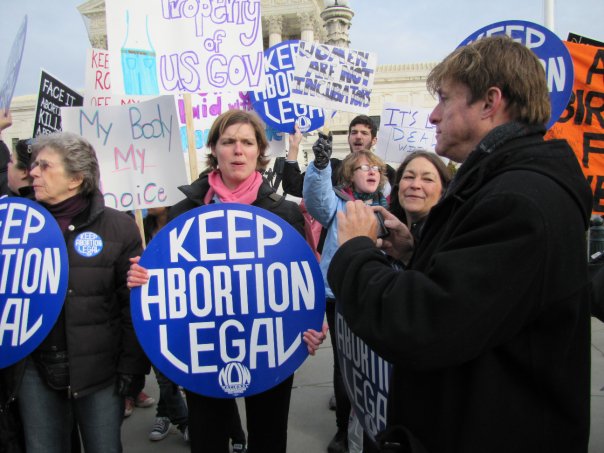
On the ground, the trolling can take the form of anti-abortion activists getting in your face and taking your picture. Here I am with one such man who I distinctly remember taking photographs of everyone’s faces outside the Supreme Court during a Roe anniversary:
Logic does not apply to trolling. Twitchy decided I should be the person to pay when Hustler, a magazine that does not have my support, created an horrific Photoshopped image of S.E. Cupp that I denounced. (Incidentally, trolling against feminists often takes the form of arguing that we need drop everything we are doing and spend the rest of our efforts applauding the personal lives and policy positions of right-wing women.)
Trolling is often, by nature, obscene, although sometimes it seems like the obscene goes beyond imagination. Horrible things have happened to some people I care very much about. Adria Richards was targeted by 4chan with the express purpose of destroying her life. Imani Gandy has been the target of racist stalking on Twitter. Andrea Grimes continues to receive rape threats in the aftermath of making a joke about vaporizing guns. These women have all spoken up bravely about their stories, and they inspire me. (And while I don’t know her, I’m also greatly moved and inspired by Lindy West speaking up about a troll who took on the identity of her deceased father.)
It is because of the bravery of these four women that I’m going to share a trolling story I have never publicly acknowledged before. It deeply hurt me and I didn’t want to reward the trolls. Now, however, I am beginning to see the power in pulling back the curtain. Here goes.
After my daughter was born, I did what a lot of new moms do: I sat in a hospital room in the dark, holding and nursing a baby all night long. To keep myself awake, I sat on my phone and sifted through congratulations and well wishes on email, Facebook, and Twitter.
An individual with more than 40,000 followers on Twitter took a photograph I had shared when my daughter was first born and put up a blog post about me, encouraging his followers to give me hell. Even pasting this partial screenshot makes me angry — the violation of my privacy, the most private and joyous and significant of moments, the appropriation of the first photograph of my beautiful daughter’s life.
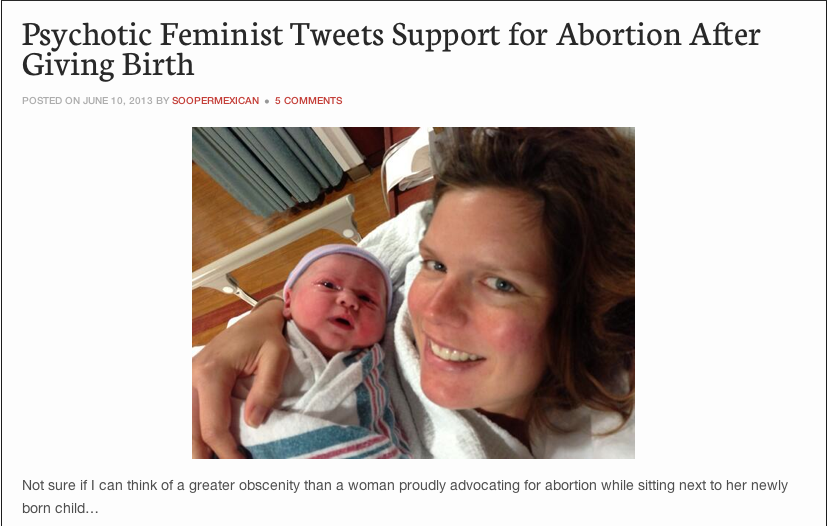
His followers began to deluge me with “pro-life” hate in my Twitter mentions, telling me that she should die, telling me that it would have been better if she had never been born, telling me that I didn’t deserve her. I held this new life in my hands in the dark — this great love of my life, this daughter who needed to be brought to me because I’d just had a C-section and could not stand up myself, and I wept as quietly as I could.
It was terrible.
I couldn’t just turn off Twitter; I’d just had a baby and I didn’t want to be alone. Tons of legitimate friends were sending me congratulations and encouragement, and I wanted to share this moment with them. So I saw the terrible messages, too, and I blocked every individual who sent them to me. I estimate that I received hundreds of hate tweets in a series of a few days, and my guess is that I received many more that I didn’t see because I’d blocked the senders.
I wanted to share this story now to illustrate one of the ways that we can deal with online abusers and stalkers: we can acknowledge them. While it doesn’t always make sense to engage at the time, I think it’s important for people to realize exactly how low trolling can go. This is not a question of whether people are “tough” enough to participate in public dialogue. There are people out there who are working very hard to silence feminists. I can speak to this especially from my perspective as a feminist who dares to call proudly and with enthusiasm for a world where, without exception, everyone has access to abortion as a matter of human dignity.
I’m okay, guys. The story I shared was really tough for me, but I got through it and I am still fighting without fear for that better world we all deserve. I’ve heard others, especially feminists who aren’t active on the Internet, or those who are but may be earlier in their careers, express doubts about taking up public space for fear of the trolls. We are all best qualified to know what our personal needs and limits are, and I respect that, but I don’t want anyone to believe I’m saying the best way to beat the trolls is to give up. That is, after all, what they want.
I’m going to conclude this post by sharing a response I once gave to a young woman who was receiving hateful emails and asked for my self-care tips. Here’s what I said:
I’m sorry to hear you are receiving bad emails. That can get pretty demotivating and demoralizing. Here are some things I’ve done to take care of myself in the past, although not all at the same time and some tips may even be contradictory. Use your judgement of what works for you now, in this situation:– Delete — without reading. I will delete some things without reading them, especially when I’m getting deluged with hate. If I start reading something and realize it’s hate, I stop mid-way through and delete.– Share. Read the bad things and then share them (without sharing the identity of the person, as they really want the attention and I’d hate to give them that). This is not something I really consider self-care, so put yourself first.– Block. I used to be slow to block people on Twitter, for example. No more. I block assholes right away. They do not deserve my mental space nor does anyone deserve an explanation from me about why I block them.– Be more guarded. While I’m still pretty free with my personal information, there are things I work hard to keep private and that varies depending on where I am in my life. I used to be really secretive about where I lived, especially when I was living alone.– Most of all, just walk away. Life is too short to accept other people’s pain unless you have freely chosen to do so. Abuse is ridiculous and doesn’t deserve your time. Even without the abuse, carve out time for yourself. I have gotten much better about not checking email and social media as constantly as I used to — and it is relaxing!
Don’t Ban All The Fraternities, Lower The Drinking Age
Sexual assault on campus is an epidemic. Estimates suggest that one in five young women will experience sexual assault while in college (and the statistics are worse for women of the same age who don’t attend college). Most of these crimes will go unreported for a variety of reasons: the victim is not “perfect,” there can be devastating social consequences to reporting that someone raped you, and on and on.
In response, the Department of Education’s Office of Civil Rights has clarified that universities have a responsibility to address sexual harassment and sexual assault as part of their obligations under Title IX, which bars sex discrimination in education. This development is strongly positive, although colleges and universities still tend to suck at implementing the requirements. (In the words of the youth-led activist group Know Your IX: “But aren’t colleges handling these reports terribly? Yup, they absolutely are. But so are the police.”)
Know Your IX is right; the best way forward is to require better enforcement so schools live up to their legal obligations. Public law enforcement involvement and response also carries wide room for improvement — although this is tricky, as bringing police in can make the situation worse for some victims, especially undocumented victims, victims of color, and those victims for whom their assailants bear continued control over their lives.
But legal strategy will only get us so far. We need cultural change as well. Some cultural change is directly traceable to activism: victims speaking out (brava!), students holding their institutions accountable (hooray!), and conversation-creators like the brave and creative Emma Sulkowicz, who commanded national attention for carrying a mattress throughout the Columbia University campus. Other cultural change will come with policy change.
One proposal increasingly floated to combat sexual assault on campus is to ban all the frats and shut them down. It makes perfect sense to close down fraternities that have been found to engage in overt racism or empower sexual assault. But shutting down every fraternity nationwide because we have proof that some are terrible is untenable. A better solution would be to defang fraternities as monarchies of rape culture. We need to take away the social gatekeeping power older men have over younger women on campus. We need to lower the drinking age.
College students are going to drink. We can get weird and moralistic about that, à la the disastrous reformers (including feminists) who brought us Prohibition, or we can accept that society as a whole benefits when unstoppable private behaviors and desires are permitted under the law.
The National Minimum Drinking Age Act of 1984 used the enticement of federal funding for state highway funds to drag states into raising the age for purchasing or publicly consuming alcohol to 21. Now many will recite for you the often-argued reasons why that’s offensive: 18 is the age of adulthood; you can vote at 18; you can enlist in the armed forces and fight and die for your country at 18, but you can’t have a drink at the bar at your homecoming party if you in fact survive. These reasons are right.
But less examined is the role that an arbitrary drinking age of 21 plays in creating destructive cultures on college campuses, particularly rape culture, and particularly for young women. Many college gatherings do involve alcohol. By granting less than half of a campus access to purchasing alcohol by virtue of their age, this situation empowers older men — including the small proportion of those older (and for that matter younger) men who are sexual predators — to control younger women’s access to social gatherings that include alcohol.
Fraternities have the power they do, by and large, because the many underage people, including underage women, who do drink must go to frat houses and other private settings to hang out. Now, one common objection raised by apologists for campus sexual assault (even if they see themselves in a very different light) is that young women should learn how to behave and be smarter about drinking. Until we are telling our young men with equal vigor that they must stop doing keg stands in order to be safe, I’m going to call that a sexist comment. Young women deserve to be human just as much as young men, without fear of getting raped. Even those young women who play drinking games before they turn 21.
If the drinking age were lowered to 18, all students would be able to go to the bar on a Friday night. This might take away some of the pressure some underage students feel to get really drunk (“pregame”) in their dorm rooms before going out for the evening. It would definitely take away this choice: Sit home and not go out and party, or go to a private house party controlled by older people you may not know who have bedrooms upstairs.
Rather than banning fraternities, this feminist argues that we should siphon away some of their power by lowering the drinking age.
Video: March 2015 To The Contrary Appearance
I appeared as a panelist on this week’s episode of To The Contrary, and discussed the 20-year anniversary of the UN Commission on the Status of Women, assessing Hillary Clinton’s leadership for women’s rights, and whether a war on women continues. You can watch a video of the show here:
When Someone Asks If You’re Pregnant … And You’re Not
Yesterday, I was checking out at the vet when the receptionist smiled. “I shouldn’t ask this,” she said, looking at what I thought was my wallet. “Is that a baby bump?”
“No,” I said.
Where is my dog? Bring back my dog. It’s time to get out of here.
The dog came back. I played it cool, smiled at the receptionist even. The dog wagged her tail as we walked to the car.
And then I cried for thirty minutes in stop-and-go traffic, on my way to pick up my daughter.
Apparently I’m fat, I thought. And then my thoughts got very, very ugly. I used to have an eating disorder — anorexia nearly killed me. Since yesterday afternoon I have encountered the ugliest body-image thoughts I’ve had in more than a decade.
On this blog I have written extensively about my experience with pregnancy after an eating disorder and related concerns. Less than a month ago I served as a keynote speaker and did a workshop on pregnancy and postpartum concerns at an eating disorder recovery event hosted by the Center for Eating Disorders at Sheppard Pratt. I spoke honestly, as a person in recovery who has been doing damn well for a long time.
It is because of this, in part, that I want to be honest. Recovery is not always easy, and things can come up and bite you in the ass out of nowhere. Living in recovery means confronting those inconveniences at inconvenient times.
What happened yesterday hurts me so much.
I cried another round telling my husband later last night. I was ashamed to tell him, for fear he would see me differently.
Shame is the dominant emotion I feel, which raises a flag. Shame is what is causing me to write about this incident openly and honestly now. I have long felt that unmasking shame is at the heart of the feminist project, that when we talk about shame it loses its power to keep us down.
It is shame telling me my body is not acceptable, when I know perfectly well that my body is healthy and a gift and powers this amazing life that is mine. It is shame telling me to feel bad personally, when in reality we should all feel bad about a culture that deems it acceptable to comment on women’s bodies and make pregnancy (actual or presumed) a spectator sport. It is shame telling me that you will look at me differently after reading this post, staring at my stomach and judging me, when in reality if that is true I should grab my dog and get away from you as quickly as I can.
A good piece of what has made me cry so hard is being forced to have the ghosts of my eating disorder engage in open combat with my political beliefs of today. I know better, and I also want better; being forced to contend with a reality I very much don’t like — being the weight my body wants to be, getting assessed and confronted by others on the basis of how I look, considering the civil rights implications of presumed pregnancies — is unpleasant.
Another piece revolves around my daughter. She watches everything I do, even when I think she’s not, and mimics my behaviors to hilarious precision. If I hate my body, I am teaching her to hate her own. If I let an idiot comment stop me from moving forward, I am teaching her to do the same thing.
I refuse to do that. Not just for her. For me. And frankly, for all of us.
So A Northern Feminist (Me) Marries Into A Southern Family
Three years ago I married someone who so happened to grow up in rural Georgia. Prior to this, my knowledge of the South was limited.
Sure, I went to the South on occasion and I knew people in the South: Mainly Southern feminists and racial and queer justice advocates living in urban areas. The majority of my knowledge about the South was confined to knowing exactly how to drive to its abortion clinics, the dossiers of the terrorists with track records targeting them, and who the brave people are willing to engage in clinic defense.
Beyond that, I was not particularly interested in engaging. I was both a product of my environment and, by virtue of my laziness and relative tunnel vision, an active participant in creating that environment for others.
It is fashionable in some circles I run in to make an outrage porn show out of legislative oppression in the South. Largely the purpose is to capture attention and raise money for national organizations. As a matter of activity, those types of national organizations primarily hold self-congratulatory events for Northerners in the North and Californians in California.
A good number of progressive people make their jokes about how Southern secession would benefit the country, which basically means they are just as guilty of dehumanizing and throwing people away as those segments of Southerners who actively do wish to restrict the rights and dignity of people on the basis of race, gender, and sexual orientation (these people very much exist and hold at least a modicum of power in all regions of the country, by the way).
Before my spouse, to say nothing of before we moved from Capitol Hill to Virginia, my life experiences didn’t point me toward deeply probing or questioning these practices.
In hindsight, I can say barely engaging with Southern people and understanding Southern culture deeply limited my potential as an organizer, as a feminist, and as a human being.
Some of my prejudices were just trivial. After one nightmarish experience with grits at a YMCA camp in Wisconsin decades ago, I had closed myself off to the possibility of cheesy grits — a major clown move.
You could forgive me for my ignorance of the South and say it was because I just didn’t have time to learn, but that’s far too generous for someone who has always cared deeply about politics. Of course I had limited time, but even though I’ve always kept a full plate, I still managed to spend a good portion of my hitherto adult life reading books, watching The Twilight Zone, and agonizing over busloads of Mr. Wrong. I had time; I didn’t use it.
The plain truth is that it’s easy to spend your life interacting with people who think like you and talk like you, or at least think and talk a lot like you. Further, people like me who spend time working for diversity and equality and justice don’t necessarily have it all figured out in our progressive circles.
It would be arrogant and totally untruthful to say I understand the South today. I don’t. However, I have learned many things in the past few years. The best are related to cuisine because cobbler and cheesy everything, but I’ve also been pleased to experience and begin to understand the strength and persistence of progressive activity and values in the South — even in the one-room, all-white church out in the country I’ve been as surprised as anyone to attend (scratch that, my mother is probably still shocked enough to burn a hole in the Minnesota snow).
What I have learned most of all is that I have so much more to learn, and that this learning will only benefit my work toward equality and justice. The more time I spend in the South the more I am genuinely curious to know what the Confederate flag means to the people who fly it. (This is not to say I think it’s acceptable; I don’t support the continued use of symbols, language, mascots, team names, and the like that signify discrimination, hatred, or oppression, even if the people using them claim it has nothing to do with that.)
I have strong opinions, yes, but even more that that, I have a strong desire for equality. Progress toward equality isn’t going to come about through conversations with people who generally see the world as I do; it’s going to come through courageous conversations with people who don’t. In order to truly be conversations, that means listening as well as talking.
A white, progressive friend remarking upon the Black Lives Matter movement noticed a tendency of her white, progressive friends to defriend people on Facebook who were saying racist shit. We all have our lines to draw and are the best judge of what those lines need to be in order to take care of ourselves (I defriended an abortion opponent from my high school who made a nasty comment about me during my pregnancy, and have never looked back). Still, there are some conversations that don’t violate what we need but are merely uncomfortable.
This is a profound point that applies to conversations about discrimination and the desire for social change. If we really want to be change agents, we need to engage with people we know who have different views — even views we strongly disagree with.
Which brings me back to my new Southern family and this deeply personal opportunity I’ve been given to learn more about the South. I’m learning, and frankly sometimes the simple act of listening is scary and hard as hell. And yet I continue.
On Nostalgia In Feminism
It is dangerous to present progress for women as an achievement of the past, but hey, it happens all the time. Today’s women’s movement is rife with nostalgia.
My argument is not that sharing stories is bad, nor that people with wisdom and experience to share are useless; in fact, education about the women’s movement throughout history and tapping into the talent of feminists of all generations is a vital part of moving forward.
But there is a line where the pursuit of an action agenda turns into a reflection on the past as an end in itself. Too often, that line is crossed.
Here’s just one tangible example (good grief, there are many): A few years ago, I attended a meeting of advocates working toward the ratification of the United Nations Convention on the Elimination of all forms of Discrimination Against Women (CEDAW). The woman opening the meeting said — I see the faces of all the people who’ve been talking about this with me since the ’80s. Who is new to this issue?
This statement wasn’t welcoming, undermined the knowledge of people who may have worked on the issue for years or even decades after the ’80s, and failed to place the emphasis where it belonged — the accountability of current elected officials holding the power and obligation to ratify the women’s treaty today.
The results of nostalgia-dominated feminism are manifest: newcomers are silenced, others choose not to come back, and above all swapping memories takes the place of working together to set and achieve goals. This environment creates a vacuum where a movement is supposed to be. What is understood to be feminist action turns into a largely fear-based electoral push to “protect” the gains of the past by electing Democrats and defeating the guys who say rape isn’t so bad because then you get a baby.
Recently Senate Minority Leader Harry Reid sent me a letter that pretty much says it all:
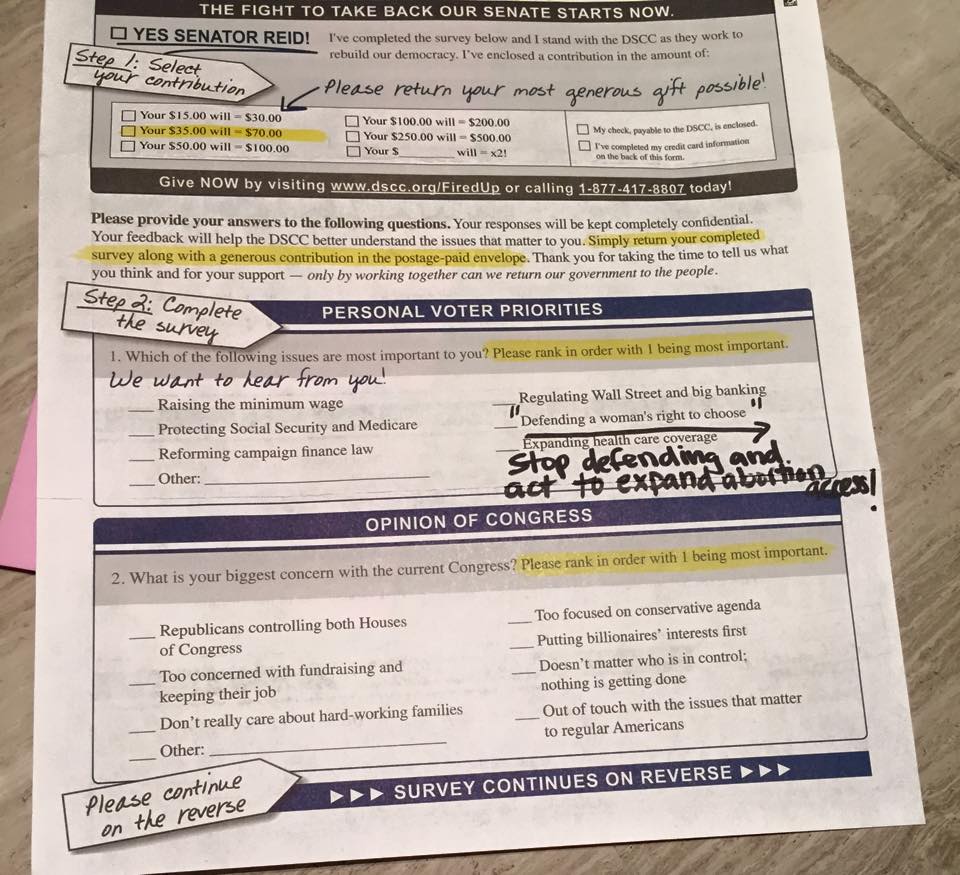
(You bet I wrote back to him!)
The voter priorities suggestions are instructive. We can — and should — raise the minimum wage, reform campaign finance law, regulate Wall Street and big banking, and expand health care coverage. These are all positive goals, and activist goals at that. (Beyond the abortion whopper, WHICH WE’LL GET TO NEXT, notice that the only other negative statement of priority refers to “protecting” Social Security and Medicare. Figures. Expansions to these programs would disproportionately benefit women, since women tend to live longer and have fewer savings.)
But “defending a woman’s right to choose” is laughable because people are faced with a reproductive health care crisis today in large part due to very new laws that restrict the human rights and dignity of women.
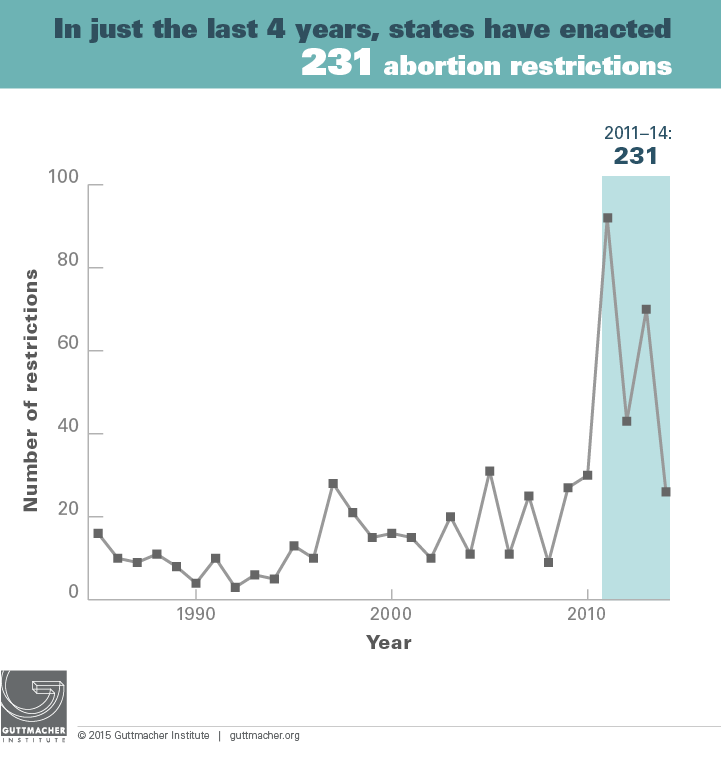
Abortion clinics are closing, y’all. Terrorist group Operation Rescue claims that three out of four abortion clinics that were open in 1991 are no longer open today — and that 73 clinics closed last year.
So when Harry Reid sends out a mailer in early 2015 saying we need to “defend” a woman’s right to choose, I frankly wonder what the Jupiter he is talking about. How much is left to defend? The financial and logistical barriers to abortion created and approved by elected officials of all parties means this country is filled with women who can’t “choose” their way out of a one-way street.
And while the abortion crisis is grave, and our elected officials who claim to care should stop reminiscing about a court decision from four decades ago and start working to expand abortion access, abortion is just one of so many things needed to ensure the full participation of women as equals in society.
Hanging our hats on the achievements of the past isn’t going to cut it; proactive action is the sauce. The United States needs paid parental leave like whoa. More than 5 million people don’t have health insurance because 22 states have failed to expand Medicaid. The new report from the Department of Justice makes it clear — it’s time to fire the Ferguson police department and start over. How about an Equal Rights Amendment? We could go on.
I am talking about external, observable realities that can be seen by those outside the women’s movement, but the Democratic Party’s ‘throwback feminism without big, bold goals’ is absolutely related to what happens within explicitly feminist quarters.
Just earlier this week I attended a woman-focused gathering where a contingent of the room directed much of the conversation around their stories from the 1970s and ’80s. The stories were interesting, to be sure; but what I frankly don’t know is whether the women doing that hard work in the 1970s and ’80s spent as much of their time being told what happened in the ’30s and ’40s. My suspicion is that they spent much of their time focused on deconstructing the realities of their present and demanding a better future — which is how we will win now.
An over-reliance on the past is dangerous because much of second-wave feminism has become, ironically enough, a conservative position — within the movement and beyond. There aren’t many people who will look you in the face and tell you women’s shouldn’t be equal, and this holds true even for most of the people who push the most anti-woman policies.
Nostalgia is also dangerous because however important the gains of the past were, they were incomplete. Women have never achieved parity in this country, and the gains of the women’s movement have always centered around the needs of white women with money at their disposal. Hanging our hats on the progress of the past is a pathetic agenda for the present.
Finally, needs evolve over time, and that’s a good thing. Twenty years ago the Vagina Monologues was revolutionary; today many young people find that language limiting and exclusionary toward transgender people. (I wrote about this issue at length over at RH Reality Check.)
At the same time, we do need more history.
Women’s lives have been systematically excluded from history curricula, and everyone (boys and girls) should be taught about them in schools. March is Women’s History Month; that’s cool, but it would be nice to have all year.
In particular a deep examination of the strategies and tactics that produced gains could prove extremely beneficial to those working for change. For example, my friend Zoe Nicholson’s examination of Alice Paul’s life and strategies is electrifying, and I think about it often in the context of my organizing work today — read about Miss Alice Paul here.
The line between nostalgia/sentimentalism and drawing upon history to kick ass for the future is often difficult to draw. But it seems that, as always, women as a whole stand to benefit from making painful attempts to grow toward more accountability, and the inclusion of new perspectives, within the women’s movement.
Long-Term, What Should We Take Away From L’Affaire Arquette?
For a second, it seemed like Patricia Arquette might be the new hero of the feminist movement.
After using her Oscar acceptance speech to call for equal rights for women, later that evening she expanded on her remarks backstage. “It’s time for all … the gay people and people of color that we’ve all fought for to fight for us now,” she said.
Look, the initial acceptance speech was not perfect — not all women give birth, citizenship is a privilege that many people don’t get to have, and “we” have not all fought for “everybody’s equal rights” that are currently being exercised and enjoyed — but it was an exciting moment for feminism anyway. The wage gap and equality for women should be mainstream issues.
That Arquette used her Oscar acceptance speech to call for political and social equality for women does not negate the harm of what she said backstage. By drawing lines around who is considered a woman (ostensibly, not gay, of color, or both) and insinuating that LGBT people and people of color (again, not mutually exclusive groups) owe something to those women who are white and straight and getting paid unfairly, Arquette set feminism back.
There are feminists and others who vehemently disagree with me on this; they think I am being too hard on Arquette or that I am demanding perfection of women who step out for feminism. Briefly, I understand it is difficult for celebrities to step out as feminists, and as, I have written before, I believe Celebrity Feminism Is A Good Thing. Nor do I think women and in particular feminists all need to be perfect. I’m not perfect and I’m not going to let that stop me from trying to advance equality for women and girls. These issues are not what’s at stake.
As a broader movement, feminism has a massive white privilege problem and exclusion problem. This is nothing new (racism has always been present in the women’s movement, with racist suffragists posing strong historical examples, and likewise Betty Friedan warned of the “lavender menace,” or the ridiculous idea that lesbians pose a threat to the women’s movement, in the 1960s), but Arquette tapped into it and reinforced it in a very public way.
If you think I am being “divisive” and ignoring that Arquette “meant well” and at this point wish to hit me over the head with a frying pan, I urge you to read Imani Gandy’s The Road to Structural Erasure Is Paved With Well-Intentioned White Ladies. (Seriously, though, if you hit her over the head with a frying pan I’m coming to get you.)
So now that all this has happened, what should we take away from this moment?
Here are my primary three suggestions:
1. Embrace fearlessness, rather than unity, as the rally cry for feminism.
Women are not all the same and, as I’ve written before, it’s not helpful to speak for all women. Many of the people standing on Arquette’s side in this affair believe that women need to “stand together,” or strive for “unity.” The problem with this logic is that inevitably “unity” means quieting the softer voices in the room, or the people with less power. Calls for unity can be oppressive because, by drawing upon and reinforcing existing power dynamics, they can come to operate as calls to resist the inclusion of marginalized people.
Feminism is at its strongest when we embrace the reality that not all women are the same, and that women experience different oppressions on the basis of a wide range of identities and privileges.
Imagine how strong the women’s movements could be if we embraced fearlessness rather than unity as the rally cry for our feminisms.
Let’s fearlessly examine how racism impacts life in America. Let’s fearlessly engage in difficult conversations with others. Let’s fearlessly remain open to changing our own views, and learning from others committed to human rights and social justice but with different perspectives. Let’s fearlessly speak up for the rights of all people — starting with but not exclusive to women. Let’s fearlessly embrace different people sharing diverse explanations of what conditions are required to thrive.
2. Criticism does not mean someone should go away, but Arquette should apologize.
It would be great if Arquette would apologize publicly for what she said, and such an apology would not be an admission of weakness but rather a representation of strength. The most feminist thing Arquette could do would be make an apology and commit publicly to growth. (While she has subsequently tweeted about the way the wage gap disproportionately impacts people of color, that is not a genuine “I’m sorry for what I said, and I will work to be more inclusive in my feminism in the future.”
As I wrote previously in Getting To Sorry: Why Apologies Matter When Someone Says Something Bigoted:
Feminism, as a practice, is not about gotcha and declaring some people good and other people bad. It is about eliminating bigotry from our lives — something all of us will have to work at — and moving forward in new ways that honor the full potential and human rights of everyone. So getting to sorry is a big deal, because it is that first step toward honoring people and making change.”
To be super clear, Arquette should not leave feminism, and her harmful words should not be used as an excuse for why others should not enter feminism. Should Arquette choose to handle the controversy with an apology, a little vulnerability, and an open commitment to expanding her practice of feminism to make it more intersectional, she could in fact give feminism a great gift.
Because lots of people will step in it. No one person can escape the thinking that underlies systems of oppression, even people who are committed to ending them in whole or in part. Social change agents will not succeed if they are not willing to change themselves.
3. Feminism must also mean listening to and elevating the experiences of women of color.
Please stop reading my blog right now and read Jasmine Burnett on Navigating a ‘Crooked Room’: Reflections From Black Women on Their Experiences in Progressive Spaces. It is a disturbing, important, vital piece.
Video: Insurance Companies Screwing Up On Birth Control
There have been reports of insurance companies failing their obligation to cover birth control — specifically the NuvaRing — under the Affordable Care Act. I recently spoke with an investigative reporter about this issue, and you can watch the video here. Take a look and let me know what you think!
What To Make Of A Woman Apologizing For Herself
I have died a little, several times, hearing a smart woman apologize for sharing her opinion. Throw me six feet under so long as you’ll send a hot vampire who cares about feminism.
It’s not just “I’m sorry, but,” at the beginning of a sentence. These apologies also show up mid-conversation stream as “I’m rambling, and I’m not making any sense” even though no one has said so. They often masquerade as hierarchal concerns, such as “I’m just an intern, but,” or “I’m new here, but,” or “I’m young, but.”
I do and have done all these things, too, so don’t think I’m judging you if you relate as a speaker. The fact is that our culture clearly communicates that women will be better liked and more likely to get ahead if we downplay our abilities but have confidence in ourselves. That’s contradictory by design, because in this framework no one can win. You’re supposed to like yourself but not too much. However that works.
It is somewhat fashionable, in some circles, to tell women to stop apologizing for ourselves so that we can get ahead. There are many problems with this approach.
It’s an utterly false premise that we can self-help our way out of gender discrimination. That’s not to say that we can’t resolve gender discrimination, because through cultural and political action we as women (and men and girls and boys) absolutely can. But picking apart women’s personal lives and offering to-do lists for personal success is neither a recipe for equality and justice, nor a feminist practice in general.
Moreover, telling an apologizing woman that she has nothing to apologize for actually creates an almost real reason for an apology! Because what we need to examine is not the psyche of the woman who uses this common gendered speech mechanism, but rather where it fits into an overall pattern of expected behavior.
Women tend to be expected to build consensus, take the needs of others into account. and work to make those around them feel comfortable. These behaviors aren’t necessarily bad, and can actually be strong leadership qualities when chosen and practiced in context, but it’s confining and discriminatory as a general matter to expect women to be oriented toward and accountable to the group.
Perhaps what we most need to question is the assumption that it’s okay to tell women what to do.
Finally, the biggest problem with telling women not to apologize for ourselves is that it doesn’t examine the root cause of why a woman feels she needs to apologize for herself at a particular moment in her life.
It may well be the case that she is surrounded by people who discount her opinion. In that case, the real problem is not a pattern of speech but that those people surrounding her are horrible and not in any way conducive to growth and development. People who discount you are horrible bosses, lovers, partners, friends, and members of your network, and the solution is to find a way to remove them from your life, even if that takes time and planning (apology optional).
No one can make you feel inferior without your consent, true, but the proper piece of consent to remove is their influence rather than your coping behaviors.
This essay was inspired by my tendency to challenge those younger women who through conversation show me a tendency to preface their brilliant ideas and opinions with apologies for their lack of experience. I have multiple times told them that by virtue of being in a meeting or in a room, they belong, and I still believe that. We are never “just interns” or “just new,” we are human beings.
But the overall situation is more complex.
 Erin Matson