Share Your Truth Without Shame

I became a feminist activist because I developed anorexia and nearly died. When I got better, I swore to do whatever I could to make it less likely others would have to go through the hell I did. I believe that eating disorders are just one awful and predictable outcome of a gender-mean society that tells women they must take up less space — and not just in physical shape and size.

I don’t think about this stuff every day, but it grounds the work I do. This is the moral center I bring to my work. When I get frustrated, or demotivated, or sick of being trolled, I remember why I’m doing what I’m doing, and my love pours back in. Oppression hurts.

Today I work primarily on increasing access to abortion and advancing reproductive justice — the right to not be pregnant, the right to be pregnant with dignity and access to quality health care, and the right to raise families in safe and healthy communities.

To me this work is a continuation of what propelled me into feminist activism in the first place: reproductive oppression, like shitty beauty standards, is predicated on the same core issues that stem from treating women like objects instead of human beings who deserve dignity, equality and respect. It’s about impossible demands on the body (food and sex are primal, yo), using internalized shame as a mechanism of control and subjugation, and a sense that women’s bodies are open for public comment and need to be controlled and tamed. And yes, men are both directly and indirectly oppressed on these lines, too, so fixing these problems benefits everyone.

So I’ve shared some version of that in more conversations and speeches I can count. It is, after all, my story and why I’m here. Today I shared this at William and Mary Law School in a talk on attacks on Planned Parenthood and how we can protect reproductive freedom.

After it was over, multiple students came up and thanked me for sharing my story. One, in particular, told me it was the first time she’d heard anyone — student or professor — share in a classroom that they’d experienced an eating disorder. Mind you this was only like a hot second of my presentation in the context of an hour, but it made a difference to her. How sad that so much of life is people pretending they’ve got it all figured out and always have. That is like the literal antithesis of power. It is overcoming that makes us strong.

We all have a reason why we work toward the causes we do, and it’s effective organizing to share it. But more important, when we share our authentic stories and make ourselves vulnerable, we are shouting the shame that’s supposed to hold us back and flipping it the bird. I believe it is radical act each time a woman tells the truth about her life. To other people. To herself.

Change really does start with you.


The Feminist Utopia Project

I am a writer.

When I started calling myself that, I wore black and flew to Green Bay to write excruciatingly parallel, AP Style directions to dairy processing plants in rural areas — the kind where you need to observe that eventually there’s an unmarked, winding hill behind the railroad you should follow.

Now I get to write about the thing I am most passionate about in the world: feminism. So I’m super stoked to share that I’ve contributed a chapter on (what else?) body positivity to a new book called The Feminist Utopia Project, edited by Alexandra Brodsky and Rachel Kauder Nalebuff.

You should read this book, because instead of presenting feminist concerns as a list of what’s wrong or terrible, there are 57 utopias blown out in all their shining glory. I went to the launch party in New York City the other night, and was tickled magenta to share a microphone with my fellow contributors imagining things like teen moms having a space at school to breastfeed their infants, and without having to cover nipples (Gloria Malone, who dreamed that up, is just one of the amazeball contributors).

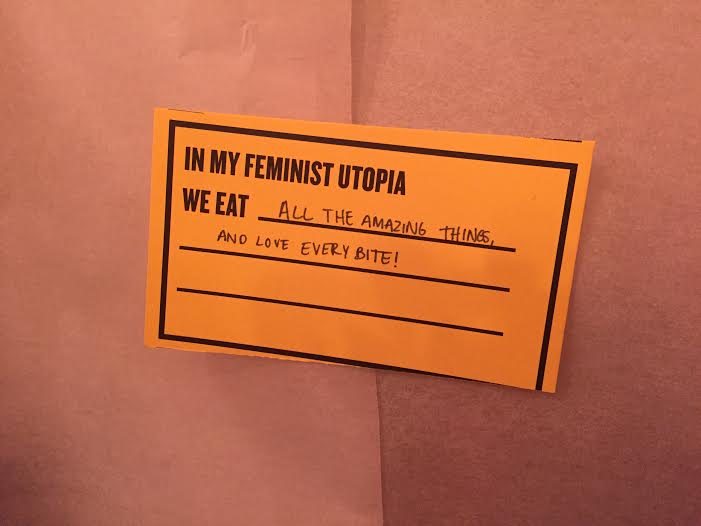
Someone handed me a card to fill out when I walked in the room, so naturally I said:

In my feminist utopia we eat all the amazing things and love every bite!

This reminds me of eating muffins out of a basket on the worst kind of windshield-scraper morning in Wisconsin, when I dreamed of a much bigger world and giving my damn all to making it happen. The fabulous thing is we can all do that.

That Would Be Me With A Toddler At The Pro-Choice Happy Hour

My daughter is two. She is a lovely, wonderful, vivacious girl. Her new thing is that she comes with me to pro-choice happy hours.

Before she was born, I was going to action/networking/professional-type stuff nearly every night of the week. Happy hours. Panel discussions. Volunteer phone-banks. Impromptu vigil for social justice? My candles were by the door. This is an easy habit to fall into as a young do-gooder, especially when you love what you do.

After she was born, I stopped doing most of these things. It was just too hard, especially when I was still nursing and rocking her to sleep. That’s changed, but babysitters are still costly and hard to find. And yes, after working all day, I like to spend time with her.

Does this make me less driven? Nope.

But yes, I had been missing some of the things I used to do.

I started questioning that. Yes, my responsibilities have changed, but that doesn’t mean I can’t find a new way to re-engage with my old interests. So I started bringing my daughter to the pro-choice happy hour. It’s happened twice in the past few weeks.

I think of it as occupying my own life. I can be a parent, and still do things I love with my kid in tow. Even if kids aren’t explicitly invited. I can use my judgement and pick and choose what might work based on the situation and her needs at the moment. Occupying my life even though I’m a mom with a kid to watch isn’t just good for me and the kid, it’s good for everyone. Kids are part of life and we must include them.

I want my daughter to know that she’s welcome to be a part of the interests I hold outside our family. I want her to know it’s okay for women and moms to be part of public life. I want the people at the pro-choice happy hour to see that we can make some of our activist spaces kid-friendly with hardly any work, and I’m happy to share the joy of my daughter with the many, many activists who support abortion rights as a matter of human dignity and also happen to love babies (believe it!).

Yes, we’re only there for 20-30 minutes on the way home from daycare, and we sit to the side with her yogurt or hummus and pretzels, but I get to see my friends and be a part of the social side of a movement I work in.

Occupying my life takes other forms, too. Turns out that having a kid means you get a lot less sleep, and don’t always get a chance to shower and/or get ready. Well, this happens to me regularly now. Just today I did a meeting on Skype video with bed-head from several hours before. I’ve stopped feeling shame about this, and invested in pomade instead. I’d rather do the things I care about than waste time or energy berating myself, or take myself out of the running because I have a kid who doesn’t serve me breakfast in bed and warm my bathrobe.

By watching me, I hope she will see that mothers can be whoever the hell they want to be. I have been enjoying showing myself that, as well.


Loving My First Gray Hair Is Political

Yesterday I got my first gray hair. It’s beautiful and light, hugging the soft space to the side of my forehead. I love it.

I have been waiting for this day. I am 35. Gray hair was going to happen. Years ago I made a conscious decision to continue loving myself as I grow older. This is an act of self-preservation, and defiance.

This is about my feminism — hatred of women is intimately tied in with dangerous, racist, and unrealistic expectations of beauty that we are expected to internalize. We must reject that as much as we can (real talk: this can be a day-by-day thing, and feeling like crap about your looks doesn’t mean you don’t get to be a feminist).

This is personal — I almost died of anorexia. Gray hair is a victory! I am fortunate I made it to my 18th, 19th, and 20th birthdays. I am both grateful and proud I did, because damn that was a lot of work. My personal interest extends beyond having overcome nearly lethal negative self-talk related to my appearance; I’ve reached an age where too many peers have died for no good reason. I’m lucky to get old.

This is about parenting, too — my daughter deserves the example of a woman who dares to look like herself and love herself.

As a social justice activist and organizer, I struggle with the decision to write posts like this sometimes. Today yet another video has surfaced of a Black person losing their life to police violence; his name was Sam DuBose. Racism is one of the most pressing issues of our time.

And so, I ask myself:

Is it indulgent to be introspective about the first freaking gray hair on my head at a time when people are dying, when politicians fail to acknowledge that Black lives matter, when terrorists are targeting abortion providers because they dare to help women?

I struggle with this question, and yet this post speaks for itself: Here I am, writing. My firm belief is that self-love is radical. You cannot fight effectively for equality, dignity, or justice when you are unable to treat yourself with respect. You cannot find the courage to accept difference in others if you’re unwilling to accommodate difference for yourself. Loving yourself is not ego or dominance (those are rooted in insecurity, after all); loving yourself is about compassion. Best part? Inner compassion is compassion, and both are contagious.

So, when I embrace my gray hair, what I am also saying is that we should embrace ourselves and one another as we are. We must treat our fragile lives with respect and love, and break every convention necessary.

112308584428765260Sb6ZHbVyc

Feminism Must Be Anti-Racist

Recently, an acquaintance on Facebook upset several mutual friends with a post that started with an admission that every time someone says the phrase ‘white privilege,’ she laughs out loud. She went on to detail how, while she was a white woman, she has experienced a number of specific oppressions in her life and felt it was unfair to conflate her with white male bankers. She identifies vociferously as a feminist.

Also this week, I was pulled over for speeding (oopsie!) and waited in frustration as the officer spent seemingly forever in his car with my registration and license. When he came back, he gave me a warning and let me go. I’ll admit; I was a little frazzled. Earlier that day my daughter had fallen and hurt herself at school, and waiting in my car for the police officer meant I was getting more and more late to pick her up. I told him so, and he left me with a genuine expression of concern. His last words were, “have a better day.”

This, when women like Sandra Bland wind up dead in jail after a routine traffic stop. When some white people continue to defend the Confederate flag after the terrorist murders in Charleston. When people I know sully the ‘feminist’ movement with open hostility toward intersectionality and a self-aggrandizing desire to shout over the lived experiences of others.

I cried as I drove away.

White privilege is an institution that is scary for whites to acknowledge. Hardly anyone wants to be called racist, and just about everyone, white people included, can cook up some stories of how they overcame hardships and got where they are by dint of hard work. The institution of white privilege does not mean that every white person is inherently bad, nor that every white person lives a dandy oppression-free life, but it does mean that every white person doesn’t have to deal with the race-based economic, political, and social inequality people of color have to deal with every day. It also means that white people have a responsibility to listen, learn, and advocate for change.

To deny that at this moment of crisis — when we keep seeing new videos and learning new names of Black people who die in police custody, when activists from the Black Lives Matter movement are tugging the strings of the nation’s conscience and doing the hard work to redistribute power where it belongs — to deny that automatically lands you on a continuum somewhere between ignorant and asshole.

Many of the best feminist activists, organizers, theorists, thinkers, and writers I know are women of color. For that matter, many of the best feminists I know who have told me they most struggle with the term “feminist” are women of color.

Because there is this baggage of white feminists who declare all women are the same, when we are most clearly not. Or things like Patricia Arquette’s exclusionary speech for ‘women’s rights’ at the Oscars.

What we don’t need is ‘unity,’ a phrase that is often deployed as a way for women with more power to get their way.

What we frankly need is to educate these women, or else.

I know many feminists who will rise up to defend why you need to support abortion rights in order to identify as a feminist. The same thing needs to happen with racial justice — if you are not willing to listen to others with different experiences and identities without putting yourself first, if you are not willing to look racism in the face, you really need to get the fuck out of the tent.

On Hating Women, Or Respectability Is Not Dignity

We are conditioned to hate women.

We hate ourselves for being too fat, too thin, too curvy, too flat, too flaky, too serious, not smart enough, not fun-loving enough. We are rarely just right, and that’s political. The problem is set up as personal — allegedly there is something wrong with us (all of us) and we should be ashamed — rather than a society that criticizes women. You can be aware and still fall into the trap.

And how we hate other women! I am tired of being expected to hate Gwyneth Paltrow, or Sheryl Sandberg, or slacker moms who supposedly get to work less than everybody else, or women who are pregnant and on public assistance, or even other feminists who see things differently.

Which brings me to my next point: I’m not sure most feminists, let alone most people, understand how radical it is to accept women as they are.

I am still on a tirade against Dos and Don’ts Feminism, or the policing of women’s personal lives and choices, as a way to evaluate whether they deserve to be equal. But I’d like to push this critique a step further, because one of the core issues at stake is whether we are going to accept women as they are and allow them to take up space, or not.

It is radical to not question women for who they are, or what they need. It is radical to support women as the people they are now, rather than the people we might wish them to be. It is radical to not use women as a yardstick to measure the inadequacies of other women.

One of the areas where this becomes crystal clear is the losing fight over abortion. For too long advocates for abortion rights have focused relentlessly on the sad and regrettable reasons why some women have abortions. Those stories exist and the point is not to minimize them; rather, it is to say that trying to make abortion relatable to people who don’t agree with it fails to attack the root cause of why abortion is controversial in the first place … we don’t believe women are good decision-makers, and we think that only if women are good decision-makers will they deserve dignity and control over their lives.

So, actually, it is very radical to accept women in all aspects of their lives, perfect or imperfect. Because accepting women “as-is” is a necessary precondition to dignity, equality, and justice for women. Dignity is not respectability.

It’s not respectability under the terms of rape apologists who believe that if only women would stop drinking that and wearing that they wouldn’t get raped.

For that matter, it’s not respectability under the very different terms of some feminists who believe that only women who buck the gendered expectations of femininity, like wearing make-up or caring for children or washing a husband’s laundry, are situated to claim equality.

Sometimes I’ll hear my radical belief against hating or criticizing women dismissed as “choices feminism,” or an idea that feminism is about allowing women to make choices and be whoever they want to be and that’s it. Nope. I want women to be equal. But they are not going to be equal so long as we demand a fixed set of behaviors from them, whatever those behaviors may be.

Supporting women as they are is radical, and a first step to greater political and social gains. If political and social gains come at the price of constricting women who do not fit a particular mold, we are simply applying a new shade of paint to an old straitjacket.

Hillary Clinton, A Pro-Choice Champion?

No one can credibly question that Hillary Clinton is a role model for women’s empowerment around the world. Further, it’s well past time for a woman to serve as president of the United States. Finally, there is always enormous pressure on feminists to line up and cart out the pom-poms during election season — and that pressure only multiplies when there is one big-time Democratic candidate, and she is a woman.

But if you ask me what I’m ready for, I stand to lose my integrity as an advocate if I don’t stick with my first answer: I’m ready for reproductive justice and I want to see it in my lifetime.

I’m ready for Hillary to step up.

Reproductive justice is a human rights framework developed by women of color that includes three keys: the right to have children, the right not to have children, and the right to parent in safe and healthy environments. Reproductive justice goes beyond issues of “choice,” and acknowledges that societies have proactive obligations to provide the means for people to live with dignity — offering quality health care for everyone, funding abortion and contraception without exceptions, and ending police violence against communities of color, to name a few. 

Is Hillary going to go there? Don’t tell me to trust her. Don’t point at the Republican candidates and their alliances and personhood bills and Terri Schiavo court briefs. And please, don’t tell me how to be a feminist and what my priorities should be.

Spring 2015 is only the beginning of campaign season; it’s still a bit chilly for cheerleading skirts, yes?

Much of my work is concerned with ending a reproductive health care crisis. This is not a side issue, and if you believe it is, I encourage you to think hard about white male dominance and how a framework of so-called bad sexuality and poor personal choices is set up, by design, to sideline just about everyone but white men in power.

That Hillary is a woman, that Hillary is a feminist, that Hillary could become president and shatter one important glass ceiling, does not automatically mean that she is going to use her backbone to reverse our gravely serious reproductive health care crisis.

Other women and men in power have not. In just two examples, the last major action of the Congressional Pro-Choice Caucus has been to collaborate and give its blessing to a deal House Minority Leader Nancy Pelosi (D-CA) struck with Speaker John Boehner (R-OH) to expand abortion funding restrictions by placing them in the Medicare “doc fix.” And, there is no defensible reason for President Obama to continue restricting abortion funding for rape victims around the world. What has Hillary done to indicate she’d be any different?

Before we start tripping over ourselves to applaud how great Hillary would be on these particular issues, it’s best to take a step back and acknowledge that the bar for who gets to be called a “pro-choice president” has been set extraordinarily low. Democrats and large reproductive rights organizations have conditioned us to accept that the champion is a person running for office against the person who says that rape is a blessing because then you get a baby. It’s time to break this cycle and tie labels to proactive policy outcomes.

We have a new, urgent, expanding crisis as far as access to reproductive care is concerned — clinics are closing, women are crossing the border to obtain medication to self-abort, and 231 abortion restrictions were enacted in the previous four years. Hillary needs to step up. Instead, she appears to be hiding.

She steered clear of abortion and focused on safer topics at the recent EMILY’s List gala, she left abortion out of her “No Ceilings” report on the status of women worldwide, and she had Melinda Gates (who refuses to talk about abortion) and a representative from the Catholic Medical Mission Board (which refuses to purchase or receive donations of condoms for its HIV/AIDS work overseas and acknowledges that it follows the lead of the presiding Conference of Catholic Bishops in each country where it has programs) lead a discussion on maternal mortality at the launch event for that report.

This strategy of trying not to go ‘too far’ or to demonstrate ‘cooperation’ with the opposition on abortion is not leadership. In fact, it’s a proven loser for women’s human rights. In one recent example, Hillary’s famous language about abortion needing to be safe and rare was just used by conservative lawmakers in Arkansas to pass a law restricting medication abortion.

Now, a few things:

Does Hillary support the right to abortion? Absolutely. Has she fought back forcefully against those who disagree? Yes. (Watch this epic takedown of Rep. Chris Smith (R-N.J.) if you don’t believe me.) But reacting to bad guys is not enough, not by itself: this overall strategy is why the reproductive movement is losing.

Second, I’m not anti-Hillary. I went to Iowa to campaign for her before the 2008 election. I wept like hell when she conceded to Obama. For years I have been saying quite loudly that I believe leaders in the Democratic Party and women’s organizations failed her eight years ago by calling for her to leave the race or endorsing her opponent while she was still ahead.

But my lens is more complicated this time around.

I am a feminist activist and a reproductive health, rights, and justice advocate. And I have seen time and time again how those who want to advance “women’s issues” believe the only winning way to do so is to drop the abortion question or be as “strategic” (which really means something between non-confrontational and weak) as possible. So, I get very worried when Hillary is not embracing abortion (and yes, I mean saying the “A” word) when all the pundits say this time around her campaign will focus on Hillary’s role as a champion for women.

There’s no doubt about it — Hillary is an icon. But is she a pro-choice champion? Have we allowed that phrase to become meaningless? Who is working to expand access to abortion today?

There will be enormous pressure, rooted both in subtle sexisms and more overt ones, to not ask these questions as a feminist woman runs for president.

We can rise above that — a woman can and should expect a vigorous primary campaign season. Women can and should be allowed to have public differences amongst each other. Feminism is not just about placing women in the most powerful positions; it’s about demanding dignity for women like Purvi Patel, who is sitting in prison for twenty years on the basis of miscarriage or self-inducing an abortion.

It’s time to set the bar higher than loving Democrats and trusting they’ll figure it out, or nothing will change.