That Would Be Me With A Toddler At The Pro-Choice Happy Hour

My daughter is two. She is a lovely, wonderful, vivacious girl. Her new thing is that she comes with me to pro-choice happy hours.

Before she was born, I was going to action/networking/professional-type stuff nearly every night of the week. Happy hours. Panel discussions. Volunteer phone-banks. Impromptu vigil for social justice? My candles were by the door. This is an easy habit to fall into as a young do-gooder, especially when you love what you do.

After she was born, I stopped doing most of these things. It was just too hard, especially when I was still nursing and rocking her to sleep. That’s changed, but babysitters are still costly and hard to find. And yes, after working all day, I like to spend time with her.

Does this make me less driven? Nope.

But yes, I had been missing some of the things I used to do.

I started questioning that. Yes, my responsibilities have changed, but that doesn’t mean I can’t find a new way to re-engage with my old interests. So I started bringing my daughter to the pro-choice happy hour. It’s happened twice in the past few weeks.

I think of it as occupying my own life. I can be a parent, and still do things I love with my kid in tow. Even if kids aren’t explicitly invited. I can use my judgement and pick and choose what might work based on the situation and her needs at the moment. Occupying my life even though I’m a mom with a kid to watch isn’t just good for me and the kid, it’s good for everyone. Kids are part of life and we must include them.

I want my daughter to know that she’s welcome to be a part of the interests I hold outside our family. I want her to know it’s okay for women and moms to be part of public life. I want the people at the pro-choice happy hour to see that we can make some of our activist spaces kid-friendly with hardly any work, and I’m happy to share the joy of my daughter with the many, many activists who support abortion rights as a matter of human dignity and also happen to love babies (believe it!).

Yes, we’re only there for 20-30 minutes on the way home from daycare, and we sit to the side with her yogurt or hummus and pretzels, but I get to see my friends and be a part of the social side of a movement I work in.

Occupying my life takes other forms, too. Turns out that having a kid means you get a lot less sleep, and don’t always get a chance to shower and/or get ready. Well, this happens to me regularly now. Just today I did a meeting on Skype video with bed-head from several hours before. I’ve stopped feeling shame about this, and invested in pomade instead. I’d rather do the things I care about than waste time or energy berating myself, or take myself out of the running because I have a kid who doesn’t serve me breakfast in bed and warm my bathrobe.

By watching me, I hope she will see that mothers can be whoever the hell they want to be. I have been enjoying showing myself that, as well.
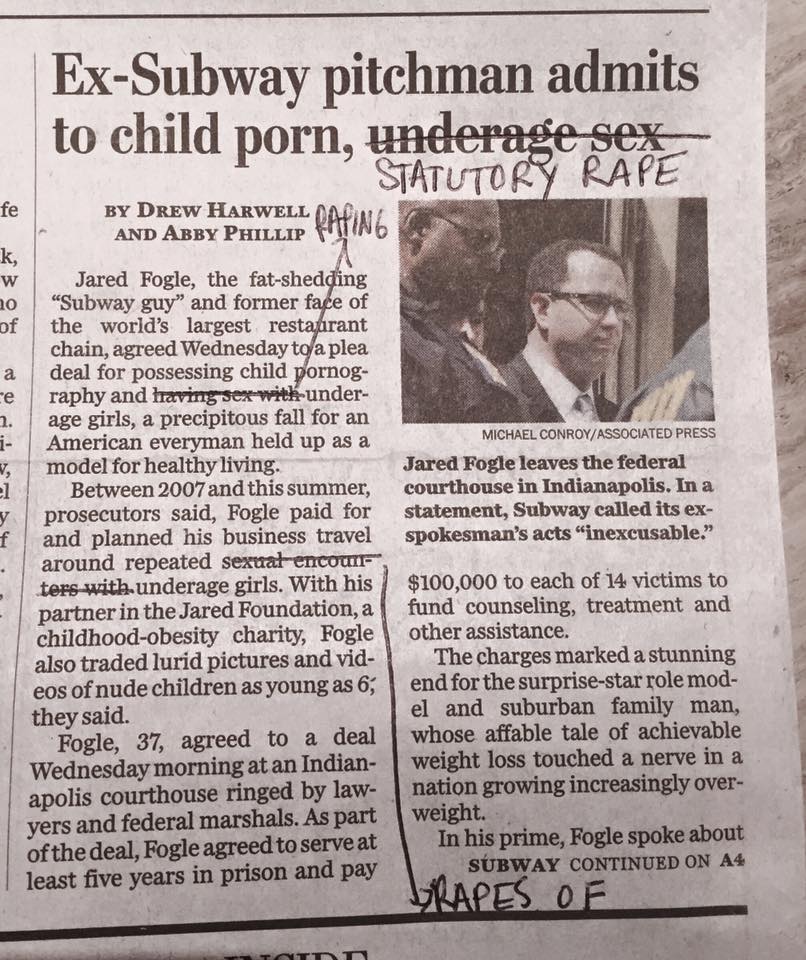
 

It’s Still Rape

It’s still rape when the rapist is famous, or well-liked. “A family guy.” That kind of bullshit.

It’s still rape when the rapist is a friend, date, hook-up, boyfriend, girlfriend, husband, or wife. Rapists are people — and usually not strangers.

It’s still rape when it happens in the LGBT community.

It’s still rape when the victim is underage. No matter what she was wearing. No matter what he said in class. They could be “asking for it,” doesn’t matter — when the person is underage, it’s rape.

It’s still rape when the media calls victims, “accusers,” and rapes, “sex.”

11870869_10206541639473647_3230721875285382665_n

It’s still rape when you’re fucked up on alcohol or drugs. When you said yes before you said no. When you’re a person who likes sex, yes, just not rape.

It’s still rape when Whoopi Goldberg is friends with the rapist. When the military protects its chain of command. When the Vatican says it shouldn’t be held responsible.

It’s still rape when politicians are too busy trying to control abortion to listen to victims and give them the dignity and support they deserve.

It’s still rape when the victim has chosen to identify as a survivor (heck yeah!).

We need a new conversation on rape, immediately. We need to insist upon it. We need to make corrections the moment they are due. Otherwise, we are all part of the problem.

Loving My First Gray Hair Is Political

Yesterday I got my first gray hair. It’s beautiful and light, hugging the soft space to the side of my forehead. I love it.

I have been waiting for this day. I am 35. Gray hair was going to happen. Years ago I made a conscious decision to continue loving myself as I grow older. This is an act of self-preservation, and defiance.

This is about my feminism — hatred of women is intimately tied in with dangerous, racist, and unrealistic expectations of beauty that we are expected to internalize. We must reject that as much as we can (real talk: this can be a day-by-day thing, and feeling like crap about your looks doesn’t mean you don’t get to be a feminist).

This is personal — I almost died of anorexia. Gray hair is a victory! I am fortunate I made it to my 18th, 19th, and 20th birthdays. I am both grateful and proud I did, because damn that was a lot of work. My personal interest extends beyond having overcome nearly lethal negative self-talk related to my appearance; I’ve reached an age where too many peers have died for no good reason. I’m lucky to get old.

This is about parenting, too — my daughter deserves the example of a woman who dares to look like herself and love herself.

As a social justice activist and organizer, I struggle with the decision to write posts like this sometimes. Today yet another video has surfaced of a Black person losing their life to police violence; his name was Sam DuBose. Racism is one of the most pressing issues of our time.

And so, I ask myself:

Is it indulgent to be introspective about the first freaking gray hair on my head at a time when people are dying, when politicians fail to acknowledge that Black lives matter, when terrorists are targeting abortion providers because they dare to help women?

I struggle with this question, and yet this post speaks for itself: Here I am, writing. My firm belief is that self-love is radical. You cannot fight effectively for equality, dignity, or justice when you are unable to treat yourself with respect. You cannot find the courage to accept difference in others if you’re unwilling to accommodate difference for yourself. Loving yourself is not ego or dominance (those are rooted in insecurity, after all); loving yourself is about compassion. Best part? Inner compassion is compassion, and both are contagious.

So, when I embrace my gray hair, what I am also saying is that we should embrace ourselves and one another as we are. We must treat our fragile lives with respect and love, and break every convention necessary.

112308584428765260Sb6ZHbVyc

Holding A Baby And An iPhone

I live-tweeted labor. The first night of my daughter’s life I realized I was going to be nursing for long stretches overnight; I began using my phone to stay awake. Every night I spent hours nursing her quietly, listening to her sweet little swallows, and surfing the Internet like it was the best Gidget movie in the world. I developed eye strain, and my carpal tunnel flared up again.

Eventually maternity leave was over. I held a different job then, one I loved, but I was also a rare part-time employee on a staff of full-timers. That meant checking in on email all the time anyway, so I wouldn’t fall behind.

Work-life balance is this elusive thing. It’s a psychic pair of skinny jeans, designed to punish. Work-life balance is not a gender-neutral phrase. Work-life balance may as well be Morse code for throwing women to the wolves. We are expected to take care of our families, make nice food that looks like it belongs on Instagram, and shatter glass ceilings through perseverance and sheer will. (Friendly reminder: There are no personal solutions to societal problems.)

Generally I suck at work/life balance, as do a good portion of the people I know, because we are expected to work all the time and we have the Internet with us almost everywhere we go.

And yet I’m not complaining: I’m fortunate that my line of work so happens to be my life passion. Still, if work/life balance means having two separate spheres of life that are both well-tended, nope, I don’t have that.

I’m the woman who is opening up Slack for conversations with a colleague while my daughter eats in a high chair next to me. You can catch me firing off work emails at the playground. And I’m ashamed by how often I look at Facebook when she is in my care.

My daughter has taught me a love of presence. We should listen to crickets and wonder what they are. An airplane overhead is worth pointing to and talking about. Silence is a lavish gift — seriously, take it when you can get it.

It is hard for me to reconcile my actual and/or perceived need to be always available online with being the attentive mother I want to be. And yet, I am terrifically proud to be a working mother, and I claim that title. I can’t wait until my daughter is old enough to realize that the woman suffrage poster in her bedroom is not just wall art, and that her mom is a troublemaker.

Ultimately, I am doing both. Sometimes I hold my daughter and write emails. Sometimes I push the stroller and go on Twitter rants.  I am a parent and a working feminist at the same time.

Feminism Must Be Anti-Racist

Recently, an acquaintance on Facebook upset several mutual friends with a post that started with an admission that every time someone says the phrase ‘white privilege,’ she laughs out loud. She went on to detail how, while she was a white woman, she has experienced a number of specific oppressions in her life and felt it was unfair to conflate her with white male bankers. She identifies vociferously as a feminist.

Also this week, I was pulled over for speeding (oopsie!) and waited in frustration as the officer spent seemingly forever in his car with my registration and license. When he came back, he gave me a warning and let me go. I’ll admit; I was a little frazzled. Earlier that day my daughter had fallen and hurt herself at school, and waiting in my car for the police officer meant I was getting more and more late to pick her up. I told him so, and he left me with a genuine expression of concern. His last words were, “have a better day.”

This, when women like Sandra Bland wind up dead in jail after a routine traffic stop. When some white people continue to defend the Confederate flag after the terrorist murders in Charleston. When people I know sully the ‘feminist’ movement with open hostility toward intersectionality and a self-aggrandizing desire to shout over the lived experiences of others.

I cried as I drove away.

White privilege is an institution that is scary for whites to acknowledge. Hardly anyone wants to be called racist, and just about everyone, white people included, can cook up some stories of how they overcame hardships and got where they are by dint of hard work. The institution of white privilege does not mean that every white person is inherently bad, nor that every white person lives a dandy oppression-free life, but it does mean that every white person doesn’t have to deal with the race-based economic, political, and social inequality people of color have to deal with every day. It also means that white people have a responsibility to listen, learn, and advocate for change.

To deny that at this moment of crisis — when we keep seeing new videos and learning new names of Black people who die in police custody, when activists from the Black Lives Matter movement are tugging the strings of the nation’s conscience and doing the hard work to redistribute power where it belongs — to deny that automatically lands you on a continuum somewhere between ignorant and asshole.

Many of the best feminist activists, organizers, theorists, thinkers, and writers I know are women of color. For that matter, many of the best feminists I know who have told me they most struggle with the term “feminist” are women of color.

Because there is this baggage of white feminists who declare all women are the same, when we are most clearly not. Or things like Patricia Arquette’s exclusionary speech for ‘women’s rights’ at the Oscars.

What we don’t need is ‘unity,’ a phrase that is often deployed as a way for women with more power to get their way.

What we frankly need is to educate these women, or else.

I know many feminists who will rise up to defend why you need to support abortion rights in order to identify as a feminist. The same thing needs to happen with racial justice — if you are not willing to listen to others with different experiences and identities without putting yourself first, if you are not willing to look racism in the face, you really need to get the fuck out of the tent.

Coming Soon: Reproaction

Awesomesauce announcement time! In the near future, I’ll be launching a new group called Reproaction with my inestimable co-conspirator, co-founder, and co-director, Pamela Merritt. We’re going to use direct action to increase access to abortion and advance reproductive justice.

What’s up ahead will not be more of the same. The depth of the human and civil rights crisis wrought by barriers to reproductive healthcare is neither widely known nor appreciated, and we intend to stand up for the right thing – all of it, all the time, and no matter who is in the wrong. If you want change, you must stand up for change. You must be willing to be unpopular. You must be committed to breaking convention. And, we are.

Please read a little more about us at Reproaction.org, and sign up for alerts to receive notification when we do launch.

See you in the streets.

IMG_1520

We Can Change Attitudes

A few months ago, I so happened to be at Georgetown University during a protest hosted by the Westboro Baptist Church. They had their hateful signs in tow, targeting LGBT people, Muslims, and anyone who does not subscribe to their hate club masquerading as a religion.

What was remarkable to me was not the haters, but rather the student response. There were several counter-demonstrations. Some students were playing songs like “Let It Go,” and “Born This Way,” loudly to drown out the hateful chants and bullhorns. Others wore rainbow leis and stood out with their homemade signs bearing messages of tolerance and hope. Still others held hands silently with their backs to the demonstration, and there was an official unity rally with students speaking up for LGBT rights and more.

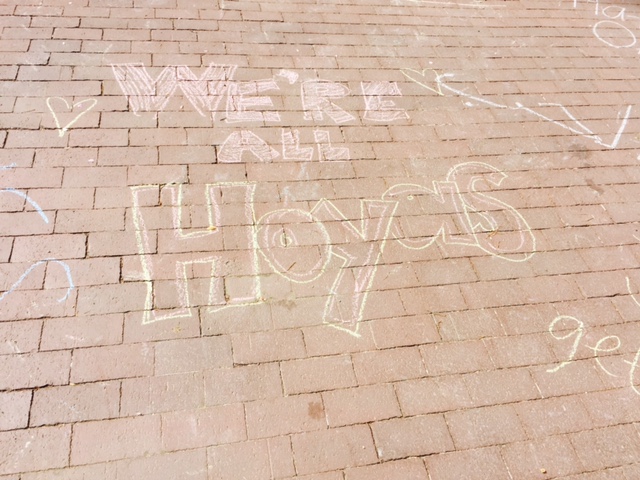
Some students chalked inclusion messages on the bricks, surrounded by hearts.

We Are All Hoyas

I graduated from Georgetown in 2002. While there were people who were out, and there were people who supported LGBT rights, I know this counter-response would not have happened in my time.

Three cheers to younger people leading the way with love and positivity today, and also to those (sometimes) deeply hated outcasts who came before them and demanded recognition when others were inclined to sneer, or look away if they were being charitable.

All of it matters. We all can do something.

We must never forget that we can change attitudes, and even dramatically.

Parenting, Self-Esteem, And Toddlers Holding One Leg Up

My self-esteem kind of fell to the shits some time after my daughter was born. It wasn’t postpartum depression; I’d made it okay through the weeks of shifting hormones and months of endless infant crying. I cried twice after she was born; once in frustration that I wasn’t getting to hold her as much as I wanted during what felt like a never-ending cycle of visitors, and once that first day after my husband went to work and everyone was gone. Other than that, I was fine.

Until I wasn’t. I started losing confidence. New parenthood can be isolating, physically: You just can’t leave the house as easily as you used to.

To compound matters, I had less to say about work, because I was working half-time. I had been used to connecting with people on the basis of work.

Sometimes it’s said that people who talk about their kids are boring. Emotionally, I bought right into that, while intellectually I still know this is a feminist issue that angers me. Frowning on kid-talk serves as a way to silence and trivialize women since we often find ourselves serving as primary caregivers to any children we may have.

All of this meant I became more isolated still.

I realized in the grocery store that I was getting out of tune with myself; it was becoming too hard to buy basic things like pasta or peanut butter. I would look at multiple varieties and not know which to pick. I didn’t trust myself. Decisions that should have taken three seconds were taking 10.

So I wrote an email to two of my closest, dearest friends, telling them that I felt my self-esteem was hitting a lower patch and asking for advice on what they thought I should do. I also asked my husband for ideas.

I think, honestly, it surprised some of them, although they all rose to the occasion, were supportive, and offered awesome ideas. There is some taboo in admitting when you don’t feel great. There shouldn’t be.

Our security in ourselves and the way we feel about the world are hardly static. You could even be the strongest person in the world and still hit rough patches. Admitting the crap times when you have them is a really helpful step to tossing them down the Litter Genie.

Through conversations with my lovelies, I came to realize that what I was really missing was a sense of accomplishment, and that was what was decking my self-esteem. When I had been working around the clock, I had stacks of achievements in the detritus of my to-do lists. People recognized my work. I had the ability to write for pleasure 20 times more often than before the baby, and get feedback in the process.

Motherhood didn’t feel like that. Every time I changed her outfit, my dear sweet daughter seemed to spit up profusely again. Even putting her down for a nap wasn’t much accomplishment, since she’d usually wake up and start crying almost immediately. What I needed, bluntly, was something new that we could do. I knew it had to be us and not just me, or I wouldn’t get the accomplishment near often enough.

So we tried a baby yoga class. And we started coming back, week after week. We’ve been going for almost a year and a half now. Thing is, it worked, and actually fairly quickly. I just needed something new, something I could point to as something I was getting done. As time went on, and my daughter grew, the class became irresistible fun. I love to watch her sing, dance, and do a tree pose (A DEAD-SERIOUS TODDLER DOING A TREE POSE!).

Recently I shared this story in a workshop I facilitated on pregnancy after an eating disorder, as an example of how it’s totally cool to speak up during the divots of life and work toward your own mental health. A doctor who was also leading the workshop responded to my claim that probably none of the other parents in the room knew how important that 45-minute class is to me. She said: It probably is for them, too.

We need to be honest that parenting is not always easy, that life is not always easy, that it’s okay to experience ups and downs and talk about them. It’s actually a sign of strength. At least, that’s the message I hope I’m teaching my daughter.

No More Bad Hair Days And Skinny Clothes

I’m done with bad hair days, they don’t exist. Men don’t have bad hair days; those few who say they do are distinctly in the minority because bad hair days are about sexism, not appearance.

Bad hair days are a way of trivializing women and making us feel like we aren’t good enough as we are. It takes hours for a woman to get the kind of hair that graces magazine covers — time that could be spent getting more sleep. Death to bad hair days!

My hair is neither curly nor straight nor wavy. I had been thinking of it as kind of this perpetual bad hair day. Except it’s not.

Recently I realized how much time I’d been spending beating myself up for not having time to blow dry my hair, since my mornings are about walking dogs, feeding dogs, changing diapers, and then getting a toddler dressed and fed before encouraging her to brush her teeth (good luck). I’m fortunate if I get in a shower before starting to work.

Thinking negatively about my hair had started to invade my space. I started thinking I didn’t look “professional” enough to see colleagues or “good” enough to see friends. I had all this self-imposed stress in the mornings to meet this goal to blow dry my hair.

Wait, what?

When I started unpacking it, I realized I have the same hair that I used to think was totally hot on guys I used to date. (I focused a good chunk of my single life on men who look like Jesus.) This made me realize — hey wait, that’s bunk! I’m not having bad hair days. I’m feeling bad about not measuring up to impossible standards for women. Perhaps, even, my natural hair looks good.

Well, okay then. Bye-bye bad hair days.

On a similar note, the other day I purged my closet of small (skinny) clothes. It felt wonderfully empowering. Leaving clothes that are too small in my wardrobe implies that I need to lose weight to get dressed. No, thank you. Clothes are supposed to fit people, not the other way around.

Self-esteem is not fluff, y’all. When we are able to stand tall, we are able to insist others respect our bodies and our minds. We can dare to be vulnerable, and we can dare to change. Creating the world that should exist is actually a hell of a lot of fun.

hair-styling-tools-clip-art-285646