Being A Young Feminist Can Turn A Girl Old

A therapist told me to try a women’s studies class, so I did that first semester of my freshman year. I still remember exactly what I was wearing that September morning in 1998, not because it was a cute outfit but because I was obsessed with my legs. The therapist had been treating me for an eating disorder that nearly killed me a few months before.

In this context, going to college was a luxury; hell, living was a luxury. I enrolled in Women’s Studies 101 to check a box. Instead a new world opened. I don’t say this hyperbolically — feminism helped save my life. I was able through relapses and hospitalizations and treatment to stabilize and beat down the anorexia. But what truly saved my life was making the connection that eating disorders are just one manifestation of a deeply sexist world that denigrates and trivializes women, weaponizes our bodies against us, and then tells us it’s all our fucking fault anyway.

With its radical messages of dignity, equality, and honesty, my feminism made it impossible for me to go back to the dark side. How the light went on! I dove headfirst into all the women writers. Kate Chopin, Sylvia Plath, Alexandra Kollontai, Shulamith Firestone, Valerie Solanis. Judith Butler. I told myself I wanted to be a women’s studies professor someday. Until I realized that a lot of this postmodern stuff was hard to read, and I could have an obscure argument in an obscure language with about three other people who maybe understood me, or I could try to work for justice out in the real world.

So this is the ironic thing. I had a series of proto-feminist moments (making GOTV calls for the woman who could have been Minnesota’s first woman senator when I was 11, writing about gender discrimination in the SAT for the school newspaper, the obsession with the Indigo Girls) well before I started taking women’s studies courses in college. But it wasn’t until I left the classroom and went into the feminist non-profit world that I became a “young feminist.” Even if by that time I was 21. Not 18. Or 11.

I’m 35 and I still get called “young feminist” in those contexts on occasion today, although that says far more about those contexts than my age. If 35 is young, it’s only to reflect our societal fears of identifying as old, and our societal inability to give our young people career opportunities with growth potential rather than a pile of student debt that’s damn near impossible for so many to repay. The weird thing is that the term young feminist exists at all.

This label, like anything that impacts a person’s identity, is complicated for me. Sometimes I love the term — you know, it is true that people will have different views of what equality will look like as they grow up in different generations. If all goes well, after all, what a previous generation of feminists fought for should be appallingly conservative to the next generation.

And yet sometimes I think the concept of a young feminist is total horse shit.  I identified as a feminist a few years before feminist non-profits taught me to identify as a young feminist. Just what was the point of segregating us?

I bristle every single time I hear someone say that young women need to be educated so they don’t take the freedoms they’ve gained for granted. First because not every woman has gained the freedoms we’re told feminism has won. But also and especially because it’s so insulting. Talking down to young women is anti-feminist. Presuming young women are not capable of identifying and articulating and fighting for what they need to live as full human beings is anti-feminist. Treating young women as sidekicks in a women’s movement is anti-feminist, particularly in a legislative context where older white men are obsessed with controlling and restricting younger women’s bodies, and demonizing those who dare to have sex and live their lives anyway.

And yet it happens all the time. Today was the latest entry with Rep. Debbie Wasserman Schultz (D-FL) expressing regret over the “complacency” of young women born after Roe v. Wade (1973, how young!). Blaming apathetic young women for the declining state of abortion access has been something of a cottage industry hovering over the pro-choice movement ever since I’ve been around, but in the last few years the situation has gotten markedly better, in large part due to those with less power having the ability to present alternative views on social media. To my knowledge there wasn’t a similar mechanism to democratize voices between activists and the leaders making the big bucks before then.

You know, we should push back every single time someone ‘on our side’ tells us young women are apathetic about feminism or abortion or any number of concerns that impact our lives. We should push back that young men are somehow not included in the group who should take equal responsibility to work toward progress. But frankly I’m getting old (a privilege for which I feel blessed, not shamed) and sometimes I wonder if we will ever find that moment where we won’t have to fight for the full recognition of young people in a women’s movement that has a tendency to treat them as helpmeets or hire them as unpaid interns.

There are approximately two gray hairs on my head now, and I swear, at least half of them came from a vocal minority of older feminists who have been patronizing or worse about my work.
Goodbye, Yoga: On Parenting And Perpetual Loss

My daughter’s yoga studio is closing, and I am sad. Before I became a mother I would have sneered at that — it is particularly easy to sneer at women doing trivial things (basically just about anything) and having feelings about them.

But as I’ve written about here, starting baby yoga classes when she was 10 months old was a self-esteem boost I desperately needed at a time when I was working half-time, and feeling a diminished sense of accomplishment. I needed to get out of the house. I needed to have something on my calendar, somewhere to be. I needed to say I did something. Yoga gave me that.

But it also taught me how to play with my kid. I was not entirely comfortable singing goofy to her in front of other people before this class. We would do imaginative things alone together, but I still felt like I needed to be “cool” in front of adults. It was these classes that started opening my eyes to the joy of giving no fucks about looking mature while parenting.

I watched my daughter shift from being the youngest, most afraid, infant in the class to the girl who ran over to pull the parachute out before it was time. She sings and dances her yoga songs around the house. She does a terrific down dog for a kid who is two years old. Watching her learn — and to wait her turn to walk on the train and get a stamp, or have her name sung and chanted, or ring the chime and pass it to another child — filled my heart with pride. These were things I couldn’t have taught her at home.

As time went on, our life circumstances changed. My daughter enrolled in school (day care) full-time, and I went on to start a new organization. When you love what you do, it’s easy to work all the time, as I do and basically always have save my one brief stint as a half-time, stay-at-home mom. Suddenly our late Wednesday afternoons took on a new import. Whereas we had first started because I needed something to do, now I was continuing because I needed to carve out 45 minutes every week (or even third week) to not do, to invest in moving and being silly with my daughter.

More time passed and the late Wednesday family class was cancelled; not enough interest. It was replaced with an adult playtime yoga class, with kids encouraged to play with toys during the session. I was skeptical. How could I justify leaving work early not to enrich her, but me? This, too, was a learning experience. I told myself to be open — I had a few paid up classes, after all. Perhaps there was something of value in the new regime.

I considered the discomfort I felt in investing in myself versus doing something explicitly for my daughter. I still consider it, and find myself learning every time.

But also I challenged myself to take to heart what I’ve been saying for years: That sometimes we need to let one thing end in order to create space for something new and wonderful to enter our lives. Actively creating space has worked well for me in the past. The glamorous notion of leaping from one fully formed thing to another can often mean that the next thing is not nearly as interesting as giving yourself the mental space to dream up a new paradigm, then create it. This is why I have left multiple jobs without the next one lined up. Applying this to my personal life and my parenting life was challenging.

But it bore fruit. The new class was also quite nice. We had just hit a stride. I was getting that great yoga high and she was loving the chance to play with new toys in the studio. She would bring me plastic fruits as I breathed and did warrior poses. Sometimes she would ask to sit on my knee during a pose. Other times she’d be off in the playroom chatting with the other kids while I did a headstand, my shirt over my ribs and my round belly flopping exposed in the air — and me feeling a mega-triumph over the eating disorder that no longer controls my life.

When I learned the studio was closing, I wanted to cry. We went to our last class Saturday, and this time my daughter was the biggest kid there. The teacher announced it was the last class she was teaching there, and she might have to cry.

One of the most difficult parts of parenting is realizing that just when you think you’ve got it figured out, just when you’ve found your sense of anchor and permanence in a challenge that doesn’t play by rules written anywhere, it’s all gone. Your kid has grown out of the stage and the world no longer offers the same antidotes for younger kids now living that stage. Brand new becomes memory with alarming speed. Not just the pride and the giggles, but also the fear and the difficulty.

I am telling myself to enjoy the space that is being created by the end of something I love. I am digging deeper and telling myself it’s okay to grieve and create space at the same time. We can hold many things.

Carly Fiorina’s Faux Feminism Is A Joke

Carly Fiorina’s faux feminism is an offensive ribbon tied around a dangerous pile of lies.

Life is short, so let’s dive in. Carly has made her pro-life views and willingness to lie through her teeth for them a marquee aspect of her candidacy.

This woman has concocted disgusting, disturbing and roundly discredited lies about Planned Parenthood that fan the flames of terrorist attacks like the recent mass shooting in Colorado Springs. These lies are in service of a small group, to which Carly belongs, who wish to ban abortion entirely — and that hurts women. Access to abortion is a great thing for women. Whether we use it or not (though lots of women — 1 in 3 — do), easy access to abortion ensures our safety and well-being if we find ourselves pregnant in the wrong place or at the wrong time.

There is no such thing as a pro-life feminist. Pro-life opposition to abortion, contraception, sex education, and reproductive health care is diametrically opposed to women achieving equality and justice. This is basic stuff: If women don’t have control over whether and when we have kids, we have no dignity and equality under the law. We need to be able to control our fertility in order to have equal access to opportunities, period.

Pro-life advocates like to say they are pro-woman (which often takes on an additional LOLsob factor when you account for the overwhelming number of men driving the pro-life bus). But if you can only agree that women should have the final say over their bodies when they do not have sex and are not pregnant, you aren’t actually pro-woman — and you certainly don’t believe in equality for women.

All this makes Carly Fiorina’s latest faux feminist salvo even more weird. Now she’s claiming a feminist is a woman who lives the life she chooses (emphasis mine). Ooh, that’s rich from a woman working to prevent women from having choices over their own lives.

Deeper still, Fiorina’s definition of feminism as a woman doing whatever she wants — well, that’s ridiculous. Feminism is an action agenda working to secure equality and justice for women. A feminist is someone who believes in redistributing power toward women and other marginalized people, and works toward that goal. Living your life the way you want is great, and feminism works so that women can have those choices. But simply having choices and exercising any choice whatsoever doesn’t mean that you’re a feminist.

You can choose to work against the interests of women — and men — as Fiorina does, and if you are a woman that may make you a trailblazer in the backward-looking world of the male-dominated GOP.

But choosing to live your life doesn’t make you a feminist, though presuming to make some of the most important choices in life for other women certainly makes you a hypocrite.

Share Your Truth Without Shame

I became a feminist activist because I developed anorexia and nearly died. When I got better, I swore to do whatever I could to make it less likely others would have to go through the hell I did. I believe that eating disorders are just one awful and predictable outcome of a gender-mean society that tells women they must take up less space — and not just in physical shape and size.

I don’t think about this stuff every day, but it grounds the work I do. This is the moral center I bring to my work. When I get frustrated, or demotivated, or sick of being trolled, I remember why I’m doing what I’m doing, and my love pours back in. Oppression hurts.

Today I work primarily on increasing access to abortion and advancing reproductive justice — the right to not be pregnant, the right to be pregnant with dignity and access to quality health care, and the right to raise families in safe and healthy communities.

To me this work is a continuation of what propelled me into feminist activism in the first place: reproductive oppression, like shitty beauty standards, is predicated on the same core issues that stem from treating women like objects instead of human beings who deserve dignity, equality and respect. It’s about impossible demands on the body (food and sex are primal, yo), using internalized shame as a mechanism of control and subjugation, and a sense that women’s bodies are open for public comment and need to be controlled and tamed. And yes, men are both directly and indirectly oppressed on these lines, too, so fixing these problems benefits everyone.

So I’ve shared some version of that in more conversations and speeches I can count. It is, after all, my story and why I’m here. Today I shared this at William and Mary Law School in a talk on attacks on Planned Parenthood and how we can protect reproductive freedom.

After it was over, multiple students came up and thanked me for sharing my story. One, in particular, told me it was the first time she’d heard anyone — student or professor — share in a classroom that they’d experienced an eating disorder. Mind you this was only like a hot second of my presentation in the context of an hour, but it made a difference to her. How sad that so much of life is people pretending they’ve got it all figured out and always have. That is like the literal antithesis of power. It is overcoming that makes us strong.

We all have a reason why we work toward the causes we do, and it’s effective organizing to share it. But more important, when we share our authentic stories and make ourselves vulnerable, we are shouting the shame that’s supposed to hold us back and flipping it the bird. I believe it is radical act each time a woman tells the truth about her life. To other people. To herself.

Change really does start with you.


How To Explain The Benghazi And Planned Parenthood Hearings To Your Two-Year-Old Daughter

What’s this? 

It’s a hearing, sweetie. And we need to talk about something important.

What do you notice about the people asking questions?

Yes, they seem mad. Really mad. What else?

That’s right. They’re almost all boys. Usually when boys grow up we should call them men.

Now what about the person getting yelled at?

Yes, she’s not a boy.

So this is not fair, but it’s true: There are a lot of boys who grew up thinking they were better than girls.

Why?

People were mean and they were wrong in the old days. They thought only boys could be strong, and only girls should take care of other people. I know, that’s not at all like your friends! Now boys play with dolls, and girls are great at running and jumping and playing baseball.

Unfortunately, it’s pretty hard for people to let go of things they learned when they were little, even when those things are mean and wrong.

The reason why they are picking on Hillary Clinton and Cecile Richards, and not boys, is that for a lot of people, these women represent more opportunities for girls. One could be our first woman president. The other works so that girls get to pick what to do with their lives.

A lot of boys with mean and wrong ideas don’t like that. So they’re trying to put them in their place.

What I want you to notice is that neither of them are giving up, even though the questions are really mean. If someone ever tries to bully you because you are a girl, you shouldn’t either.

And I will be so proud of you. I already am.

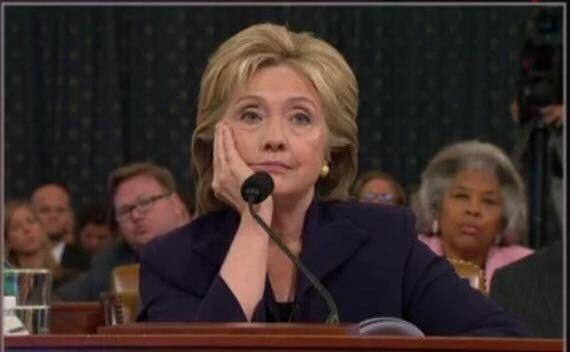
Hillary Clinton at Benghazi hearing

The Feminist Utopia Project

I am a writer.

When I started calling myself that, I wore black and flew to Green Bay to write excruciatingly parallel, AP Style directions to dairy processing plants in rural areas — the kind where you need to observe that eventually there’s an unmarked, winding hill behind the railroad you should follow.

Now I get to write about the thing I am most passionate about in the world: feminism. So I’m super stoked to share that I’ve contributed a chapter on (what else?) body positivity to a new book called The Feminist Utopia Project, edited by Alexandra Brodsky and Rachel Kauder Nalebuff.

You should read this book, because instead of presenting feminist concerns as a list of what’s wrong or terrible, there are 57 utopias blown out in all their shining glory. I went to the launch party in New York City the other night, and was tickled magenta to share a microphone with my fellow contributors imagining things like teen moms having a space at school to breastfeed their infants, and without having to cover nipples (Gloria Malone, who dreamed that up, is just one of the amazeball contributors).

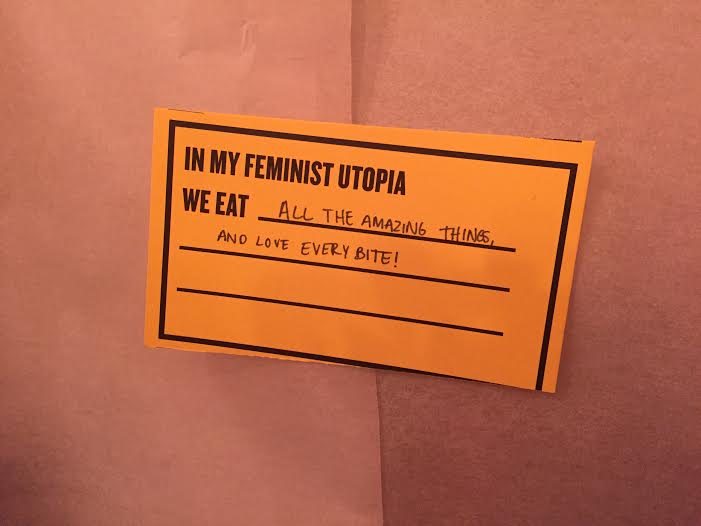
Someone handed me a card to fill out when I walked in the room, so naturally I said:

In my feminist utopia we eat all the amazing things and love every bite!

This reminds me of eating muffins out of a basket on the worst kind of windshield-scraper morning in Wisconsin, when I dreamed of a much bigger world and giving my damn all to making it happen. The fabulous thing is we can all do that.

About That Viral Jared Fogle Cover Story Image

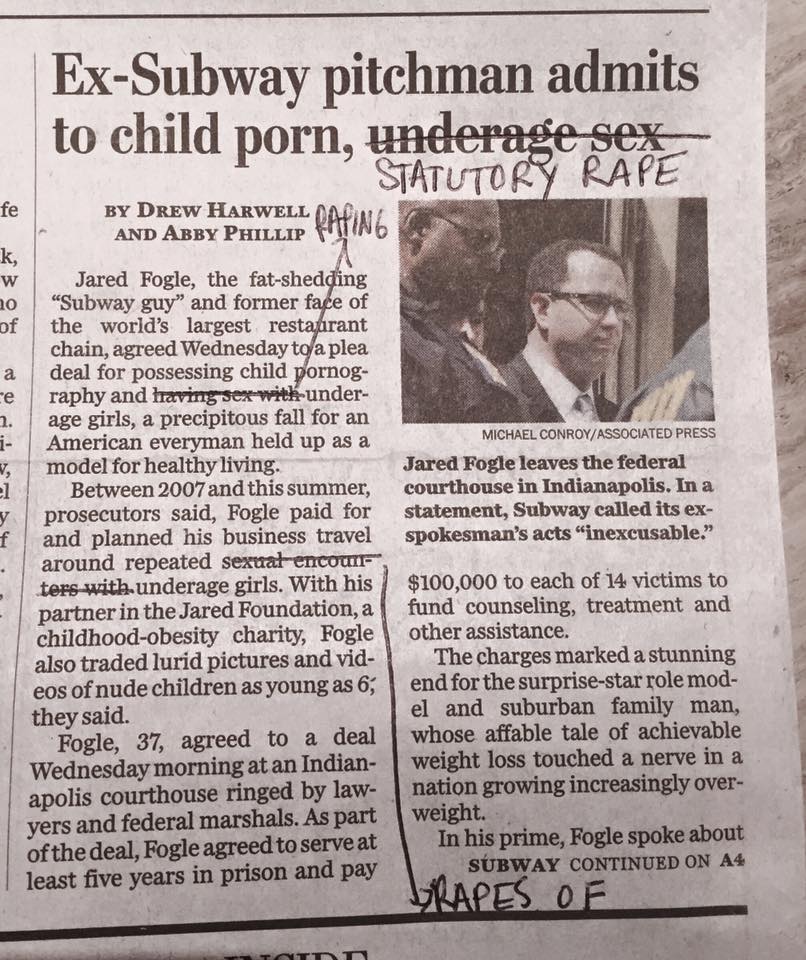
Less than two weeks ago, I used a pen to fix a cover story in The Washington Post on Jared Fogle. I crossed out the word “underage sex” and wrote in “statutory rape” in the headline, and then changed a few more words in the story: “having sex with” and “sexual encounters with” became “raping” and “rapes of” underage girls. Then I took a picture and posted the image to Twitter and Facebook.

11870869_10206541639473647_3230721875285382665_n

The image went viral. Using the most conservative estimates that don’t account for people copying and pasting on their own, the image has been shared well over 40,000 times. I want to talk about why that image resonated so strongly and make some suggestions about where to go from here.

People are sick and tired of rape culture. Rape culture is the way media, law, language, sexism, and social norms interact to create a world where sexual assault is commonplace. It manifested in the Post story by wrapping Fogle’s sexual misconduct with minors in the language of consensual sex.

We can, and should, talk about why this happened. It happened, in part, because of the inadequacy of the charges against Fogle: “Distributing and receiving child pornography, and conspiring to do so, as well as repeatedly traveling to engage in commercial sex acts with underage minors.” Here’s the problem: Legal language and technicalities can obstruct telling it like it is and pursuing justice to the point where it becomes an open question whether the law is designed to protect victims of sexual crimes or powerful, popular men like Jared Fogle and Bill Cosby.

In plain language and the lived experiences of victims of sexual assault, if a person is unable to consent to sex – it’s rape, and that includes the circumstance of an adult preying upon minors below the age of consent. The exchange of money does not override other factors that make a person unable to consent to sex. Fogle engaged in criminal sexual conduct with minors – and while journalists can say that, they can’t say he raped them unless or until the law says he did.

The general population is pretty unaware that one of the largest concerns about reporting on rape within newsrooms is making sure you don’t get sued. So, The Washington Post couldn’t have said that Fogle raped those girls or young women, even though tens of thousands of people agree with me and wish they could have. Part of our ire should rightfully be focused on the U.S. Attorney’s Office in the Southern District of Indiana that offered Fogle the plea deal that allowed him to avoid rape charges.

That said, The Washington Post must be held accountable to an open accounting of its editorial standards surrounding sexual crimes, and revising them to avoid the appearance of victim-blaming. The article in question is hardly the first time the newspaper has reported criminal sexual conduct in the language of consensual sex, or published outrageous things about rape victims – last year, columnist George Will suggested victimhood is “a coveted status that confers privileges” on campus. Tell that to Willa Murphy, who was told to leave Georgetown after she was raped and her academic performance suffered a setback.

The headline on Fogle could have spotlighted that a plea deal meant he avoided rape charges. The text of the story could have referenced the charges explicitly by name, and then paraphrased them later as “sexual misconduct” rather than “sexual encounters.” Language really matters.

We do not use the language of consensual practices to describe other crimes. We don’t read stories about people sharing their wallets with the criminals who robbed them, or offering their lives to the murderers who killed them. We should not do the same with criminal sexual conduct – no matter the other circumstances of the victim’s life, and no matter the celebrity of the person facing charges.

While less relevant to the Fogle story, there is an important, additional step The Washington Post can and should take in its reporting moving forward. It should not call victims “accusers” and/or present the facts of their personal lives, but instead place the emphasis on charges and the people facing them. “Accuse” carries a hostile connotation that reflects upon the person doing it. It is time to use the language of crime to report all crimes, including sexual crimes.

Editorial standards need to change. It’s also pretty clear the application of law does, too. Judging by the shares of the image I created recently, people of all political persuasions on the Internet are leading the way.