Coming Soon: Reproaction

Awesomesauce announcement time! In the near future, I’ll be launching a new group called Reproaction with my inestimable co-conspirator, co-founder, and co-director, Pamela Merritt. We’re going to use direct action to increase access to abortion and advance reproductive justice.

What’s up ahead will not be more of the same. The depth of the human and civil rights crisis wrought by barriers to reproductive healthcare is neither widely known nor appreciated, and we intend to stand up for the right thing – all of it, all the time, and no matter who is in the wrong. If you want change, you must stand up for change. You must be willing to be unpopular. You must be committed to breaking convention. And, we are.

Please read a little more about us at Reproaction.org, and sign up for alerts to receive notification when we do launch.

See you in the streets.

IMG_1520

We Can Change Attitudes

A few months ago, I so happened to be at Georgetown University during a protest hosted by the Westboro Baptist Church. They had their hateful signs in tow, targeting LGBT people, Muslims, and anyone who does not subscribe to their hate club masquerading as a religion.

What was remarkable to me was not the haters, but rather the student response. There were several counter-demonstrations. Some students were playing songs like “Let It Go,” and “Born This Way,” loudly to drown out the hateful chants and bullhorns. Others wore rainbow leis and stood out with their homemade signs bearing messages of tolerance and hope. Still others held hands silently with their backs to the demonstration, and there was an official unity rally with students speaking up for LGBT rights and more.

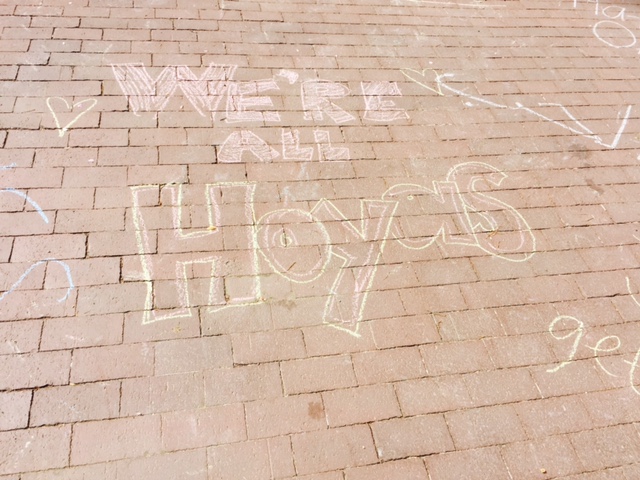
Some students chalked inclusion messages on the bricks, surrounded by hearts.

We Are All Hoyas

I graduated from Georgetown in 2002. While there were people who were out, and there were people who supported LGBT rights, I know this counter-response would not have happened in my time.

Three cheers to younger people leading the way with love and positivity today, and also to those (sometimes) deeply hated outcasts who came before them and demanded recognition when others were inclined to sneer, or look away if they were being charitable.

All of it matters. We all can do something.

We must never forget that we can change attitudes, and even dramatically.

Parenting, Self-Esteem, And Toddlers Holding One Leg Up

My self-esteem kind of fell to the shits some time after my daughter was born. It wasn’t postpartum depression; I’d made it okay through the weeks of shifting hormones and months of endless infant crying. I cried twice after she was born; once in frustration that I wasn’t getting to hold her as much as I wanted during what felt like a never-ending cycle of visitors, and once that first day after my husband went to work and everyone was gone. Other than that, I was fine.

Until I wasn’t. I started losing confidence. New parenthood can be isolating, physically: You just can’t leave the house as easily as you used to.

To compound matters, I had less to say about work, because I was working half-time. I had been used to connecting with people on the basis of work.

Sometimes it’s said that people who talk about their kids are boring. Emotionally, I bought right into that, while intellectually I still know this is a feminist issue that angers me. Frowning on kid-talk serves as a way to silence and trivialize women since we often find ourselves serving as primary caregivers to any children we may have.

All of this meant I became more isolated still.

I realized in the grocery store that I was getting out of tune with myself; it was becoming too hard to buy basic things like pasta or peanut butter. I would look at multiple varieties and not know which to pick. I didn’t trust myself. Decisions that should have taken three seconds were taking 10.

So I wrote an email to two of my closest, dearest friends, telling them that I felt my self-esteem was hitting a lower patch and asking for advice on what they thought I should do. I also asked my husband for ideas.

I think, honestly, it surprised some of them, although they all rose to the occasion, were supportive, and offered awesome ideas. There is some taboo in admitting when you don’t feel great. There shouldn’t be.

Our security in ourselves and the way we feel about the world are hardly static. You could even be the strongest person in the world and still hit rough patches. Admitting the crap times when you have them is a really helpful step to tossing them down the Litter Genie.

Through conversations with my lovelies, I came to realize that what I was really missing was a sense of accomplishment, and that was what was decking my self-esteem. When I had been working around the clock, I had stacks of achievements in the detritus of my to-do lists. People recognized my work. I had the ability to write for pleasure 20 times more often than before the baby, and get feedback in the process.

Motherhood didn’t feel like that. Every time I changed her outfit, my dear sweet daughter seemed to spit up profusely again. Even putting her down for a nap wasn’t much accomplishment, since she’d usually wake up and start crying almost immediately. What I needed, bluntly, was something new that we could do. I knew it had to be us and not just me, or I wouldn’t get the accomplishment near often enough.

So we tried a baby yoga class. And we started coming back, week after week. We’ve been going for almost a year and a half now. Thing is, it worked, and actually fairly quickly. I just needed something new, something I could point to as something I was getting done. As time went on, and my daughter grew, the class became irresistible fun. I love to watch her sing, dance, and do a tree pose (A DEAD-SERIOUS TODDLER DOING A TREE POSE!).

Recently I shared this story in a workshop I facilitated on pregnancy after an eating disorder, as an example of how it’s totally cool to speak up during the divots of life and work toward your own mental health. A doctor who was also leading the workshop responded to my claim that probably none of the other parents in the room knew how important that 45-minute class is to me. She said: It probably is for them, too.

We need to be honest that parenting is not always easy, that life is not always easy, that it’s okay to experience ups and downs and talk about them. It’s actually a sign of strength. At least, that’s the message I hope I’m teaching my daughter.

No More Bad Hair Days And Skinny Clothes

I’m done with bad hair days, they don’t exist. Men don’t have bad hair days; those few who say they do are distinctly in the minority because bad hair days are about sexism, not appearance.

Bad hair days are a way of trivializing women and making us feel like we aren’t good enough as we are. It takes hours for a woman to get the kind of hair that graces magazine covers — time that could be spent getting more sleep. Death to bad hair days!

My hair is neither curly nor straight nor wavy. I had been thinking of it as kind of this perpetual bad hair day. Except it’s not.

Recently I realized how much time I’d been spending beating myself up for not having time to blow dry my hair, since my mornings are about walking dogs, feeding dogs, changing diapers, and then getting a toddler dressed and fed before encouraging her to brush her teeth (good luck). I’m fortunate if I get in a shower before starting to work.

Thinking negatively about my hair had started to invade my space. I started thinking I didn’t look “professional” enough to see colleagues or “good” enough to see friends. I had all this self-imposed stress in the mornings to meet this goal to blow dry my hair.

Wait, what?

When I started unpacking it, I realized I have the same hair that I used to think was totally hot on guys I used to date. (I focused a good chunk of my single life on men who look like Jesus.) This made me realize — hey wait, that’s bunk! I’m not having bad hair days. I’m feeling bad about not measuring up to impossible standards for women. Perhaps, even, my natural hair looks good.

Well, okay then. Bye-bye bad hair days.

On a similar note, the other day I purged my closet of small (skinny) clothes. It felt wonderfully empowering. Leaving clothes that are too small in my wardrobe implies that I need to lose weight to get dressed. No, thank you. Clothes are supposed to fit people, not the other way around.

Self-esteem is not fluff, y’all. When we are able to stand tall, we are able to insist others respect our bodies and our minds. We can dare to be vulnerable, and we can dare to change. Creating the world that should exist is actually a hell of a lot of fun.

hair-styling-tools-clip-art-285646

On Hating Women, Or Respectability Is Not Dignity

We are conditioned to hate women.

We hate ourselves for being too fat, too thin, too curvy, too flat, too flaky, too serious, not smart enough, not fun-loving enough. We are rarely just right, and that’s political. The problem is set up as personal — allegedly there is something wrong with us (all of us) and we should be ashamed — rather than a society that criticizes women. You can be aware and still fall into the trap.

And how we hate other women! I am tired of being expected to hate Gwyneth Paltrow, or Sheryl Sandberg, or slacker moms who supposedly get to work less than everybody else, or women who are pregnant and on public assistance, or even other feminists who see things differently.

Which brings me to my next point: I’m not sure most feminists, let alone most people, understand how radical it is to accept women as they are.

I am still on a tirade against Dos and Don’ts Feminism, or the policing of women’s personal lives and choices, as a way to evaluate whether they deserve to be equal. But I’d like to push this critique a step further, because one of the core issues at stake is whether we are going to accept women as they are and allow them to take up space, or not.

It is radical to not question women for who they are, or what they need. It is radical to support women as the people they are now, rather than the people we might wish them to be. It is radical to not use women as a yardstick to measure the inadequacies of other women.

One of the areas where this becomes crystal clear is the losing fight over abortion. For too long advocates for abortion rights have focused relentlessly on the sad and regrettable reasons why some women have abortions. Those stories exist and the point is not to minimize them; rather, it is to say that trying to make abortion relatable to people who don’t agree with it fails to attack the root cause of why abortion is controversial in the first place … we don’t believe women are good decision-makers, and we think that only if women are good decision-makers will they deserve dignity and control over their lives.

So, actually, it is very radical to accept women in all aspects of their lives, perfect or imperfect. Because accepting women “as-is” is a necessary precondition to dignity, equality, and justice for women. Dignity is not respectability.

It’s not respectability under the terms of rape apologists who believe that if only women would stop drinking that and wearing that they wouldn’t get raped.

For that matter, it’s not respectability under the very different terms of some feminists who believe that only women who buck the gendered expectations of femininity, like wearing make-up or caring for children or washing a husband’s laundry, are situated to claim equality.

Sometimes I’ll hear my radical belief against hating or criticizing women dismissed as “choices feminism,” or an idea that feminism is about allowing women to make choices and be whoever they want to be and that’s it. Nope. I want women to be equal. But they are not going to be equal so long as we demand a fixed set of behaviors from them, whatever those behaviors may be.

Supporting women as they are is radical, and a first step to greater political and social gains. If political and social gains come at the price of constricting women who do not fit a particular mold, we are simply applying a new shade of paint to an old straitjacket.

The Sexism Is Everywhere, But Handling Hillary Clinton With Kid Gloves Isn’t Feminist; It’s Sexist

No woman in the public eye symbolizes the tremendous change in opportunities for women more than Hillary Clinton. It is not in spite of this, but because of this, that she inspires passion and deep ambivalence. People love her, or people hate her. The media reports on and questions her style as if the entire credibility of constitutional democracy might rest on her cleavage, her hair, her pantsuits, her scrunchies, and now, her logo.

On substance, feminists are frequently told to judge her by the sexual mores of the man she married. Someone has yet to credibly explain how judging a woman by the actions of her partner, rather than her own actions, is feminist.

In the 2008 elections, the Democratic Party failed to treat Hillary with the respect she deserved. She was surrounded with calls to get out of the race while she was still ahead in the primary.

As one of my mentors, Olga Vives, argued with passion, even during her final days on a sick bed, the women’s movement failed to recognize the extraordinary transformative power of a woman candidate for president, and failed to stand behind Hillary during a grueling primary.

I was, with Olga, active in the National Organization for Women then. It was a contentious time.

Some women’s organizations bestowed endorsements on Obama early in the race, when their memberships were still divided on whether to support Obama or Hillary; others endorsed her, but didn’t challenge the blatant sexism of the Democratic Party pushing her out too soon.

In this vacuum, some of those women’s advocates left standing for Hillary went to ugly places. Some refused to accept Obama as a legitimate candidate, and one who earnestly continues to champion advancements for women, especially in the areas of pay equity and sexual assault; others embraced the racist strategies to defeat him deployed by the right.

One of the strangest strains was a vocal group that proclaimed Sarah Palin was both a feminist (wow, no) and the right candidate to assume the vice presidency (oh my goodness, considering what might have happened really could give a woman the vapors).

This climate presented a difficult slate of options for those of us who were ready for Hillary the first time. She was treated with horrific, condescending, get-out-of-the-way sexism by her own party, and yet the most vocal response to that was a fantasy-land embrace of Sarah Palin, an emotional reaction that amounted to gender essentialism and overlooked the antifeminist platform of her platform, party, and ticket.

My response was simply to get behind Obama, cry when Hillary spoke at the convention, and lose faith that women’s organizations will do the right thing simply because they are women’s organizations — and that the Democratic Party, its leadership, and the progressive movement should be trusted to handle feminist affairs with the current infrastructure charged with holding them accountable.

Which brings me to today.

The problem is that this time around, the treatment of Hillary from within also bears shades of sexism, albeit in a different way. It’s as if to atone for what happened, now the new rule is that Democrats are not allowed to criticize or question Hillary’s positions. Any of them. Even before the general election. Or you, yes you, are failing feminism and perhaps our one and only chance to see a woman president in our lifetimes.

This is not how politics works. Politics, and particularly primary season, is supposed to involve a robust debate of the issues and honing of positions on matters vital to the community.

There is an inherent sexism in the idea that, this time around, Hillary must be handled with kid gloves. If a woman is running for president with the blessing of the big dogs, why must we sit in the back of the classroom and raise our hands and wait to be called on?

There was sexism coming from the establishment in the past, too, in the idea that it wasn’t Hillary’s turn, that something was wrong with her “likability,” when she was a competitive candidate in 2008.

Just as there is sexism in the frame that only women can credibly challenge Hillary today. Why must Hillary play in a women’s league?

This piece is happening on both sides of the aisle.

The calls to draft Sen. Elizabeth Warren (D-MA) are interesting, because by dint of her actions, principles, and resolve, Warren symbolizes the progressive movement better than any other one candidate. But I’d also like to challenge these calls a bit from a gender lens.

First, it’s the simple matter men dominate everything, including the infrastructural leadership of the progressive movement, and even with Warren’s qualifications, it’s a bit fishy that the official energy backed by money and power has coalesced around her and no other alternative; that a woman is expected to challenge a woman from the left.

Second, some of us may remember when Jessica Williams asked her “feminist” critics on Twitter to lean the fuck away from her after she indicated she was not interested in taking over as host of The Daily Show. There’s an element of that here, although it’s nuanced.

On one hand, Elizabeth Warren has said repeatedly that she is not running for president — and the activists continue to beat the drum. On the other hand, this is sort of how politics work — the song and dance of being asked to run by the grassroots. Still, one is left with a discomfiting sense that were Warren a man, her word might be taken at her word by large progressive organizations like MoveOn.

On the Republican side, Carly Fiorina is expected to run for president, or at least make a great deal of noise. No one expects her to become president — she couldn’t even win a Senate election. So what exactly is she running for, and why is she getting so much space to air her views in presidential fora on the right?

Simple. She is running against Hillary’s campaign on behalf of the real candidates for the Republican Party — just like Jackie Sharp on House of Cards. It’s insulting to Fiorina, and it’s insulting to Hillary. It’s also insulting that the men of the Republican Party who are credible contenders are delegating the women’s work of taking down a woman named Hillary Clinton who steps out of the boundaries of traditional womanhood.

The coming election will bring with it a bevy of sexist attacks; and feminists must call them out and demand a change in culture, no matter where we stand on Hillary and her priorities. But feminists and everyone must also be free to question Hillary and examine her policy proposals as we move forward; it’s frankly sexist to silence ourselves in pursuit of elevating one woman to the top.

Hillary Clinton, A Pro-Choice Champion?

No one can credibly question that Hillary Clinton is a role model for women’s empowerment around the world. Further, it’s well past time for a woman to serve as president of the United States. Finally, there is always enormous pressure on feminists to line up and cart out the pom-poms during election season — and that pressure only multiplies when there is one big-time Democratic candidate, and she is a woman.

But if you ask me what I’m ready for, I stand to lose my integrity as an advocate if I don’t stick with my first answer: I’m ready for reproductive justice and I want to see it in my lifetime.

I’m ready for Hillary to step up.

Reproductive justice is a human rights framework developed by women of color that includes three keys: the right to have children, the right not to have children, and the right to parent in safe and healthy environments. Reproductive justice goes beyond issues of “choice,” and acknowledges that societies have proactive obligations to provide the means for people to live with dignity — offering quality health care for everyone, funding abortion and contraception without exceptions, and ending police violence against communities of color, to name a few. 

Is Hillary going to go there? Don’t tell me to trust her. Don’t point at the Republican candidates and their alliances and personhood bills and Terri Schiavo court briefs. And please, don’t tell me how to be a feminist and what my priorities should be.

Spring 2015 is only the beginning of campaign season; it’s still a bit chilly for cheerleading skirts, yes?

Much of my work is concerned with ending a reproductive health care crisis. This is not a side issue, and if you believe it is, I encourage you to think hard about white male dominance and how a framework of so-called bad sexuality and poor personal choices is set up, by design, to sideline just about everyone but white men in power.

That Hillary is a woman, that Hillary is a feminist, that Hillary could become president and shatter one important glass ceiling, does not automatically mean that she is going to use her backbone to reverse our gravely serious reproductive health care crisis.

Other women and men in power have not. In just two examples, the last major action of the Congressional Pro-Choice Caucus has been to collaborate and give its blessing to a deal House Minority Leader Nancy Pelosi (D-CA) struck with Speaker John Boehner (R-OH) to expand abortion funding restrictions by placing them in the Medicare “doc fix.” And, there is no defensible reason for President Obama to continue restricting abortion funding for rape victims around the world. What has Hillary done to indicate she’d be any different?

Before we start tripping over ourselves to applaud how great Hillary would be on these particular issues, it’s best to take a step back and acknowledge that the bar for who gets to be called a “pro-choice president” has been set extraordinarily low. Democrats and large reproductive rights organizations have conditioned us to accept that the champion is a person running for office against the person who says that rape is a blessing because then you get a baby. It’s time to break this cycle and tie labels to proactive policy outcomes.

We have a new, urgent, expanding crisis as far as access to reproductive care is concerned — clinics are closing, women are crossing the border to obtain medication to self-abort, and 231 abortion restrictions were enacted in the previous four years. Hillary needs to step up. Instead, she appears to be hiding.

She steered clear of abortion and focused on safer topics at the recent EMILY’s List gala, she left abortion out of her “No Ceilings” report on the status of women worldwide, and she had Melinda Gates (who refuses to talk about abortion) and a representative from the Catholic Medical Mission Board (which refuses to purchase or receive donations of condoms for its HIV/AIDS work overseas and acknowledges that it follows the lead of the presiding Conference of Catholic Bishops in each country where it has programs) lead a discussion on maternal mortality at the launch event for that report.

This strategy of trying not to go ‘too far’ or to demonstrate ‘cooperation’ with the opposition on abortion is not leadership. In fact, it’s a proven loser for women’s human rights. In one recent example, Hillary’s famous language about abortion needing to be safe and rare was just used by conservative lawmakers in Arkansas to pass a law restricting medication abortion.

Now, a few things:

Does Hillary support the right to abortion? Absolutely. Has she fought back forcefully against those who disagree? Yes. (Watch this epic takedown of Rep. Chris Smith (R-N.J.) if you don’t believe me.) But reacting to bad guys is not enough, not by itself: this overall strategy is why the reproductive movement is losing.

Second, I’m not anti-Hillary. I went to Iowa to campaign for her before the 2008 election. I wept like hell when she conceded to Obama. For years I have been saying quite loudly that I believe leaders in the Democratic Party and women’s organizations failed her eight years ago by calling for her to leave the race or endorsing her opponent while she was still ahead.

But my lens is more complicated this time around.

I am a feminist activist and a reproductive health, rights, and justice advocate. And I have seen time and time again how those who want to advance “women’s issues” believe the only winning way to do so is to drop the abortion question or be as “strategic” (which really means something between non-confrontational and weak) as possible. So, I get very worried when Hillary is not embracing abortion (and yes, I mean saying the “A” word) when all the pundits say this time around her campaign will focus on Hillary’s role as a champion for women.

There’s no doubt about it — Hillary is an icon. But is she a pro-choice champion? Have we allowed that phrase to become meaningless? Who is working to expand access to abortion today?

There will be enormous pressure, rooted both in subtle sexisms and more overt ones, to not ask these questions as a feminist woman runs for president.

We can rise above that — a woman can and should expect a vigorous primary campaign season. Women can and should be allowed to have public differences amongst each other. Feminism is not just about placing women in the most powerful positions; it’s about demanding dignity for women like Purvi Patel, who is sitting in prison for twenty years on the basis of miscarriage or self-inducing an abortion.

It’s time to set the bar higher than loving Democrats and trusting they’ll figure it out, or nothing will change.

On Motherhood And Employment

In our culture, pregnancy is viewed as something you did to yourself. Having a child comes with consequences you must be prepared to accept. This isn’t gender neutral; it’s no accident that women’s reproductive capacity is reduced to a supposedly objective decision-making matrix that sets up women as a class to fail.

On any given day, cultural and political leaders will portray children as punishments for casual sex; as luxuries for wealthy families; and at their most heinous, as ruses for public benefits or citizenship status.

The idea of pregnancy and children as consequences for which women must pay plays out in many sectors of our lives, including restrictions upon reproductive rights, and punitive attacks on the social safety net.

Here I will discuss some of the negative consequences for women in the workplace. I say women intentionally; although not all women are or will become mothers, it is often anticipated they will. So even a woman who has no intention of having children is often unfairly judged by her actual and prospective employers.

The United States does not guarantee paid parental leave. Today pregnant workers still face inadequate workplace protections, as made clear by the failure of Congress to pass a Pregnant Workers Fairness Act that would simply clarify that employers must offer minor accommodations when necessary, such as increased bathroom breaks or lighter lifting duties. A year of day care costs more than a year in public college in 31 states.

These are not just women’s issues or family issues; these are massive economic problems that constrain our economy.

But, I’d argue, our cultural attitudes suck at least as much as our institutional failures to accommodate the reality of parents who work, a reality that resoundingly ends in undervaluing women in their personal lives and on the job.

I have a toddler. It has only been a few years since I was in my early thirties, single, and facing all sorts of biological clock-type questions about whether I wanted to have kids. Bluntly, this kind of pressure can destroy a dating life (if you want one) — I have watched it happen with friends and experienced variations of it myself. But even more, I wish that some of those people who wondered about me being single would have instead asked what I was reading, or working on, or thinking about current events.

If and when women do have children, the very real work they turn around and put into caring for those children is often portrayed as heroic (“the hardest job in the world”), which may be well-intentioned but is ultimately patronizing since caregiving for one’s own family is put on a pedestal but neither compensated nor respected in the marketplace. In portraying the motherly woman as idol, this false heroism also excuses men in heterosexual child-rearing relationships from stepping up to do their fair share.

And on the job? Mark Zuckerberg once said of Facebook having younger (i.e., childless) employees:

“Young people just have simpler lives. We may not have a car. We may not have family. Simplicity in life allows you to focus on what’s important.”

What’s important, apparently, is to be found in those corners of the office where working moms don’t hang out late at night.

You might think, “What the fuck, Zuck?!” and write it off, but I’ve heard versions of this riff in explicitly feminist settings. In one example, I heard a non-profit executive express resentment that women with children didn’t have to work as much as she did. In another, I heard a consultant express concern that a boss who worked standard business hours because of her kids didn’t understand her younger employees needs to come in later in the day.

The first case is frankly bullshit. There’s a cliche going around that if you want something done, you should give it to a mom — and that’s often true. I know motherhood has greatly increased my time management skills. If I need to get something done, I no longer plan to get it done later — that leaves too much margin for error when a toddler depends on me. Further, it’s unfair because many employees smoke and take smoke breaks, or go on long lunches with friends, or leave early to play recreational sports.

The second case greatly concerns me, because ultimately what concern over the supposed rigidity of a working mom’s office schedule says is that a woman with children isn’t fit to make decisions, and isn’t fit to judge how her team should work, including whether they should keep the same hours. In other words, that a mom isn’t fit to be the boss.

Yes, dads get some crap in the workplace, too, but rarely if ever will you hear it suggested that he’s not pulling his weight, or he’s not fit to be the boss, because he has kids. It’s assumed a woman will step up for him when junior throws up all over the classroom on presentation day.

My college thesis examined the failure of the feminist movement (at the time, so we’re talking 2002) to tackle the problem of child care in a visionary way and as a major rallying cry — specifically, why it costs so much, why quality is so varied, and why it is inaccessible to so many. The voices calling for universal child care, or Social Security contributions for caregivers, are too few and far between.

Ultimately the conclusion I reached is that liberal feminism is too invested in theories of bootstraps individualism, and that acknowledging caregiving as gendered, much less a societal obligation (it takes a village) rather than a personal lifestyle, could be seen as threatening to undermine the “long way” you’ve come, “baby.”

I still believe, to an extent, that’s true, but to another extent I would argue today that the failure to progress also sits largely in the friendly and willing cooptation of many feminist organizations by the Democratic Party, which throws bones to the ladies as a matter of electoral convenience and sometimes deeply felt principle, but never should be confused with a movement making radical demands for social change. Although it has been.

I believe these dynamics are at play when we consider why it is not equal to be a mother, or for that matter a woman, in the workplace.