How To Explain The Benghazi And Planned Parenthood Hearings To Your Two-Year-Old Daughter

What’s this? 

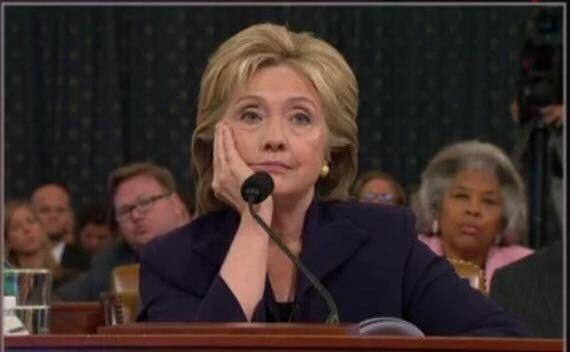
It’s a hearing, sweetie. And we need to talk about something important.

What do you notice about the people asking questions?

Yes, they seem mad. Really mad. What else?

That’s right. They’re almost all boys. Usually when boys grow up we should call them men.

Now what about the person getting yelled at?

Yes, she’s not a boy.

So this is not fair, but it’s true: There are a lot of boys who grew up thinking they were better than girls.

Why?

People were mean and they were wrong in the old days. They thought only boys could be strong, and only girls should take care of other people. I know, that’s not at all like your friends! Now boys play with dolls, and girls are great at running and jumping and playing baseball.

Unfortunately, it’s pretty hard for people to let go of things they learned when they were little, even when those things are mean and wrong.

The reason why they are picking on Hillary Clinton and Cecile Richards, and not boys, is that for a lot of people, these women represent more opportunities for girls. One could be our first woman president. The other works so that girls get to pick what to do with their lives.

A lot of boys with mean and wrong ideas don’t like that. So they’re trying to put them in their place.

What I want you to notice is that neither of them are giving up, even though the questions are really mean. If someone ever tries to bully you because you are a girl, you shouldn’t either.

And I will be so proud of you. I already am.

Hillary Clinton at Benghazi hearing

The Feminist Utopia Project

I am a writer.

When I started calling myself that, I wore black and flew to Green Bay to write excruciatingly parallel, AP Style directions to dairy processing plants in rural areas — the kind where you need to observe that eventually there’s an unmarked, winding hill behind the railroad you should follow.

Now I get to write about the thing I am most passionate about in the world: feminism. So I’m super stoked to share that I’ve contributed a chapter on (what else?) body positivity to a new book called The Feminist Utopia Project, edited by Alexandra Brodsky and Rachel Kauder Nalebuff.

You should read this book, because instead of presenting feminist concerns as a list of what’s wrong or terrible, there are 57 utopias blown out in all their shining glory. I went to the launch party in New York City the other night, and was tickled magenta to share a microphone with my fellow contributors imagining things like teen moms having a space at school to breastfeed their infants, and without having to cover nipples (Gloria Malone, who dreamed that up, is just one of the amazeball contributors).

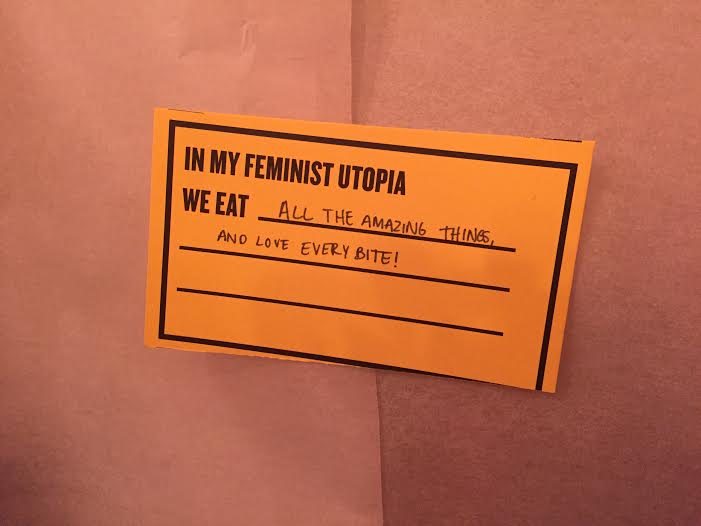
Someone handed me a card to fill out when I walked in the room, so naturally I said:

In my feminist utopia we eat all the amazing things and love every bite!

This reminds me of eating muffins out of a basket on the worst kind of windshield-scraper morning in Wisconsin, when I dreamed of a much bigger world and giving my damn all to making it happen. The fabulous thing is we can all do that.

About That Viral Jared Fogle Cover Story Image

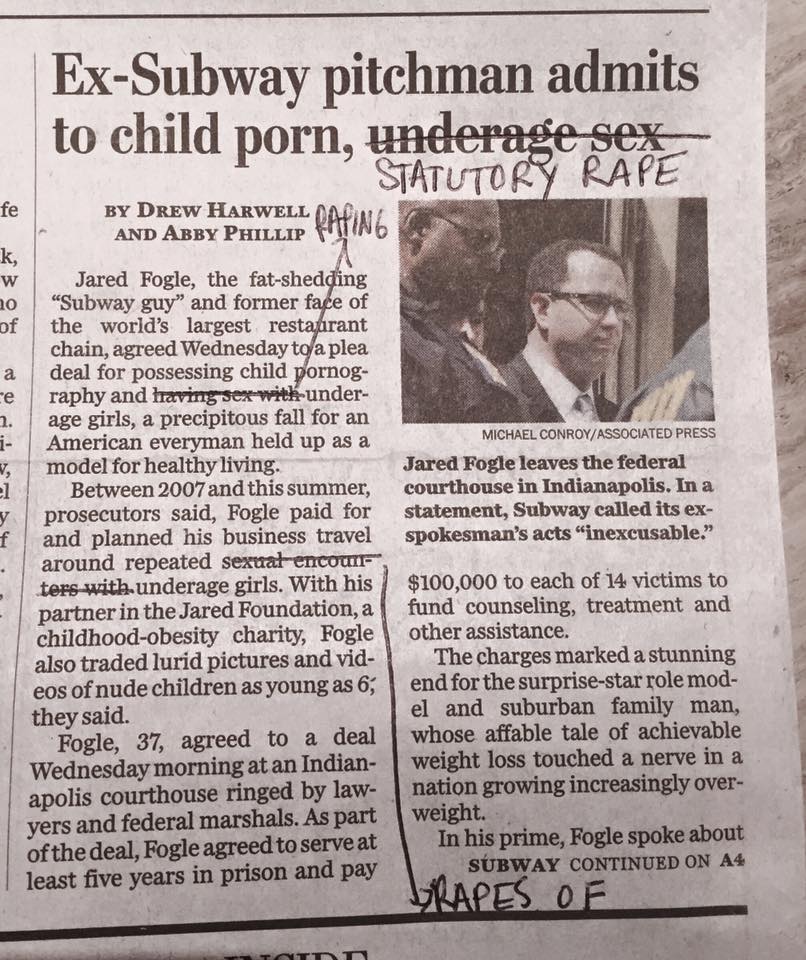
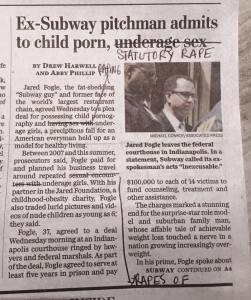
Less than two weeks ago, I used a pen to fix a cover story in The Washington Post on Jared Fogle. I crossed out the word “underage sex” and wrote in “statutory rape” in the headline, and then changed a few more words in the story: “having sex with” and “sexual encounters with” became “raping” and “rapes of” underage girls. Then I took a picture and posted the image to Twitter and Facebook.
11870869_10206541639473647_3230721875285382665_n

The image went viral. Using the most conservative estimates that don’t account for people copying and pasting on their own, the image has been shared well over 40,000 times. I want to talk about why that image resonated so strongly and make some suggestions about where to go from here.

People are sick and tired of rape culture. Rape culture is the way media, law, language, sexism, and social norms interact to create a world where sexual assault is commonplace. It manifested in the Post story by wrapping Fogle’s sexual misconduct with minors in the language of consensual sex.

We can, and should, talk about why this happened. It happened, in part, because of the inadequacy of the charges against Fogle: “Distributing and receiving child pornography, and conspiring to do so, as well as repeatedly traveling to engage in commercial sex acts with underage minors.” Here’s the problem: Legal language and technicalities can obstruct telling it like it is and pursuing justice to the point where it becomes an open question whether the law is designed to protect victims of sexual crimes or powerful, popular men like Jared Fogle and Bill Cosby.

In plain language and the lived experiences of victims of sexual assault, if a person is unable to consent to sex – it’s rape, and that includes the circumstance of an adult preying upon minors below the age of consent. The exchange of money does not override other factors that make a person unable to consent to sex. Fogle engaged in criminal sexual conduct with minors – and while journalists can say that, they can’t say he raped them unless or until the law says he did.

The general population is pretty unaware that one of the largest concerns about reporting on rape within newsrooms is making sure you don’t get sued. So, The Washington Post couldn’t have said that Fogle raped those girls or young women, even though tens of thousands of people agree with me and wish they could have. Part of our ire should rightfully be focused on the U.S. Attorney’s Office in the Southern District of Indiana that offered Fogle the plea deal that allowed him to avoid rape charges.

That said, The Washington Post must be held accountable to an open accounting of its editorial standards surrounding sexual crimes, and revising them to avoid the appearance of victim-blaming. The article in question is hardly the first time the newspaper has reported criminal sexual conduct in the language of consensual sex, or published outrageous things about rape victims – last year, columnist George Will suggested victimhood is “a coveted status that confers privileges” on campus. Tell that to Willa Murphy, who was told to leave Georgetown after she was raped and her academic performance suffered a setback.

The headline on Fogle could have spotlighted that a plea deal meant he avoided rape charges. The text of the story could have referenced the charges explicitly by name, and then paraphrased them later as “sexual misconduct” rather than “sexual encounters.” Language really matters.

We do not use the language of consensual practices to describe other crimes. We don’t read stories about people sharing their wallets with the criminals who robbed them, or offering their lives to the murderers who killed them. We should not do the same with criminal sexual conduct – no matter the other circumstances of the victim’s life, and no matter the celebrity of the person facing charges.

While less relevant to the Fogle story, there is an important, additional step The Washington Post can and should take in its reporting moving forward. It should not call victims “accusers” and/or present the facts of their personal lives, but instead place the emphasis on charges and the people facing them. “Accuse” carries a hostile connotation that reflects upon the person doing it. It is time to use the language of crime to report all crimes, including sexual crimes.

Editorial standards need to change. It’s also pretty clear the application of law does, too. Judging by the shares of the image I created recently, people of all political persuasions on the Internet are leading the way.

That Would Be Me With A Toddler At The Pro-Choice Happy Hour

My daughter is two. She is a lovely, wonderful, vivacious girl. Her new thing is that she comes with me to pro-choice happy hours.

Before she was born, I was going to action/networking/professional-type stuff nearly every night of the week. Happy hours. Panel discussions. Volunteer phone-banks. Impromptu vigil for social justice? My candles were by the door. This is an easy habit to fall into as a young do-gooder, especially when you love what you do.

After she was born, I stopped doing most of these things. It was just too hard, especially when I was still nursing and rocking her to sleep. That’s changed, but babysitters are still costly and hard to find. And yes, after working all day, I like to spend time with her.

Does this make me less driven? Nope.

But yes, I had been missing some of the things I used to do.

I started questioning that. Yes, my responsibilities have changed, but that doesn’t mean I can’t find a new way to re-engage with my old interests. So I started bringing my daughter to the pro-choice happy hour. It’s happened twice in the past few weeks.

I think of it as occupying my own life. I can be a parent, and still do things I love with my kid in tow. Even if kids aren’t explicitly invited. I can use my judgement and pick and choose what might work based on the situation and her needs at the moment. Occupying my life even though I’m a mom with a kid to watch isn’t just good for me and the kid, it’s good for everyone. Kids are part of life and we must include them.

I want my daughter to know that she’s welcome to be a part of the interests I hold outside our family. I want her to know it’s okay for women and moms to be part of public life. I want the people at the pro-choice happy hour to see that we can make some of our activist spaces kid-friendly with hardly any work, and I’m happy to share the joy of my daughter with the many, many activists who support abortion rights as a matter of human dignity and also happen to love babies (believe it!).

Yes, we’re only there for 20-30 minutes on the way home from daycare, and we sit to the side with her yogurt or hummus and pretzels, but I get to see my friends and be a part of the social side of a movement I work in.

Occupying my life takes other forms, too. Turns out that having a kid means you get a lot less sleep, and don’t always get a chance to shower and/or get ready. Well, this happens to me regularly now. Just today I did a meeting on Skype video with bed-head from several hours before. I’ve stopped feeling shame about this, and invested in pomade instead. I’d rather do the things I care about than waste time or energy berating myself, or take myself out of the running because I have a kid who doesn’t serve me breakfast in bed and warm my bathrobe.

By watching me, I hope she will see that mothers can be whoever the hell they want to be. I have been enjoying showing myself that, as well.


It’s Still Rape

It’s still rape when the rapist is famous, or well-liked. “A family guy.” That kind of bullshit.

It’s still rape when the rapist is a friend, date, hook-up, boyfriend, girlfriend, husband, or wife. Rapists are people — and usually not strangers.

It’s still rape when it happens in the LGBT community.

It’s still rape when the victim is underage. No matter what she was wearing. No matter what he said in class. They could be “asking for it,” doesn’t matter — when the person is underage, it’s rape.

It’s still rape when the media calls victims, “accusers,” and rapes, “sex.”

11870869_10206541639473647_3230721875285382665_n

It’s still rape when you’re fucked up on alcohol or drugs. When you said yes before you said no. When you’re a person who likes sex, yes, just not rape.

It’s still rape when Whoopi Goldberg is friends with the rapist. When the military protects its chain of command. When the Vatican says it shouldn’t be held responsible.

It’s still rape when politicians are too busy trying to control abortion to listen to victims and give them the dignity and support they deserve.

It’s still rape when the victim has chosen to identify as a survivor (heck yeah!).

We need a new conversation on rape, immediately. We need to insist upon it. We need to make corrections the moment they are due. Otherwise, we are all part of the problem.

Loving My First Gray Hair Is Political

Yesterday I got my first gray hair. It’s beautiful and light, hugging the soft space to the side of my forehead. I love it.

I have been waiting for this day. I am 35. Gray hair was going to happen. Years ago I made a conscious decision to continue loving myself as I grow older. This is an act of self-preservation, and defiance.

This is about my feminism — hatred of women is intimately tied in with dangerous, racist, and unrealistic expectations of beauty that we are expected to internalize. We must reject that as much as we can (real talk: this can be a day-by-day thing, and feeling like crap about your looks doesn’t mean you don’t get to be a feminist).

This is personal — I almost died of anorexia. Gray hair is a victory! I am fortunate I made it to my 18th, 19th, and 20th birthdays. I am both grateful and proud I did, because damn that was a lot of work. My personal interest extends beyond having overcome nearly lethal negative self-talk related to my appearance; I’ve reached an age where too many peers have died for no good reason. I’m lucky to get old.

This is about parenting, too — my daughter deserves the example of a woman who dares to look like herself and love herself.

As a social justice activist and organizer, I struggle with the decision to write posts like this sometimes. Today yet another video has surfaced of a Black person losing their life to police violence; his name was Sam DuBose. Racism is one of the most pressing issues of our time.

And so, I ask myself:

Is it indulgent to be introspective about the first freaking gray hair on my head at a time when people are dying, when politicians fail to acknowledge that Black lives matter, when terrorists are targeting abortion providers because they dare to help women?

I struggle with this question, and yet this post speaks for itself: Here I am, writing. My firm belief is that self-love is radical. You cannot fight effectively for equality, dignity, or justice when you are unable to treat yourself with respect. You cannot find the courage to accept difference in others if you’re unwilling to accommodate difference for yourself. Loving yourself is not ego or dominance (those are rooted in insecurity, after all); loving yourself is about compassion. Best part? Inner compassion is compassion, and both are contagious.

So, when I embrace my gray hair, what I am also saying is that we should embrace ourselves and one another as we are. We must treat our fragile lives with respect and love, and break every convention necessary.

112308584428765260Sb6ZHbVyc

Holding A Baby And An iPhone

I live-tweeted labor. The first night of my daughter’s life I realized I was going to be nursing for long stretches overnight; I began using my phone to stay awake. Every night I spent hours nursing her quietly, listening to her sweet little swallows, and surfing the Internet like it was the best Gidget movie in the world. I developed eye strain, and my carpal tunnel flared up again.

Eventually maternity leave was over. I held a different job then, one I loved, but I was also a rare part-time employee on a staff of full-timers. That meant checking in on email all the time anyway, so I wouldn’t fall behind.

Work-life balance is this elusive thing. It’s a psychic pair of skinny jeans, designed to punish. Work-life balance is not a gender-neutral phrase. Work-life balance may as well be Morse code for throwing women to the wolves. We are expected to take care of our families, make nice food that looks like it belongs on Instagram, and shatter glass ceilings through perseverance and sheer will. (Friendly reminder: There are no personal solutions to societal problems.)

Generally I suck at work/life balance, as do a good portion of the people I know, because we are expected to work all the time and we have the Internet with us almost everywhere we go.

And yet I’m not complaining: I’m fortunate that my line of work so happens to be my life passion. Still, if work/life balance means having two separate spheres of life that are both well-tended, nope, I don’t have that.

I’m the woman who is opening up Slack for conversations with a colleague while my daughter eats in a high chair next to me. You can catch me firing off work emails at the playground. And I’m ashamed by how often I look at Facebook when she is in my care.

My daughter has taught me a love of presence. We should listen to crickets and wonder what they are. An airplane overhead is worth pointing to and talking about. Silence is a lavish gift — seriously, take it when you can get it.

It is hard for me to reconcile my actual and/or perceived need to be always available online with being the attentive mother I want to be. And yet, I am terrifically proud to be a working mother, and I claim that title. I can’t wait until my daughter is old enough to realize that the woman suffrage poster in her bedroom is not just wall art, and that her mom is a troublemaker.

Ultimately, I am doing both. Sometimes I hold my daughter and write emails. Sometimes I push the stroller and go on Twitter rants.  I am a parent and a working feminist at the same time.

Feminism Must Be Anti-Racist

Recently, an acquaintance on Facebook upset several mutual friends with a post that started with an admission that every time someone says the phrase ‘white privilege,’ she laughs out loud. She went on to detail how, while she was a white woman, she has experienced a number of specific oppressions in her life and felt it was unfair to conflate her with white male bankers. She identifies vociferously as a feminist.

Also this week, I was pulled over for speeding (oopsie!) and waited in frustration as the officer spent seemingly forever in his car with my registration and license. When he came back, he gave me a warning and let me go. I’ll admit; I was a little frazzled. Earlier that day my daughter had fallen and hurt herself at school, and waiting in my car for the police officer meant I was getting more and more late to pick her up. I told him so, and he left me with a genuine expression of concern. His last words were, “have a better day.”

This, when women like Sandra Bland wind up dead in jail after a routine traffic stop. When some white people continue to defend the Confederate flag after the terrorist murders in Charleston. When people I know sully the ‘feminist’ movement with open hostility toward intersectionality and a self-aggrandizing desire to shout over the lived experiences of others.

I cried as I drove away.

White privilege is an institution that is scary for whites to acknowledge. Hardly anyone wants to be called racist, and just about everyone, white people included, can cook up some stories of how they overcame hardships and got where they are by dint of hard work. The institution of white privilege does not mean that every white person is inherently bad, nor that every white person lives a dandy oppression-free life, but it does mean that every white person doesn’t have to deal with the race-based economic, political, and social inequality people of color have to deal with every day. It also means that white people have a responsibility to listen, learn, and advocate for change.

To deny that at this moment of crisis — when we keep seeing new videos and learning new names of Black people who die in police custody, when activists from the Black Lives Matter movement are tugging the strings of the nation’s conscience and doing the hard work to redistribute power where it belongs — to deny that automatically lands you on a continuum somewhere between ignorant and asshole.

Many of the best feminist activists, organizers, theorists, thinkers, and writers I know are women of color. For that matter, many of the best feminists I know who have told me they most struggle with the term “feminist” are women of color.

Because there is this baggage of white feminists who declare all women are the same, when we are most clearly not. Or things like Patricia Arquette’s exclusionary speech for ‘women’s rights’ at the Oscars.

What we don’t need is ‘unity,’ a phrase that is often deployed as a way for women with more power to get their way.

What we frankly need is to educate these women, or else.

I know many feminists who will rise up to defend why you need to support abortion rights in order to identify as a feminist. The same thing needs to happen with racial justice — if you are not willing to listen to others with different experiences and identities without putting yourself first, if you are not willing to look racism in the face, you really need to get the fuck out of the tent.