Why Must We Disagree With Successful Women?

Sheryl Sandberg has a new campaign. Beyonce has a sexy dance at the award show. A woman is running for political office. And, reliably, in every instance, you will hear women’s advocates disagree with what she is doing.

This should happen for the simple fact that women are not all the same, and we don’t all think the same. We sure as hell don’t have the same experiences. Yet surprisingly, this fact is little acknowledged within mainstream discourse. One woman’s actions are interpreted to speak for what is possible for the whole. We do not do this to heterosexual white men.

If a heterosexual white man is elected into office, we don’t comment on the message he is sending to other heterosexual white men. We comment on his ideas. If a woman has enough privilege to share her ideas with a broader audience, which remains relatively rare, we insist upon placing a frame around her that simultaneously evaluates all other women and urges women to disagree with her.

It is precisely because women in the public eye are interpreted as representing the whole that women, including but not limited to feminist women, are under pressure to so vehemently disagree with the actions of women in the public eye. We have been presented with a vision of gender empowerment that gives women one to a few slots among a sea of other slots primarily occupied by heterosexual white men. We are supposed to celebrate the few women leaders we have, and encourage ourselves and others to be just like them. What this means is that someone else has already beaten us to the punch. We are, in other words, encouraged to compete with other women rather than insist that heterosexual white men share power to the extent that a diverse array of women can share an equal seat at the table.

When a strong woman acts, the next step in the social media world is to talk about her ideas or actions in relation to that woman. A referendum on her action ensues. It is beneficial to analyze, disagree, and parse out new opinions, yes. Women are not all the same.

Still, it would be nice to see a referendum on the practice of assigning women and in particular feminist women the job of picking apart the actions of the comparatively few women leaders we have. It is both radical and necessary to call for a culture of abundance, where more than one type of womanhood is celebrated and supported, and more than a few women get to speak for the whole. The whole is never going to be one woman speaking for all women; that form of feminism is out-of-date. Let’s also rewrite the sell-by date on the practice of demanding women  reply to and vehemently disagree with the actions of the pathetically small number of women at the top.

If we are truly engaged in a zero-sum game for increasing the options available to women (a premise a culture of abundance rejects anyway), a handful of brand-name women with platforms are the wrong target; white heterosexual men are not called upon to defend the way patriarchal dominance means they are evaluated primarily for their ideas every time they try something new.

Cosmo Says Male-Dominated Workplaces Are Great Places To Score A Date

For decades, Cosmopolitan magazine has been enthusiastically converting the mainstream, feel-bad-about-yourself mythology of girl-meets-guy into a mainstream, monthly infection. You’re supposed to only want guys (duh), and be validated through men (it’s so exciting!), and make yourself pretty so he’ll like you (eat a smaller lunch and tone those glutes!) and taking this matter into your own hands is empowering (and here are some bonus sex tips to help make him moan, because the sex is about the pleasure, or at least his).

Telling women that male-dominated workplaces are great places to score a date is taking this yuck to a whole new level.

From The Best Places to Meet a Guy (emphases mine):

Hot spot: A Fortune 500 or tech company

The draw: How’s this for a fab job perk? Twenty-two percent of people met their spouses or long-term significant others on the job, according to a survey by Vault.com. But all careers are not created equal, guy-wise. If you’re searching for a new position, consider working for either a Fortune 500 company (75 percent of incoming full-time associates at top banks, many of which are in the Fortune 500, are guys) or a tech company (men make up 75 percent of the technology workforce, according to the National Science Foundation). Hint: Once you’re in, join the office Super Bowl pool.

Find it near you: Visit hoovers.com for a list of companies. The following Fortune 500 companies have an impressive guy-to-girl ratio: 

    • California: 75 percent of new hires, as of their latest report, at Cisco Systems, an Internet networking business, are male; cisco.com.
    • Nationwide: At Dominion, an energy company, 78 percent of staffers are male; dom.com. And 70 percent of Hewlett-Packard employees are men; hp.com.

Hot spot: A political rally or campaign

The draw: The hottest political organization these days is the Save Darfur Coalition, which is dedicated to ending the genocide in Darfur, the western region of Sudan in Africa. Stars like George Clooney are getting involved in the movement, and the number of members (read: smart, passionate guys) is rapidly increasing. If you feel fired up for the cause too, check out upcoming rallies, vigils, roundtables, and concerts. Or join a political campaign. The best part: Many senatorial and gubernatorial campaign teams are male-dominated. The atmosphere is intense (you’re all working hard toward a goal: the candidate winning), and there’s a set end point (the election), which lends itself to a live-for-the-moment attitude that’s conducive to love connections.

Find it near you: Visit savedarfur.org/events or electionprojection.com for a list of candidates by state.

Yes! This is real! ZOMFG. Cosmopolitan is proudly presenting the glass ceiling as an aphrodisiac. Why rage against the machine when you can run your leg alongside it? You are being encouraged to research companies run by dudes not so you can demand answers or take away your business (which would be totally valid ways to seek empowerment), but so you can seek a job for the purpose of finding someone to bang you. Not once is it suggested that seeking a job in one of these boys clubs might be about advancing your career or the status of women (which would also be totally valid ways to seek empowerment). Nor is it suggested there is something wrong with these ratios.

But wait! Not only are men doing it pretty much by themselves in the big companies for the big salaries, they are also doing it in politics. It’s even “the best part” that “many senatorial and gubernatorial campaigns are male-dominated.”

While holding individual women and their sexual choices responsible for the second-class status of women is not a feminist activity, we have every right to be concerned that Cosmopolitan is suggesting that women should go into male-dominated workspaces on the prowl for mating partners. This kind of sludge serves to reinforce sexist ideas about women in the workplace and suggests that we might be working hard and showing enthusiasm not because we care or want to get promoted, but because we want to get laid. All while managing to simultaneously avoid addressing and also celebrate the skirts off the power differential of a man pursuing a more junior woman in the male-dominated workspace.

Cosmopolitan calls itself a “cheerleader for millions of fun, fearless females who want to be the best they can be in every area of their lives.” In 2014 it’s hard to believe the best we can be is holding fewer than one in 10 of the top-earner slots in Fortune 500 companies and maybe also taking it on the copy machine.

If you would like to see Cosmopolitan stop turning “Lean In” into “Sleaze In,” drop them a line at inbox@cosmopolitan.com.

Man-Sitting-Clip-Art-Silhouette1

Is It Rude To Bring A Baby To A Restaurant?

Is it rude to bring a baby to a restaurant? Should parents get a babysitter or stay home so other patrons can have an adult conversation without the threat of crying in the background? Should mothers breastfeed their infants in the restroom because boobies don’t belong in a dining room? To all of the above: Hell, no!

Let’s be clear about something. The most disruptive behavior I have witnessed in public restaurants, coffee shops, and bars has always been drunk and/or horny adults, not babies. Sure, I’ve been in restaurants where babies cried, but I never remembered those crying babies years later, the way I do the drunk guys who puked on the floor of the restaurant, the frat boys who shouted and shoved each other into the snowbanks on the sidewalk outside the door, the middle-age couple with mismatched ring fingers more or less sliding into second base at Starbucks (it was so clear you were cheating, OMG!).

And yet no one is saying the drunk and/or horny shouldn’t be allowed to go into restaurants.

Being a new parent of an infant in our culture can be incredibly isolating. One of the things you hear new parents say over and over again is that first going into public can be scary for fear of the baby needing to cry, nurse, or both. This fear is culturally supported by the idea that infants in restaurants and other public spaces are disruptive. Further, this fear is supported by deeply ingrained ideas about gender: That women and children should “stay home,” that public spaces are primarily for “adults” (read: men, or women without children), that breastfeeding infants is  somehow “sexual” or “dirty.” Gender matters because while this affects parents of both genders, women are disproportionately and uniquely impacted.

It’s something we should overcome because infants are part of our human family as much as everyone else, and deserve to live in public, declare their basic needs, and have them met. It’s something we should overcome because mothers (and fathers!) are adults who deserve to take up space in public restaurants at least as much as, if not more than, rude adults who can be much more disruptive than a crying baby a parent is working to soothe. 

No one makes blanket statements that drinkers and people who are going to have sex should not be allowed in restaurants.

Justice Ruth Bader Ginsburg Is A Rock Star

Recently, Justice Elena Kagan gave a speech honoring Justice Ruth Bader Ginsburg. It is moving and wonderful. You can watch it here.

The speech gives those of us who identify as feminist a lot to think about. In particular, I noticed the reoccurring theme of the strategic approach Justice Ginsburg used in her career before becoming a judge: the way she chose which issues to work on, prepared immaculate arguments, and waited for the perfect moments to act.

Toward the end, Justice Ginsburg herself speaks, touching on how rewarding it is to work on something larger than yourself, in her case, the cause of working toward equality for women. We are so lucky to have this rock star in the highest court.

The Push To “Lose The Baby Weight” Is Bunk

The social and psychological push to “lose the baby weight” is among the crappier things we do to new moms. There is, even during pregnancy, a fixation on “getting your body back” that leads to pregnancy fat-talk, or the push to share how much weight you have gained. I have written before about why I chose not to participate in that talk, as well as my story navigating pregnancy after an eating disorder, and on having a new sense of body image after having a baby.

By now, I’m fairly good at resisting negative body image-type things. In fact, I can often completely shut down internal and external messages that conflate my worth with taking up less space. If I hadn’t — painfully — learned how to do this through the course of various medical interventions, I do believe anorexia would have prevailed and I would be dead. This does not mean I don’t hear the pressure to lose the baby weight. I hear it loud and clear. And I find it irritating.

Yes, losing the baby weight is most definitely something other people do and do care about, and my eating disorder culture police siren isn’t chasing after them. It is not feminist to judge others in a different lane in life. I can appreciate the drive to want to fit into more of your old clothes, and to “feel like yourself again.” But I would, again, like to push back against a broader frame that asserts that a pregnant body and a body after giving birth belongs to anyone but the person in it.

There is strong overlap between eating disorder culture, voyeur culture, and an anti-modern fundamentalist culture that denies the existence of reproductive rights. I have written about this before in the context of why I chose not to post pregnancy photos to Facebook. To boil it down more essentially, modern pregnancy is a spectator sport, socially, and an increasingly church- and state-controlled sport, physically, and these two phenomena support each other. At the core is a belief that having a baby is an other-worldly condition, something that doesn’t belong to a woman herself, which is rather funny as the process of giving birth is, once initiated, an unavoidable, unstoppable total body experience for women.

In this context, body hatred and shame, within the frames of losing the baby weight and getting your body back, operate to support the idea that your body does not belong to you right now. Before birth, during birth, and even after birth. It is as if, with regards to pregnancy, a woman’s body is not allowed to change, and if it does, that woman’s true body is seen as a state in the past, captured in photographs or pant sizes gone by, while the state of present is simply a misshapen shell to be rejected.

Body hatred as a general state operates to keep women in a second-class status by making us prisoners of our appearance; by obliterating our self-worth; by robbing us of time, energy, and in many cases nutrients; by pitting us in competition with what appears to be other women but what is actually an unattainable state for all; by caging us from within. All of this continues with the fixation on the pregnant and post-pregnant body. But there is an additional punch: The social and psychological rejection of a pregnant body as “that woman’s body” from a hot-or-not standpoint operates to support the increasing violation of pregnant women’s civil and human rights. If that body isn’t yours now, then it’s easier to suggest that a statute written by a pen passed between politicians and clergy should trump you in moments of life, death, and great weight. This is one way that the psychological rejection of the pregnant and post-pregnant body is so serious.

But it’s most of all serious in the immediate experience of women who find themselves under pressure to not accept their bodies as they are now, before, and after giving birth. Having a new baby means you are usually tired all the time; if the pressure to lose weight is followed to its logical end of dieting and restriction, new moms may feel starving as well as tired. Giving birth is a moment of profound strength. It’s simply disgusting that a woman who has given birth should, as a matter of cultural expectation, then look at her body and reject it. This year I intentionally chose not to make a New Year’s resolution to lose my remaining “baby weight,” which I am reminded, when I look at my adorable daughter rolling on the floor, is actually “my weight.” She deserves better goals from me, and I, like any woman, deserve to accept myself as I am today.

P.S. – I feel it is nearly inevitable that this post will receive a comment about “health.” We are trained to equate less weight with “health,” and I not only reject that, but also identify it as a critical Jenga piece in eating disorder culture. Concern-trolling about health as a means to push weight loss upon post-pregnant people (or anyone else, for that matter), is not legitimate in a cultural context. Your doctor can credibly claim you need to lose weight for health reasons but the peanut gallery is not qualified to do so.

Feeding My Dog

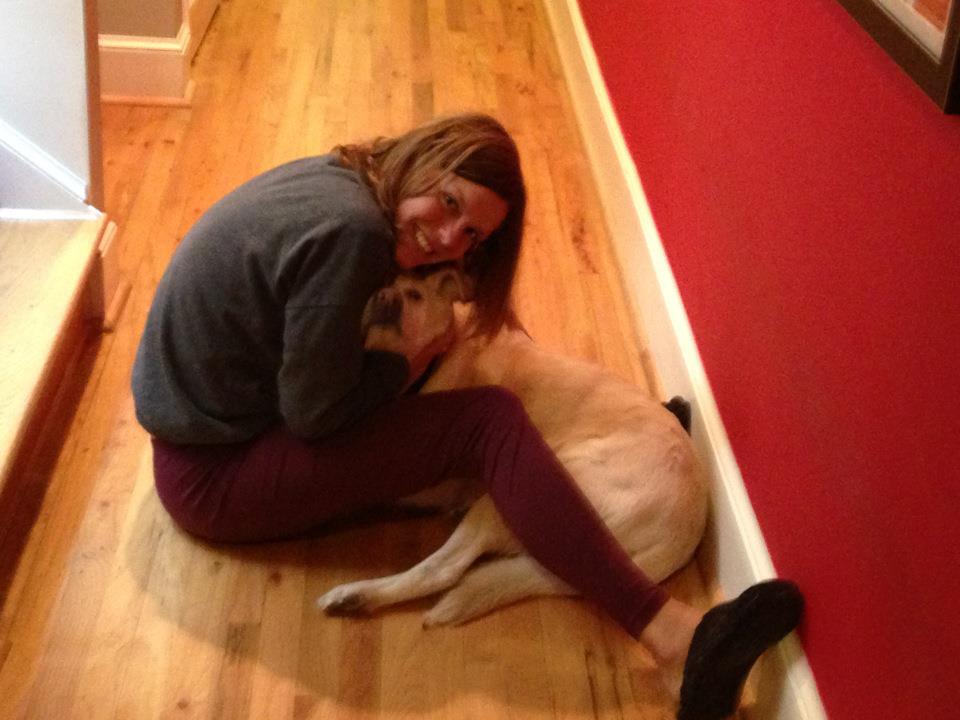
My husband kept his last name when we married; only our eldest dog, Auggie, chose to hyphenate. Augusta Matson-Johnson does what she wants.

“It’s a good sign when the dog who knows you best connects with your new wife,” I explained to my husband. He agreed. He and Auggie are the best package deal. Like Auggie, I have imagined so many ways to get through the banalities and indignities of daily life. Until a few years ago, I never could have dreamed of sharing it with a man as good as her owner, and her.

Mornings are exciting. After feeding the baby, I walk the dogs, then feed the dogs, then take a shower, then feed the cat. No one waits patiently for me to do this on my own timetable. Two labrador chins rest on my side of the mattress while I nurse, Auggie wanting her walk and Joon wanting her food. If it’s early, I will walk beneath the stars with the dogs, Auggie leading the way with her wagging tail while Joon searches for scraps of anything to put in her mouth. This time is a religion for me.

When we get home, breakfast time in the kitchen is Joon’s purpose in life. Auggie, not so much. Auggie often waits before eating. “She’s reminding us she’s not a dog,” my husband says. This was funny until she stopped eating.

Eventually, I fed her slowly on the floor, pellet by pellet, between my fingers. I did this two times a day around the time our baby was two months old. She took some of the food, so it was worth it. Then she stopped taking the pellets, even from my hands, even one by one. We came up with a series of elaborate rituals designed to stop the cat from eating her food, in case she might want it later. We started using wet food. She took it for a time, and then she stopped.

As a former anorexic, I can relate to the emotional tinnitus Auggie must feel: The stupid, hollow ring of someone’s well-intentioned and totally fucking clueless “Why don’t you just eat?” in response to obvious emaciation and declining health. I suspect there are many reasons why Auggie doesn’t just eat, many of them going beyond her arthritis and being almost 14 years old. But she is weak and we had to do something.

Saturday, we took her to the vet. He expressed surprise that she wasn’t falling over given her dramatic weight loss, and told us to start feeding her whatever people food she would take. He used the word “hospice.” And so, though my husband and I are both vegetarians since childhood and frankly find cold cuts to be disgusting, we now have a refrigerator full of meat.

I pick up some smoked turkey and it’s slimy. I roll it. I smile. I call for Auggie. And she eats piece after piece after piece. This is a time when I could start to get really sad, because I love this dog. But I love this dog. This is a dream come true for her. I am making her sandwiches, feeding her cookies, and giving her exactly what she wants. When she gets up, I hear her, and call for her to come my way, cheering, “Yay, Auggie!” She comes in a little less wobbly now, beaming. We are not sorry and we are not sad. Life is a present moment. It should be so fun.

229318_10151098443816559_292784131_n