Are Art And Activism Incompatible?

I’d just quit my job as an officer of the National Organization for Women (NOW). What did I do the next morning? I pulled my laptop into bed, and launched this blog. This sounds fairly anticlimactic, but it was a huge deal. I had pulled my old blog offline after being elected action vice president. Too much stuff was getting scrutinized by too many people.

The truth was, I felt horribly stifled. To be a spokesperson for the nation’s largest feminist organization was awesome, exciting, and an honor–and a lot of the time, it really fucking sucked. I was an activist and an artist. At the time of my election, just after my twenty-ninth birthday, I had been in a phase of life when I’d been deeply expressing my artistic side. But all that changed when I moved to Washington.

At the time I told myself that abandoning my writing was about the climate surrounding me. In Minneapolis, I’d been surrounded by artists. Those were my people, my friends. In Washington, I was surrounded with feminists and activists and political types. In Washington, what do you do? was the transactional question when you met someone. The question really meant this: what power do you have, and how can that benefit my agenda?

So, I basically stopped writing for three-plus years. I didn’t have the time to do it, because I was a workaholic. But I also didn’t have the frame of mind to do it, because as a primary spokesperson for NOW, I knew that everything I said would be taken as a reflection of the organization. There were many people out to get that organization. And the organization also had bitter infighting, over a variety of topical and identity fissures. One glance outside the invisible lines and the grenades would come.

Today I have found a healthier balance with work, life, activism, and art. I still apply myself to more endeavors than almost anyone I know, but that’s also just kind of what I like to do. It’s who I am. I like to do stuff. Life is short, and I like to live it.

I kept the same old crutch from my NOW days, though: I felt like my feminism and my writing had some serious incompatibilities. While I am most definitely a feminist writer and these things are intertwined, there is a tautology in movement life. There is much saying of the same things: a climate of stifling agreement. Even though in my current activist posture there are no longer decades worth of NOW resolutions of policies and platforms (many of them predating my life) I have to reflect throughout my words, as when I was in leadership there, I still find myself at times contending with the deep and incredible pressure not to challenge group wisdom as it exists in movement spaces. There are stories to be championed. Stories that fall outside those lines are often branded harmful.

The problem is, that’s not how life works. It’s certainly not how writing is supposed to work. You need to go for the truth, no matter how damn uncomfortable it is, or you’re writing absolute schlock. You need to let the words get away from you. Jean-Paul Sartre wrote in What Is Literature?

“A work is never beautiful unless it in some way escapes its author. If he paints himself without planning to, if his characters escape his control and impose their whims upon him, if the words maintain a certain independence under his pen, then he does his best work.” (160)

I was afraid to write freely. Might I write outside the lines? Would it get me cancelled?

I’d also felt a certain self-imposed pressure to downplay the work that I do as a writer, because would that mean that I might be perceived that I’m not committed to my professional leadership roles?

I’ve been in the process of getting over this. I’m beginning to see that I can integrate my life more, and that it’s okay for my nonfiction writing self and my fiction characters to reflect the messy that is real. I’m beginning to see that I can be an artist and activist at the same time, and that these things are not necessarily in opposition to each other, but rather, that they offer different outlets for expressing my desires for a better world.

One more Sarte quote from What Is Literature?:

“The ‘committed’ writer knows that words are action. He knows that to reveal is to change and that once can reveal only by planning to change. He has given up the impossible dream of giving an impartial picture of society and the human condition.” (14)

As I’m starting to see it in my newer integrated conception of myself, both art and activism are tools. They are not the same tools. I am not a writer in service of anything but truth, no matter how uncomfortable that truth may be. I still get to be a feminist when I do this. I’m also starting to understand it’s on me, too, to model the change I wish to see regarding the non-productive pressures for group-speak in activist spaces. Finally, I’ve stopped hiding in my professional life how much writing matters to me, personally, outside of work. These moments are liberatory.

This is journey of abandoning my own dogma (“my art and my feminism are in conflict with one another,” as I’ve said for years), and woo-ee, is it refreshing.

A Trip To Paris With Pictures And My Commonplace Book

During my first semester of my MFA program, one of my instructors assigned us to keep a commonplace book over the course of the semester. A commonplace book is a file of quotations. It had to be at least 25 pages, so I had to be a bit of a bunny with our assigned reading. I couldn’t slough it off until the last minute.

More than three years later, I’m still going strong, although I’m no longer doing it in a document in exchange for class credit. I now have a small Moleskin notebook. I write in it by hand. No one is assigning me this. I just love to do it.

Please meet my commonplace book, as it records my readings during my stay in Paris over the past week.

“I always say that you can not tell what a picture really is or what an object really is until you dust it every day and you cannot tell what a book is until you type it or proof-read it. It then does something to you that only reading can never do.” – Gertrude Stein, “The Autobiography of Alice B. Toklas”

I picked up a copy of Gertrude Stein’s “The Autobiography of Alice B. Toklas” at Shakespeare and Company, just behind Notre Dame. I read it in one day. Admittedly, this is the day we flew home from Paris, so I had time on my hands. Let’s talk about the above quote, because not only is it the ultimate validation for my quest, it’s fascinating. I reread it several times as I transmitted it to paper. She really spelled “can not” as two words the first time, and “cannot” as one word the second time. This was a woman of great intentionality. I refuse to believe she made this choice casually. What does she mean?

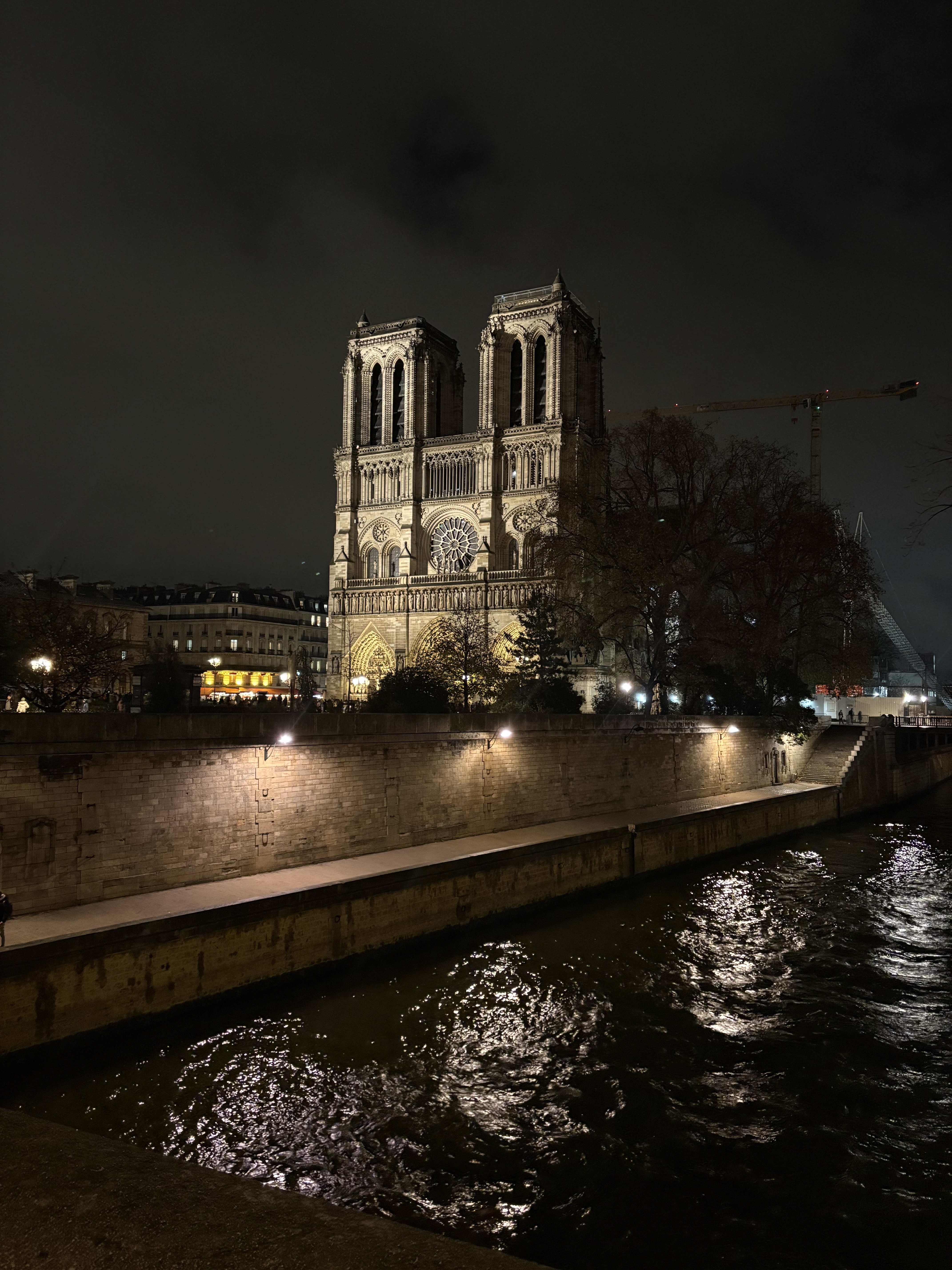
Notre Dame at night. We stayed at an apartment so close by, sometimes you could hear her bells.

I read Gertrude Stein’s poetry, if you can call it that, during the course of my program. It was inscrutable. It made me want to craft shoe leather out of the roof of my mouth, anything, anything to get away from her words. But “The Autobiography of Alice B. Toklas” was pretty good. I’m glad I gave it a try.

“A little artist has all the tragic unhappiness and the sorrows of a great artist and he is not a great artist.” – Gertrude Stein, “The Autobiography of Alice B. Toklas”

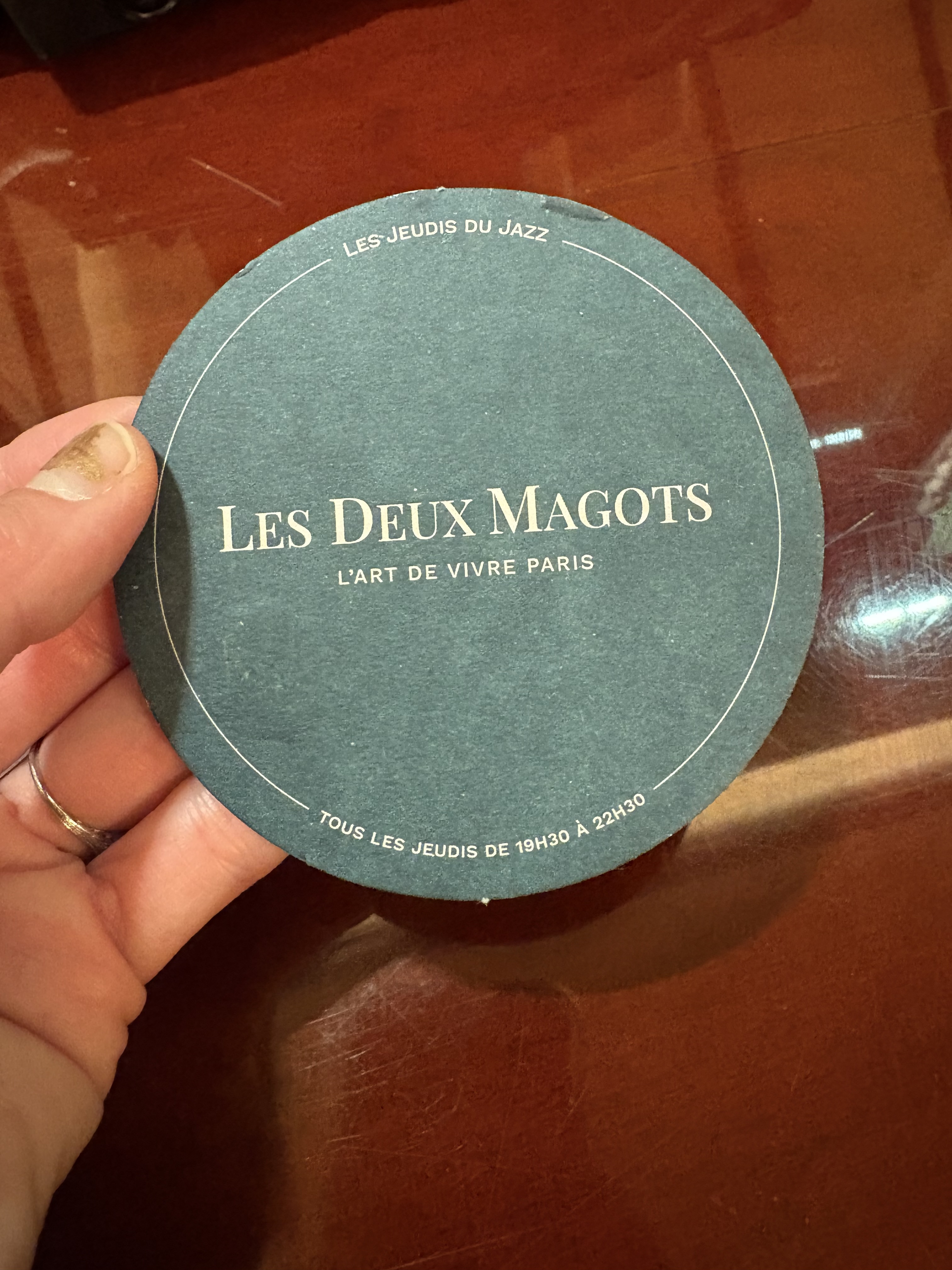
Ouch, Gertrude. A little close to home, yes? Me and my tragic unhappiness and sorrows, and sloppy prose. Alas. We went to Musee D’Orsay and the Louvre. There are no little artists featured there. I’m not much of a picture-taker, though. I delegate that to my husband. He loves a camera. Thus I took no pictures in the Musee D’Orsay or the Louvre. But I did take this photograph of a coaster at Les Deux Magots, where James Joyce used to drink.

What kind of idiot looks at fine art for several hours on two separate days, and takes no pictures, but does take a picture of a used coaster presented with her glass of red wine? Alack, a little artist.

I read two other books during the trip. Haruki Murakami’s “1Q84,” and Jean-Paul Sartre’s “What Is Literature?” Technically, I started Murakami at home, but the book is bigger than the telephone directories they used to give you for free. It was totally genius. The two quotes from the trip that I’ve put in my commonplace book I’ll withhold for now, as I may use them in a project I’m working on.

I also still have a bit to go with “What Is Literature?” Perhaps 70 pages remaining. Maybe 60. I read that immediately after finishing “The Autobiography of Alice B. Toklas.” I never got up from my window seat during that Air France flight. Why worry about blood clots when there is the threat of brain clots? These are the two books I purchased at the Shakespeare and Company bookstore. I worry that, like the maracrons purchased at the airport, I shouldn’t let Sartre go more than a few days if I hope to get back into it. It will be hard to finish that book in a not-captivity situation, but I’ll do it.

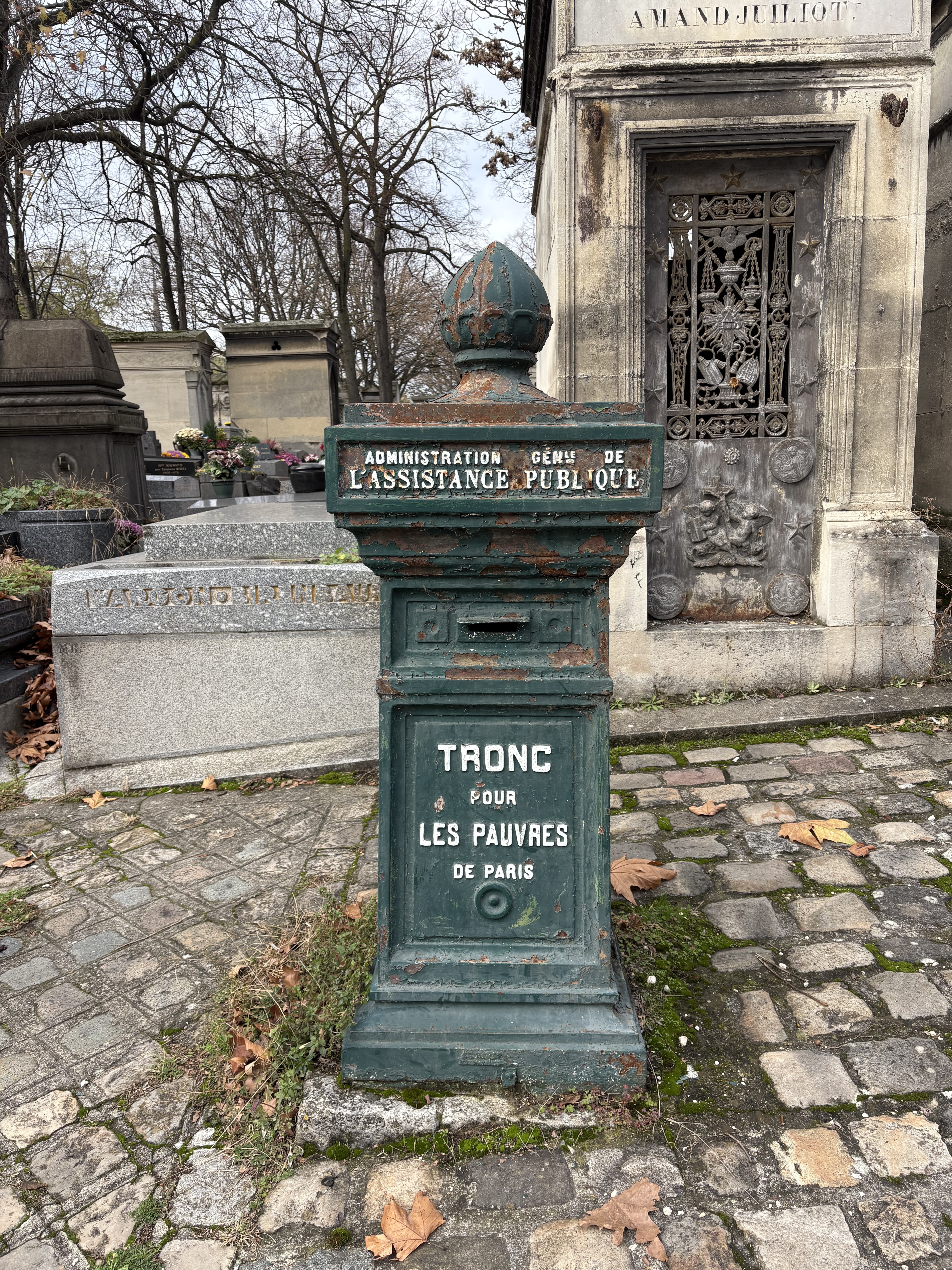
Things they do better in Paris, beyond the accurate “EVERYTHING” include public toilets and a genuine encouragement to give to the poor. This encouragement to donate sits inside the front gates of the Pere-Lachaise Cemetery. I didn’t take photos of these graves visited: Oscar Wilde, Jim Morrison, Edith Piaf, Frédéric Chopin. I was too busy looking at them.

Cemeteries are among my favorite places. I go in a cemetery a half dozen to a baker’s dozen times a month, and have been doing this for years. They are great places to still the mind, to explore, to run. Thus, Pere-Lachaise is the place we visited that was my favorite. No contest. I can’t believe how packed together everything was. Rotting grandeur is my favorite vibe. This one had it.

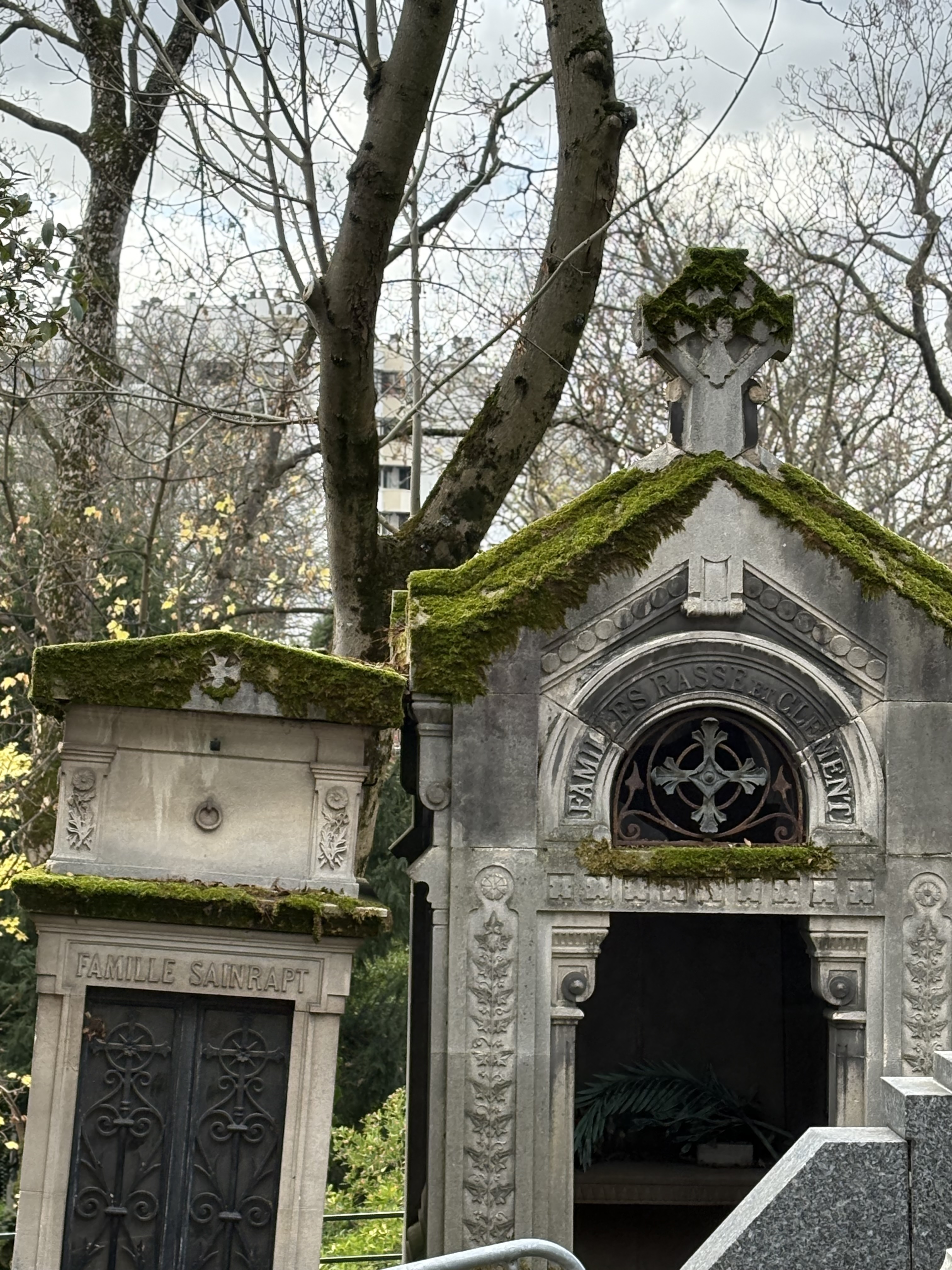
“You must have deep down as the deepest thing in you a sense of equality. Then anybody will do anything for you.” – Gertrude Stein, “The Autobiography of Alice B. Toklas”

It is possible to lean on one another in life, and in death. This is what I see in this image.

Reviewing my phone, I took seventeen photographs during my seven days in Paris. The first photograph was of kohlrabi for sale in a market. My small-town Minnesota grandmother loved kohlrabi. As they say, wherever you go, there you are.

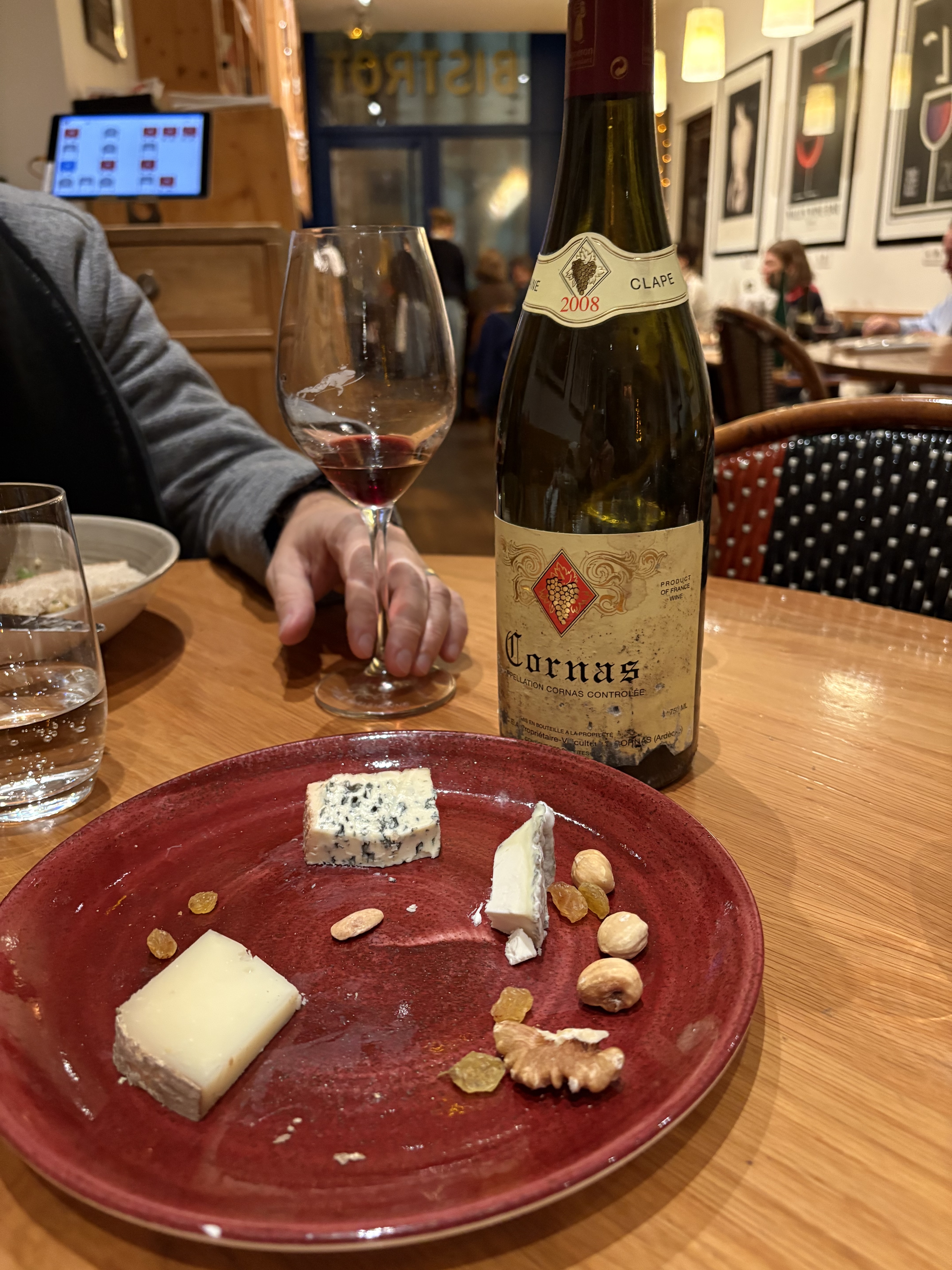
And that was me. Reading my books. Writing down quotes. Not taking many pictures. Eating croissants every day. Never looking once at social media (oh my God, yes). Drinking copious quantities of red wine. Not having Thanksgiving dinner because our family is vegetarian anyway. Rather, some nice wine and cheese.

This is what a nice Thanksgiving meal in Paris looks like when no one in your family eats flesh.

I was struck, landing at Charles de Gualle, and walking through customs, how different it felt to be in a country without fascist leadership. I felt much freer and safer than I did walking through U.S. customs on the way home. You never know what kind of shit they’re going to pull on the abortion people, and when.

But in Paris? I didn’t have to think about it.

What I’m Really Getting From My MFA Degree

I’m about to graduate with my MFA in creative writing.

I enrolled in my program because I wanted to become a better writer. On that level, I think I have succeeded. Here is what I’ve gained:

More rigor toward my own writing. When I turned in my thesis novel, I instantly knew that I needed another big project of that scale, or I would lose my mind. I have realized I like having something substantive to work on, and enough structure to make real. My program has taught me that big projects don’t just happen. I need to outline, have daily writing goals, have reading goals, and a game plan.

Acceptance that I need to revise things over and over. And over. Any first draft that I love, that I feel is on fire? It’s likely shit. My MFA program has helped me to understand that I am a horrible writer. Like, truly terrible. That I am only as good as my willingness to keep rewriting. Rewriting. Then rewriting, again.

An eye toward craft while reading. I’m a different reader than I was when I entered the program. I now am far more interested in how choices around point of view, voice, and narrative arc shape a story. I have grown obsessed with the choices authors make.

Reverence for the literary community. I now understand literary magazines, and what treasures they are. I understand how much work goes into editing. Publication. I’ve been a professional writer in much of my career, and with a fair degree of success, but I was not a literary writer. I now have appreciation for this whole other world, on the literary side.

Friends. Making new friends is no trivial matter when you’re 45! It’s been a rare gift to make a handful of close friends from my program. Friends who write! I read their stuff, they read mine. But the friendships are deeper than that. These relationships are life blessings.

An MFA degree is a degree no one cares about. As for me, it does nothing to advance my career or earning potential. I have already been a professional writer and communicator. Thus, this degree opens no doors for me. It could matter if I wanted to go on and teach at the university level. But I don’t.

Still, I’m super glad I did this. I’m proud. Though I admit I have senioritis. I’m ready to say, “it’s over.”

Soon. Three weeks, to be exact.

I’m Writing A Novel, For Real This Time

In my twenties, I quit my job several times to write a novel. The premise was: working was incompatible with writing a novel.

This assumption of needing to stop everything to write a novel is especially hilarious now. Fast forward to 45, when I’m writing a novel, for real this time. And leading a non-profit organization. And married with a school-age child. And providing elder care support as the only child of my lovely parents. And completing an MFA in creative writing. And chairing a board of directors. And volunteering with the school. And going to church. And running a few marathons a year.

Writing a novel while I’m doing an ungodly number of things is weird, but I’m actually doing it. I’ve puttered around the margins of this story for years, trying to write my way in. How many times have I started a new draft, a new outline? It was time that I needed. Because now, the real novel is on.

I’ve written hundreds of pages, and write four a day on average. Every day. No matter what. I have an outline I’m more than halfway through, and am 136 pages into the draft that is actually going to be the real first draft, the serious first draft. The first time I ran a marathon I started tearing up around mile 24 because I realized I was far enough to actually finish. I have reached this feeling with this novel. I trust it. I will finish this first serious draft.

How is this possible? Especially given the number of commitments I’ve listed above?

Here’s my secret: Writing my novel is actually the most relaxing thing I do.

It’s gotten to the point where I’m in out-of-body mode when I’m writing my novel. I just zone out and let ‘er rip on the page.

Perhaps I have reached the maturity to write in flow (I am a merciless self-editor) because I have finally come to accept the real thing they teach you in MFA programs. Everything you write is only going to be rewritten. Again. Again. And again. And just when you think you’re about done, someone new will tell you to take it from the top once more in this new way that requires more work, more time. (The never-ending workshops of the MFA are their own topic, but I will note with envy the wise words of one of my favorite colleagues in my program: “I hate these people.”)

I have an Oura ring, which is constantly mad at me, in its polite Finnish way. I have learned: My body is showing a physiological stress response pretty much all the time. For example: Folding laundry is especially rough on my stress levels, apparently. But this is not addressable. I am a mom. I am always folding laundry. This fact is only made worse by the fact that I’m a distance runner. Talk about heart rate. (In an amusing paradox, whereas my husband very much wants his Apple Watch to track every bit of exercise he does for tracking purposes, I sometimes take my ring off for a long run so it won’t dock my readiness scores for the next few days.)

The amazing thing is the proof of my novel love is in my pulse. Short of sleep, there is no time my body is more relaxed than when I am writing my novel. Interestingly, this doesn’t apply to other times I am writing (creatively or professionally) or working at the same computer and desk. But if my vanilla novel-writing candle is lit, and I’ve got my coffee cup beside me, and the for-real first draft is open, it’s on.

And this is how I know that I’m writing a novel for real this time. That I’ll actually finish. That it doesn’t matter if I have a million other things going on. Because writing the novel has become the best part of my day, and I miss it when I’m not doing it. I want to be in that seat even when the scene is sputtering. The novel is not an aspiration, a chore, or even an end. The process has become the point.

As with running, when I’m writing the novel I am free. In a trance. Who cares if it’s any good? I don’t think I’ve done anything as beneficial for my mental and physical health in years.

What Does It Mean To Be A Writer In The Trump Era?

I’ve been thinking on what it means to be a writer in the Trump era.

It means nothing good.

The latest salvo in the assault on the press out of the dictator-elect looks like a lawsuit against The Des Moines Register and others for publishing a poll that suggested Kamala Harris would win the state on election day (she didn’t).

This comes on the heels of a $15 million settlement payment from ABC to Donald Trump following a defamation lawsuit he filed regarding George Stephanopoulos’ characterization of E. Jean Carroll v. Trump, a civil suit in which Trump was found liable for sexual abuse.

To wind it back, so what does this mean for writers?

The next phase of Trumpism hasn’t even taken the reins yet, and it’s clear that speech is out for punishment.

As a hobby I study authoritarian governments and their effects on societies, and I think an instructive example is to look toward Russia, the country that gave literature Tolstoy, Chekov, Gogol … and then,

nothing.

There is nothing like a vindictive, hostile state demanding obedience to kill the publication of creativity.

I’ve also been thinking about the disturbing trend of book bans, and the edict in Project 2025 that school librarians be registered as sex offenders if the censors deem they have been providing sexually explicit material.

And I’ve also been thinking about trends within the left that also hamper free speech. I’ve noticed a definite uptick among colleagues and friends with concern that speaking out of turn will lead to getting cancelled. This is quite frightening at a time when the left needs to robustly champion open and free debate. The right is sure as hell not going to do it.

I’ve heard it said before, “reading is thinking on the page.” So, too, is writing.

So here’s what I think: To be a writer in the Trump era–a writer, not a sycophant–is going to require taking creative risks at even greater levels than before. It is an audacious thing to believe one has something to contribute. Only growing moreso.

I Actually Have No Idea How Fast I Am Going

I write about running a lot, because I run a lot. Perhaps too much. It is entirely possible that my running is detracting from my writing. It used to be the case that when I got up early, I would write. Now when I get up early, I run. Or I start working on my job so that I have time to run when it gets light outside. If I’m being honest, I have too many [waves hands] hobbies.

But running gives me energy. That feeds my ability to write. And my ability to give my best thwack to fighting the hateful ideas behind gender-based oppression, which, tbh, is not an easy nutcracker to ballet.

I work out many ideas on my feet.

I am a middle-age recreational lady runner. For that demographic, I take it seriously. For years I’ve kept a daily journal noting time, distance, pace. I schedule my runs. I compete against myself like whoa. (The only person you’re ever really competing against is yourself, I’ve learned. All these lessons are for running and so much more.)

One thing I’ve been focusing on is my speed. Training myself to run faster is fun. In this process, I have realized that I actually have no idea how fast I am going. Sometimes, I look at my device and realize I’m going like a minute per mile faster than I thought I was. Much more often, I think I’m going fast, and I’m like slo-mo runner in actuality.

I think to the times in my life when I’ve crashed or burned out, and how this lack of self-awareness about self in relation to time and space chases me. Me chasing me without realizing I’m doing it. But also how there are times that I think I’m going fast when actually, it’s an illusion and I need to buck up to hit the mark.

To know oneself in relationship to an actual measurement of velocity is somewhat akin to the experience of seeing yourself on video. This is how I look from outside the blinders of my body? Really?

Sometimes I think I can understand others better than I can myself. And to be clear, I’m constantly confuzzled by others. Who is this me in the sneakers? How fast is she going? I dunno.

Another Semester Of Grad School Complete

Tonight, I finished my final “normal” semester of my part-time, low-residency graduate MFA program. By this I mean, I am done with my last regular class. This end came unceremoniously, in the parking lot outside my daughter’s gymnastics, with me hunched over my laptop in the dark in the passenger’s seat, using my hotspot from my phone. I responded to the required reading for the week. I have already turned in my final project early.

It is best to turn things in early when you’re a sandwich-generation student working a full-time job. You just never know when real life will blow up. In my experience it does all the time.

The more time I spend studying writing, the more I come to believe I have no business writing. Or that I have no business doing anything but writing. The absolutes come flying at me strong, and with feeling, as if by embracing the extremes I can avoid the dull reality of what it means to keep up with the work and the laundry on a regular basis.

Next semester, I start thesis. I will do this for two semesters. My thesis is a novel I have been trying to write for years.

I know I will emerge with this degree, and this novel draft, one year from now. And I accept that I’ll probably have to revise that draft eight times or more after the degree is over.

What I’m learning most of all in this program is that it’s not about writing, which I have always done. It’s about revision. It’s about ruthlessly staring at your own words and asking how they could be better. About excising the phrase you thought was so clever. About building the eye, and then the courage, to find and eliminate that wicked phrase. And to sharpen the next one. And to try rewriting the whole damn piece, again. A fourth time.

And it’s also about managing to do all that ego-whipping grunt work when the parking lot of your child’s activity is the only available option to getting it done. I’m continually struck, reading male authors, how little they talk about the needs of daily life, of interdependence, cohabitating with their precious writing time. This imbalance is part of what inspires me to keep going.

Running With A Coaching App: Clippy In My Ears

I run four times a week. Sometimes I run in silence with a GPS watch. Other times I run on the treadmill, watching news or movies. Most often I run outdoors listening to music.

I’m a bit of a codger. I oppose the Apple Watch. I don’t track myself on Strava. I do use the Nike running app. It’s generally a good app. It integrates well with Apple Music. It tells me I’m awesome after I finish a run.

Or, more accurately, one of the Nike Plus running coaches tells me I’m awesome. They don’t say anything until I stop the run, stop the music. “Save some miles for me,” Mo Farah pleads. Coach Bennett tells me “the run is done.”

The app seems to really, really want me to go on guided runs with the coaches rather than to listen to my own music. Guided runs are recordings where the coaches follow you the whole way, talking through your music. I’ve looked at these runs with trepidation for years. What? Why? During my alone time?

In December Rivka Galchen published a great short story in The New Yorker, “Crown Heights North,” that clearly takes some inspiration from the Nike running app, though Nike is not named. It is May and I am still regularly thinking about this story.

A man is dead and he starts running with the app. The dead man runs around New York City, thinking deep thoughts with the assistance of a coach.

Last week, after four years of using the app while avoiding guided runs, I gave Coach Bennett a try. He seems like a nice man. I have no animus. But dang, he was invasive on my run! He gave me prompts to stew upon my life. Then he repeated those prompts. Then he kept coming back with more prompts. It was not coaching about running, mostly. It was about bringing up my self-esteem, letting me know I’m okay, you’re okay, and we can all be okay together. I appreciate that. It’s good and it’s right. But I prefer Barney and Sesame Street for that type of thing. When I’m running I like to rock out to Metallica.

I found the effect of a running coach in my ears to be one of Clippy, that invasive ‘helper’ popping up on the screen on retro Microsoft products. “Hi!” (Smile.) “Try this!” (Bounce.) Clippy in my ears broke the sanctity of my run. Hacked my flow. Getting continuously told to be inspired made my run feel longer and harder, not shorter and easier.

Me, Graduate School, Middle Age, The Big Box Store

Doing graduate school in middle age is strange behavior. No one is waiting for the graying to burst into our respective fields screaming, “I have arrived.” I am in the process of pursuing an MFA in creative writing at Mississippi University for Women. It is a strange choice to wallop homework into my life, and I stand by it, even though more appropriate behavior for my demographic (working mother, aging parents) entails flossing away what little time remains at the big box store.

But graduate school has not changed this fact. I continue to spend time in the big box store. I do a number of big box stores on a regular basis: the discount store, the book store, the sporting goods store that under the leadership of a woman CEO has made it harder for school shooters to buy their guns and ammo there. My daughter, who is ten, begs to go to any varietal of big box store with me because then she can beg that I buy her everything inside the store. Earlier tonight we went to the supermarket in the big box store complex and I caved. I let her get the Gingerbread House Cinnamon Toast Crunch on clearance. I am a sucker for a deal at the big box store. My daughter knows this. It is why she has a discontinued Harry Potter pen projection light from Marshalls, where I went last weekend to pick up a cheap blanket for the dogs.

The big box store in late-stage capitalism America bears similarity to middle age. Time accelerates and slows in perplexing ways, and I buy things that wouldn’t sell a few seasons ago at a lower price even though I struggle to close my chest of drawers. I am old enough to remember a time when it seemed flashy for big box stores to have soaring facades above their entrance not backed by actual levels/floors of the building structure itself. At 43 I am old enough, and moneyed enough, to have tried Botox on my forehead once. It was fine but it dissipated after a few months, and I doubt I’ll do anything like that again. Earlier tonight, in the parking lot by the shopping cart carrels, my daughter asked me why I said aging is a feminist issue. My voice shifted to its ‘spirited steed’ gear and I told her we could talk about that on the drive home. She then commanded I explain the concept in 10 words or less. I said, no.

Aging is a feminist issue because women and girls are subject to pressures on their appearance that are unrealistic, make us feel bad, and consume our time, I said. Aging is part of this, and especially for women, I said. My daughter told me that’s too many words. Fine, I said. I’ll explain it in two words: total crap. She squirreled in the backseat and we kept bickering about aging, feminism, and how many words I am allotted to express my ideas to her about politics. God I love her.

I find that to age out loud is a political statement. It is a statement I am making. I am not afraid of my age. I am proud and lucky to be here.

But it is a special type of lunacy to be in graduate school when time is as comparatively limited as mine. The reality of doing graduate school part-time in middle age while working full-time and doing sandwich generation as a fucking prickled verb looks like:

+ Me completing homework in the car in the parking lot outside of gymnastics practice

+ Me responding to emails from the school at the speed of crawling, from a baby who hasn’t learned to sit up yet

+ Me dashing off portfolio of work for the semester in the lobby of a hospital skilled enough to keep old parents old, rather than dead

I would like to revise my statement that it’s not lunacy, but rather optimism or maybe self-love that keeps me in graduate school. To believe that I can improve for the sake of improving, and to commit to doing it, is a gift. I love becoming a better writer. I’ve got a big box store of a brain full of stories and poems and essays I want to improve. I know time is precious, that it runs out. To acknowledge that and keep going in earnest as myself, this spirit attached to a woman with caregiving and professional responsibilities, is the sacrilege that interests me.

How To Be A Better Writer

I get away with things because I write. An ability to write well is power — to lead social change, to challenge assumptions and disrupt the status quo, and to validate your own feelings when other people won’t.

Writing is important to the feminist project for several additional reasons. Historically, writing has provided an outlet for women and marginalized people who had talent but were not eligible for other public roles because discrimination — and to an extent that continues today.

Writing is a way to share experience and theory, imagine alternate realities, and learn from one another. I’ve been saying for years that I believe it’s a radical act each time a woman tells the truth about her own life. Often those radical acts feel more comfortable in written form.

Recently I attended a networking event where a young woman shared that she wasn’t sure what she wanted to do after college. I asked about her interests and she said she liked to write. I encouraged her to keep pushing herself in her writing ability — it would serve her well no matter where life took her.

In that spirit, I’m offering my tips for how to be a better writer:

Read. Read books, newspapers, magazines, blogs, lyrics, Tweets, manuals. Read promiscuously. Read outside your ideology. Challenge yourself — I read Ulysses at the gym, sob — and enjoy your teen lit without shame. Buy women authors, because feminism. Just read.

Write. The way to be a writer is to write. If you say that you want to be a writer, you’re either procrastinating or speculating. Anybody who sits the fuck down and writes is a writer. The way to become a better writer is to keep writing.

Give yourself permission to be yourself. This is at least as much life hack as writing tip, but don’t try to be other people/writers! Do not worry that you do not have their perspective! You have your perspective. It matters and you deserve to share it.

Identify your narrative arc.  It can be helpful to crystallize in your mind what drives your writing. Over a decade ago I realized that one of my chief aims as a writer is to expose uncomfortable truth. I believe acknowledging things we’re not supposed to talk about takes power from oppressive systems and redistributes it to individuals. Plus honesty feels great and helps me sleep. Not all of my work fits in the uncomfortable truth category, but I do find it helpful to remind myself why I do this work. In a few words, why are you doing yours?

Do not try to sound smart. If you’re writing to be understood by smart people, you’re lost on the side of a bad road. Make it excruciatingly easy for people to understand what you’re writing. Save the fancy words for standardized tests. (You’re still taking those? I’m sorry.) Do not assume people know the basics of your topic. Organize. Clear, concise, thorough — you win.   

Most descriptive language should go away. Adjectives and adverbs mostly dilute meaning. For that matter, be ruthless in cutting words from your drafts. Say what you mean, and say it with fewer words.

Find your weaknesses. One year I resolved to stop using the word “just,” which was all over my speaking and writing. Are you awkward with commas? Identify your crutches and work on them. Which brings me to my next point:

Invent challenges for yourself. I’ve done so many fun things over the years to keep my writing fresh. Poem-A-Day competitions with friends, National Novel Writing Month. Trying to write a screenplay (holy fail). But the best challenges I invented to directly attacked my weaknesses. For instance, I recognized that in my fiction, my characters sucked. So I took a whole month where I forced myself to write a new character every day. Some days it took the form of a poem, an article, a press release, a speech, a flip book, or more often a short story.

Dabble in other kinds of writing. I’ve taken spoken word poetry classes, fiction writing classes, and workshops on placing columns. Getting out of your lane strengthens your voice in your primary writing arena. It shakes up your thinking and it’s fun. 

Find editors who hate you. Actually please don’t seek out anyone who hates you. But the good editors are the ones who will challenge you to make revisions that make you roll your eyes in irritation. I have learned the most about writing from people who redlined me to tears.

Laugh at your old writing, and celebrate your resilience. I have successfully completed one novel, and that’s the only successful thing about it. It’s so bad I want to present myself to the jail a few miles away to show I’m sorry. I read grandiose things I used to write and cringe. I’ll probably read this post next week and do the same. Life is growth. Keep moving. Thank goodness.

Keep at it, and encourage others to do the same. I was in love with someone who showed me his writing. It was so bad! (To be clear, I’ve loved folks who showed me writing that was intimidatingly good, so please give yourself the benefit of the doubt in the event you’re an ex-lover perusing the blogs I am now writing, at age 35, late on a Friday night.) Yet he was so vulnerable. I didn’t know what to do, so I encouraged him on the few good parts of what he was doing. He actually got a lot better.

We should be so gentle with ourselves. Treat yourself like someone you love — encourage the areas that really work, and turn off the critic that focuses on the shit surrounding it. Coax the good stuff out and rely on what you learn from people who edit you to prune the rest.

Keep writing and you will get better.