It is dangerous to present progress for women as an achievement of the past, but hey, it happens all the time. Today’s women’s movement is rife with nostalgia.
My argument is not that sharing stories is bad, nor that people with wisdom and experience to share are useless; in fact, education about the women’s movement throughout history and tapping into the talent of feminists of all generations is a vital part of moving forward.
But there is a line where the pursuit of an action agenda turns into a reflection on the past as an end in itself. Too often, that line is crossed.
Here’s just one tangible example (good grief, there are many): A few years ago, I attended a meeting of advocates working toward the ratification of the United Nations Convention on the Elimination of all forms of Discrimination Against Women (CEDAW). The woman opening the meeting said — I see the faces of all the people who’ve been talking about this with me since the ’80s. Who is new to this issue?
This statement wasn’t welcoming, undermined the knowledge of people who may have worked on the issue for years or even decades after the ’80s, and failed to place the emphasis where it belonged — the accountability of current elected officials holding the power and obligation to ratify the women’s treaty today.
The results of nostalgia-dominated feminism are manifest: newcomers are silenced, others choose not to come back, and above all swapping memories takes the place of working together to set and achieve goals. This environment creates a vacuum where a movement is supposed to be. What is understood to be feminist action turns into a largely fear-based electoral push to “protect” the gains of the past by electing Democrats and defeating the guys who say rape isn’t so bad because then you get a baby.
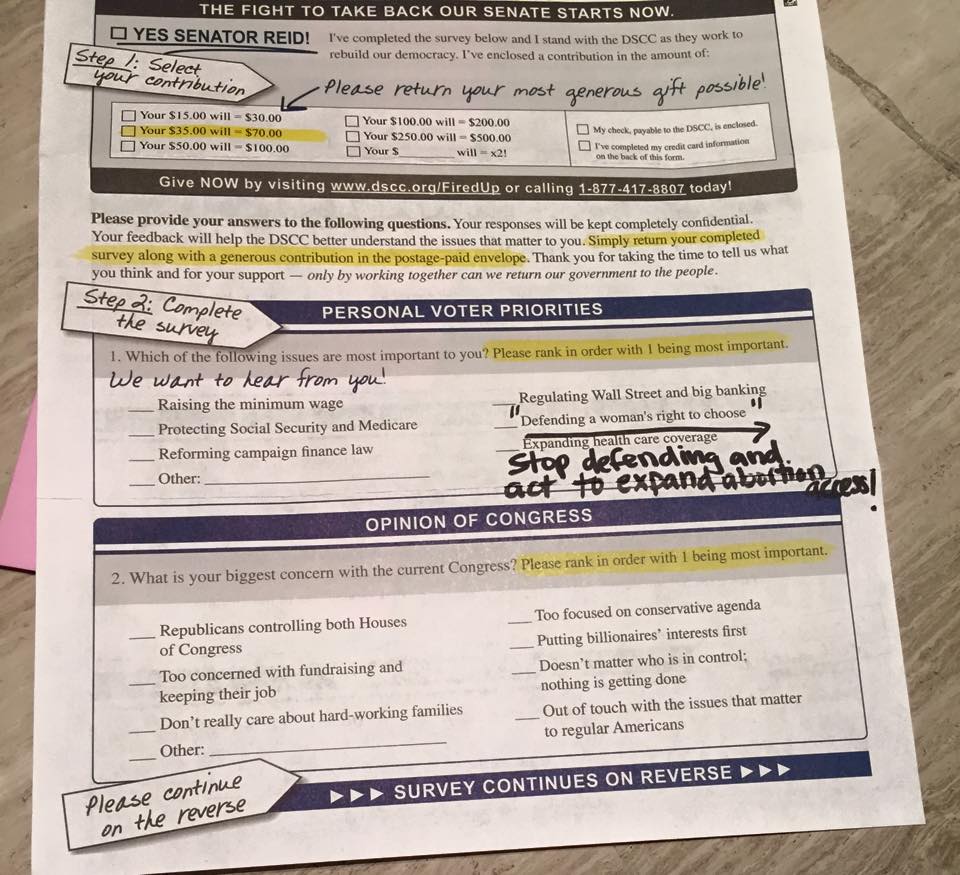
Recently Senate Minority Leader Harry Reid sent me a letter that pretty much says it all:
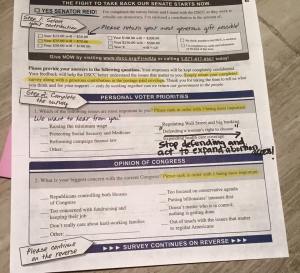
(You bet I wrote back to him!)
The voter priorities suggestions are instructive. We can — and should — raise the minimum wage, reform campaign finance law, regulate Wall Street and big banking, and expand health care coverage. These are all positive goals, and activist goals at that. (Beyond the abortion whopper, WHICH WE’LL GET TO NEXT, notice that the only other negative statement of priority refers to “protecting” Social Security and Medicare. Figures. Expansions to these programs would disproportionately benefit women, since women tend to live longer and have fewer savings.)
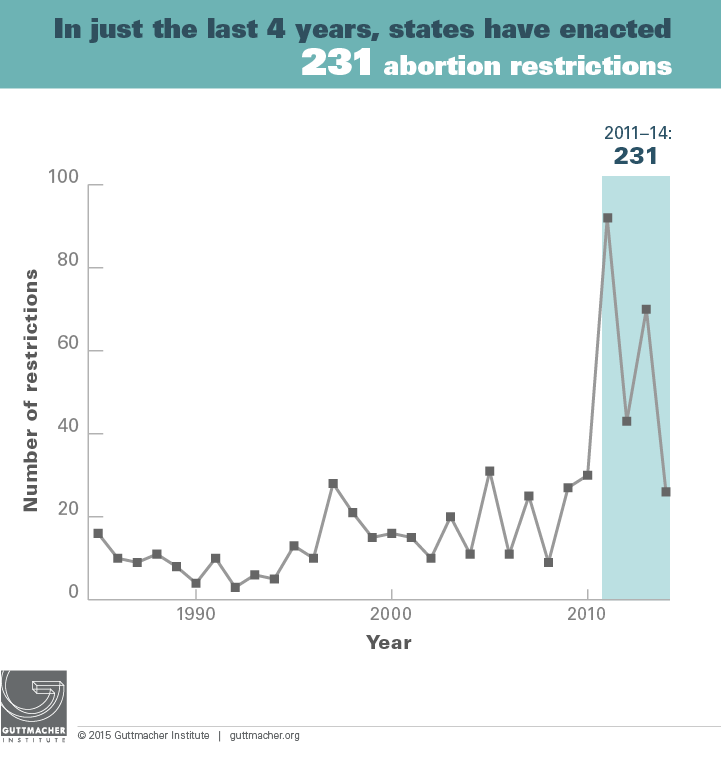
But “defending a woman’s right to choose” is laughable because people are faced with a reproductive health care crisis today in large part due to very new laws that restrict the human rights and dignity of women.
Abortion clinics are closing, y’all. Terrorist group Operation Rescue claims that three out of four abortion clinics that were open in 1991 are no longer open today — and that 73 clinics closed last year.
So when Harry Reid sends out a mailer in early 2015 saying we need to “defend” a woman’s right to choose, I frankly wonder what the Jupiter he is talking about. How much is left to defend? The financial and logistical barriers to abortion created and approved by elected officials of all parties means this country is filled with women who can’t “choose” their way out of a one-way street.
And while the abortion crisis is grave, and our elected officials who claim to care should stop reminiscing about a court decision from four decades ago and start working to expand abortion access, abortion is just one of so many things needed to ensure the full participation of women as equals in society.
Hanging our hats on the achievements of the past isn’t going to cut it; proactive action is the sauce. The United States needs paid parental leave like whoa. More than 5 million people don’t have health insurance because 22 states have failed to expand Medicaid. The new report from the Department of Justice makes it clear — it’s time to fire the Ferguson police department and start over. How about an Equal Rights Amendment? We could go on.
I am talking about external, observable realities that can be seen by those outside the women’s movement, but the Democratic Party’s ‘throwback feminism without big, bold goals’ is absolutely related to what happens within explicitly feminist quarters.
Just earlier this week I attended a woman-focused gathering where a contingent of the room directed much of the conversation around their stories from the 1970s and ’80s. The stories were interesting, to be sure; but what I frankly don’t know is whether the women doing that hard work in the 1970s and ’80s spent as much of their time being told what happened in the ’30s and ’40s. My suspicion is that they spent much of their time focused on deconstructing the realities of their present and demanding a better future — which is how we will win now.
An over-reliance on the past is dangerous because much of second-wave feminism has become, ironically enough, a conservative position — within the movement and beyond. There aren’t many people who will look you in the face and tell you women’s shouldn’t be equal, and this holds true even for most of the people who push the most anti-woman policies.
Nostalgia is also dangerous because however important the gains of the past were, they were incomplete. Women have never achieved parity in this country, and the gains of the women’s movement have always centered around the needs of white women with money at their disposal. Hanging our hats on the progress of the past is a pathetic agenda for the present.
Finally, needs evolve over time, and that’s a good thing. Twenty years ago the Vagina Monologues was revolutionary; today many young people find that language limiting and exclusionary toward transgender people. (I wrote about this issue at length over at RH Reality Check.)
At the same time, we do need more history.
Women’s lives have been systematically excluded from history curricula, and everyone (boys and girls) should be taught about them in schools. March is Women’s History Month; that’s cool, but it would be nice to have all year.
In particular a deep examination of the strategies and tactics that produced gains could prove extremely beneficial to those working for change. For example, my friend Zoe Nicholson’s examination of Alice Paul’s life and strategies is electrifying, and I think about it often in the context of my organizing work today — read about Miss Alice Paul here.
The line between nostalgia/sentimentalism and drawing upon history to kick ass for the future is often difficult to draw. But it seems that, as always, women as a whole stand to benefit from making painful attempts to grow toward more accountability, and the inclusion of new perspectives, within the women’s movement.

 Erin Matson