
I appeared on PBS’ To The Contrary, and discussed weight-loss drugs and their impact on culture, and AI slop. Watch here:
Tag: feminism
January 2026 To The Contrary Appearance
I appeared as a panelist on PBS’ To The Contrary, and discussed hiring bias against women on LinkedIn; and leadership at the United Nations. Watch here:
We Should All Be Worried About The State Of Feminist Infrastructure
“The initial Trumpean protests were largely unfocused and self-satisfied. They had limited structure and deficient leaders–if they possessed leaders at all. The Women’s March crumbled away. Black Lives Matter devolved. Serious organizers sat at the helm of the civil rights and feminist movements of the 1960s and 1970s, and material change was won. The upsurges of the 2010s and 2020, when George Floyd was killed, amounted to spectacle and little else. Some laws did change on the criminal justice front, and progressive prosecutors were swept into office, but there was little thought given to the long term, to building durable organizations that would outlive the boom times. Movements cannot rise on froth alone.” – Ross Barkan, “Facism or Genocide: How a Decade of Political Disorder Broke American Politics”
In these waning days of 2025, there is much to be worried about. I am not advocating unmitigated despair: There is also much to be joyous about in the confines of our own lives, if we are willing to look for those reasons to smile, to love, to be (and we should!). But if we’re talking about the republic of the United States, the democracy we are at least on paper supposed to be, we are not doing too well. An authoritarian is president; Congress has all but abdicated its authority; the judiciary, stacked by that same authoritarian in his first term, seems to consider itself along for the ride.
I am a lifelong feminist, and a feminist organizer along with being a writer, duh. And so, I take an explicitly feminist lens. When I lay the facts side by side that feminist infrastructure is weak, and that we are in this authoritarian moment, I grow very concerned.
Because women’s movements are one of the chief tools we have to fight against autocracy. The reason why repressive governments crack down on women and sexual minorities first is not just culture wars, it’s a mechanism of control. For organized women are very powerful.
Do you know it might be a crime to look up and watch Pussy Riot videos in Russia? This is not some random thing. Dictators hate feminist women. They are terrified of us.
Recently, a friend who I respect very much, who participates in organized feminist work, and writes, but what is unique about her is her willingness to take radical direct action whether or not people support her, this friend posted on social media about the weakness of the feminist movement. She is right to be concerned. I had replied at the time that I saw it, too. That we are weaker today than we were ten years ago, when there were people marching in the streets, when there was a cultural feminist moment. We are in the midst of a cultural backlash with trad wives and super skinny heroin chic all back. Hell, we can’t even teach women’s studies in a number of the universities anymore (and of course these attacks are quadrupled on DEI, and women of color–Black women in particular have been disproportionately fired from the federal workforce by unqualified Elon Musk backpack dudes).
But also, we are in a time where are organizations have dwindled greatly. Root causes include a variety of issues, including but not limited to infighting, lack of sustained investment, and the false mirage of so-called ‘leaderless organizing’ (which is never as egalitarian as it professes to be, since when there is no leader, the unspoken power that is wicked powerful takes the wheel, but everyone denies it at the same time). What’s more, we now have a president who wants to decimate the primary sector that supports structured feminist organizing, which is 501(c)3s.
To be very clear, I don’t think a non-profit or a set of bylaws is what makes a movement, but I also think we unabashedly need structures. I want women in particular to get serious about tending to and building our feminist structures. If we’re going to fight, we need to methodically build capacity.
Some are doing this work.
But as of right now, it’s not enough to break through. Given the overwhelming power of organized women in fighting back against autocracy, that makes the low-infrastructure state of feminism everyone’s problem.
Are Art And Activism Incompatible?
I’d just quit my job as an officer of the National Organization for Women (NOW). What did I do the next morning? I pulled my laptop into bed, and launched this blog. This sounds fairly anticlimactic, but it was a huge deal. I had pulled my old blog offline after being elected action vice president. Too much stuff was getting scrutinized by too many people.
The truth was, I felt horribly stifled. To be a spokesperson for the nation’s largest feminist organization was awesome, exciting, and an honor–and a lot of the time, it really fucking sucked. I was an activist and an artist. At the time of my election, just after my twenty-ninth birthday, I had been in a phase of life when I’d been deeply expressing my artistic side. But all that changed when I moved to Washington.
At the time I told myself that abandoning my writing was about the climate surrounding me. In Minneapolis, I’d been surrounded by artists. Those were my people, my friends. In Washington, I was surrounded with feminists and activists and political types. In Washington, what do you do? was the transactional question when you met someone. The question really meant this: what power do you have, and how can that benefit my agenda?
So, I basically stopped writing for three-plus years. I didn’t have the time to do it, because I was a workaholic. But I also didn’t have the frame of mind to do it, because as a primary spokesperson for NOW, I knew that everything I said would be taken as a reflection of the organization. There were many people out to get that organization. And the organization also had bitter infighting, over a variety of topical and identity fissures. One glance outside the invisible lines and the grenades would come.
Today I have found a healthier balance with work, life, activism, and art. I still apply myself to more endeavors than almost anyone I know, but that’s also just kind of what I like to do. It’s who I am. I like to do stuff. Life is short, and I like to live it.
I kept the same old crutch from my NOW days, though: I felt like my feminism and my writing had some serious incompatibilities. While I am most definitely a feminist writer and these things are intertwined, there is a tautology in movement life. There is much saying of the same things: a climate of stifling agreement. Even though in my current activist posture there are no longer decades worth of NOW resolutions of policies and platforms (many of them predating my life) I have to reflect throughout my words, as when I was in leadership there, I still find myself at times contending with the deep and incredible pressure not to challenge group wisdom as it exists in movement spaces. There are stories to be championed. Stories that fall outside those lines are often branded harmful.
The problem is, that’s not how life works. It’s certainly not how writing is supposed to work. You need to go for the truth, no matter how damn uncomfortable it is, or you’re writing absolute schlock. You need to let the words get away from you. Jean-Paul Sartre wrote in What Is Literature?
“A work is never beautiful unless it in some way escapes its author. If he paints himself without planning to, if his characters escape his control and impose their whims upon him, if the words maintain a certain independence under his pen, then he does his best work.” (160)
I was afraid to write freely. Might I write outside the lines? Would it get me cancelled?
I’d also felt a certain self-imposed pressure to downplay the work that I do as a writer, because would that mean that I might be perceived that I’m not committed to my professional leadership roles?
I’ve been in the process of getting over this. I’m beginning to see that I can integrate my life more, and that it’s okay for my nonfiction writing self and my fiction characters to reflect the messy that is real. I’m beginning to see that I can be an artist and activist at the same time, and that these things are not necessarily in opposition to each other, but rather, that they offer different outlets for expressing my desires for a better world.
One more Sarte quote from What Is Literature?:
“The ‘committed’ writer knows that words are action. He knows that to reveal is to change and that once can reveal only by planning to change. He has given up the impossible dream of giving an impartial picture of society and the human condition.” (14)
As I’m starting to see it in my newer integrated conception of myself, both art and activism are tools. They are not the same tools. I am not a writer in service of anything but truth, no matter how uncomfortable that truth may be. I still get to be a feminist when I do this. I’m also starting to understand it’s on me, too, to model the change I wish to see regarding the non-productive pressures for group-speak in activist spaces. Finally, I’ve stopped hiding in my professional life how much writing matters to me, personally, outside of work. These moments are liberatory.
This is journey of abandoning my own dogma (“my art and my feminism are in conflict with one another,” as I’ve said for years), and woo-ee, is it refreshing.
Fact Check After Texas A&M Censors Race And Gender Studies: I Have A Women’s Studies Degree, And I Am Successful
Texas A&M censored gender studies last night. According to The New York Times, the regents have spoken with a unanimous vote: courses are not able to “advocate race or gender ideology, or topics related to sexual orientation or gender identity” without direct approval of the university president. One regent, Sam Torn, said:
“Curriculum is created and approved based on the accepted body of knowledge needed for our students to be successful in their chosen profession. It is unacceptable for other material to be taught instead.”
I hold a bachelor’s degree in women’s studies, and thus am in a position to speak from direct experience. (Technically, I hold an interdisciplinary studies degree with a concentration in women’s studies, because that was the closest Georgetown let its women’s studies program get to recognition.)
I consider myself to have had a great deal of success in my chosen professions. I have written for Fortune 500 companies, landed and held competitive advertising creative jobs, started an organization that I have led for 10 years, served as an executive officer of the national organization for women, published work in a variety of local, national, and literary publications, and in less than a month, I’ll complete my MFA in creative writing.
I have been blessed to have a varied and rich career path, and the foundation of what I learned toward my women’s studies degree is a direct contributor to my success — I took courses in English, history, linguistics, law, psychology, and sociology that counted toward my degree. I have learned that everything counts, and that critical thinking skills are the key tool to success. The real world is multidisciplinary, too.
Academic censorship of gender studies (and race studies) has nothing to do with preparing students for meaningful careers. Rather, it’s a reflection of the authoritarian environment in which we live. The government is placing enormous pressure on our public institutions, in order to control what we think.
The goal is total control. It’s terrifying. And yes, authoritarian governments always come for the women, the sexual minorities, and the people of color first.
The Marathon Where I Let Go And Had The Time Of My Life
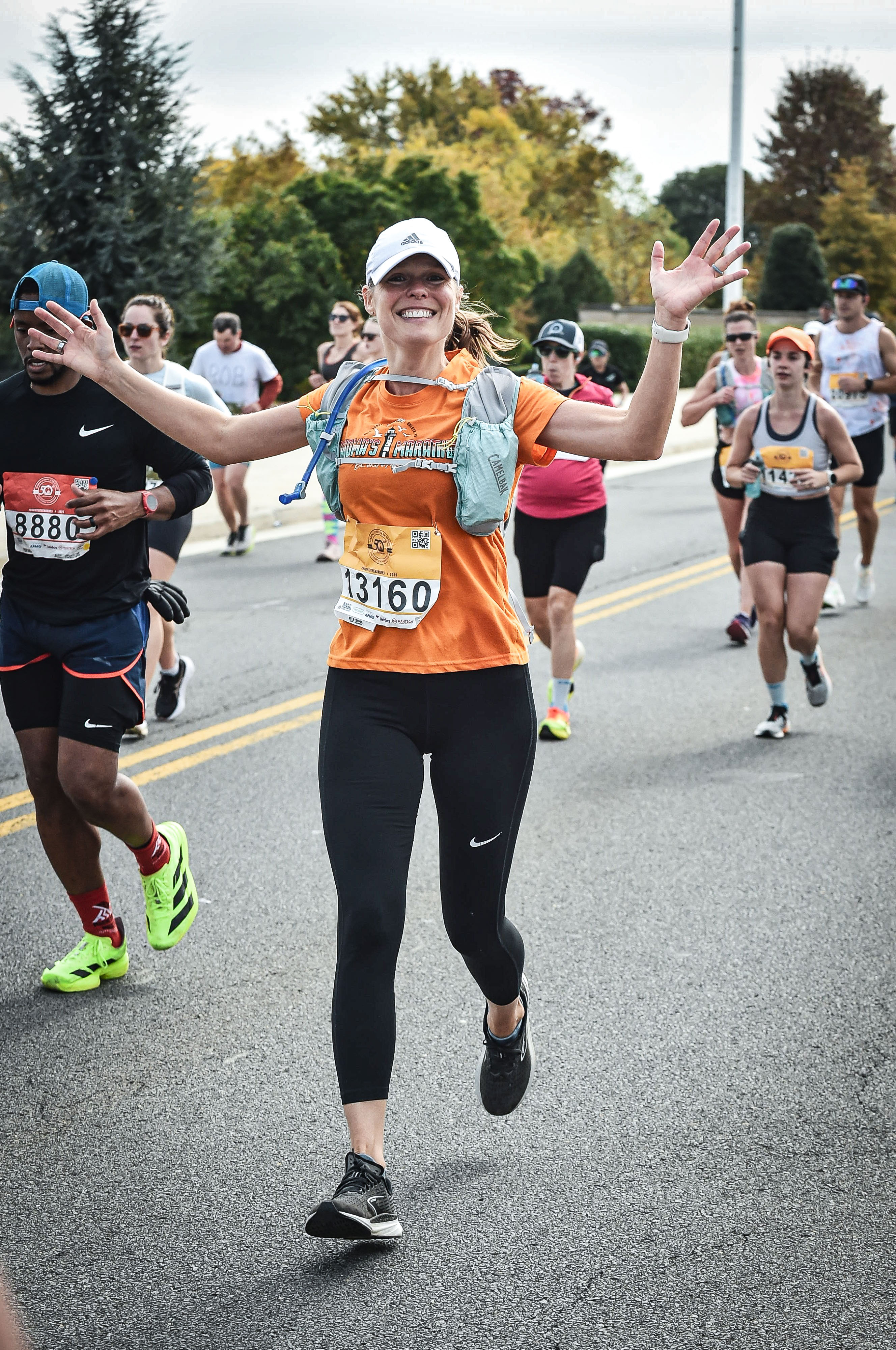
I ran the Marine Corps Marathon over the weekend. It was my fourteenth marathon completed. I am incredibly proud of this one. It represents an evolution in my hobby-level distance running career. This marathon was grounded, joyful, and while I wouldn’t say it was effortless, it was light. Airy, even. Don’t believe me? This is me somewhere around mile giganti-thousand:
I am extremely attentive to my running. For several years I’ve kept a daily running journal in which I track my time and pace. As I’ve rolled deeper into my forties I’ve started to pay more attention to things I used to ignore, namely what I’ll call The Big S’es: Strength Training, Stability Work, Stretching, and Sleep. There is no question, I’m a better runner now than when I started. Whereas injuries used to be a constant battle, I barely ever get them now. My body is in better shape.
But earlier this year, I started to slow down. A lot. Inexplicably.
It wasn’t like I lost energy. Rather, what felt like the same effort became a minute to a minute and a half slower per mile. Pretty insane, actually.
Through a routine health care appointment this summer that had nothing to do with running, I discovered that my iron levels have plummeted. My doctor put me on iron pills. I’ve also been working on an iron-heavier diet. Pretty quickly my usual pace came back. For most runs. But I’m not totally back to normal yet, and still figuring it out.
So I truly had no idea what would happen at the Marine Corps Marathon this year. In my natural state my body likes to do a marathon in about 4:10 (I’ve clocked this or something within a minute or two of it several times). Every now and then I bust out something faster. Sometimes I fall the hell apart and go much slower.
Surrendering any pretense of a time goal/prediction was freeing!
I’m especially proud of this marathon for two other reasons:
First, two years ago I ran the first 18 miles of the Marine Corps Marathon and dropped out. This is the only marathon I haven’t finished to date. That was devastating for me, which I wrote about here. I’m thrilled to have finished this time around, but also for every stride before I finished. I did not fall into the headspace of ‘doom,’ ‘sad,’ ‘revenge’ self-punishment whatever. This weekend’s success proved to me that trying again is a worthy pursuit.
Second, I have finally figured out fueling. Remember my Big S’es from before? Fueling should have been on the list. Maybe fueling is even more important than the physical stuff. This training cycle I realized that I needed to stop grinding it out, and just eat a hell of a lot more when I’m running. It worked. I never got tired. I never walked. Score one for a training run this summer that I decided to cut short and label a failure (which I had never done). That became the impetus for me to really experiment with fueling. Win!
I will never be a professional runner. I’m getting older and, with the input of funky blood, slower.
But I love this sport. I learn things from it every day. I am thinking so much about fueling and failure and patience. Consistent effort. Letting go of outcomes. How I can apply it to other areas of my life. And find more joy!
September 2025 To The Contrary Appearance
I appeared on PBS’ To The Contrary, and discussed women and the job market, as well as the Democratic Party’s attempts to rebrand. Watch here:
May 2025 To The Contrary Appearance
I appeared on PBS’ To The Contrary, and discussed DEI in business, and boys falling behind. Watch here:
Domestic Violence Is Terrorism, And The Problem Of Pete Hegseth
Domestic violence is terrorism. While anyone can be a target, and anyone can be a perpetrator, domestic violence’s primary form is the domination of individual men over individual women. But the individual stories that make up domestic violence are not one-offs, or even a pattern: they are a systemic expression of male domination. Domestic violence is patriarchy, most literally weaponized at the most elemental building block of society: within the human relationship of family.
I’m going to start with some definitions, and then discuss how they fall short. Finally, I’d like to examine how acknowledging domestic violence as terrorism further elaborates upon the dangerous, unqualified nature of Pete Hegseth’s nomination to be Secretary of Defense.
I do need to disclaimer these definitions of domestic violence and terrorism to follow, because at the time of writing (January 22), we are three days into the second Trump administration and it seems that any moment the Department of Justice will no longer have an Office on Violence Against Women, or if it does, this page will become really fucking weird. So, too, the FBI website is about to become a new outpost of RT or some such, and one can only imagine what definition of terrorism is going to slide onto this website when the top priority of the authoritarian president and wack-a-doodle FBI director is ‘RETRIBUTION.’ (And how long until someone is punished either directly by the state or by agents operating on its behalf for writing a paragraph such as this? Oh well, part of the way autocracy works is fear on the part of the people, including self-censorship, and I will be calling for free speech from the rafters until I’m hauled out!)
At the time of writing, here’s the definition of domestic violence from the Department of Justice’s Office on Violence Against Women, quoted, and with a screen shot below for posterity:
Domestic violence is a pattern of abusive behavior in any relationship that is used by one partner to gain or maintain power and control over another intimate partner. Domestic violence can be physical, sexual, emotional, economic, psychological, or technological actions or threats of actions or other patterns of coercive behavior that influence another person within an intimate partner relationship. This includes any behaviors that intimidate, manipulate, humiliate, isolate, frighten, terrorize, coerce, threaten, blame, hurt, injure, or wound someone.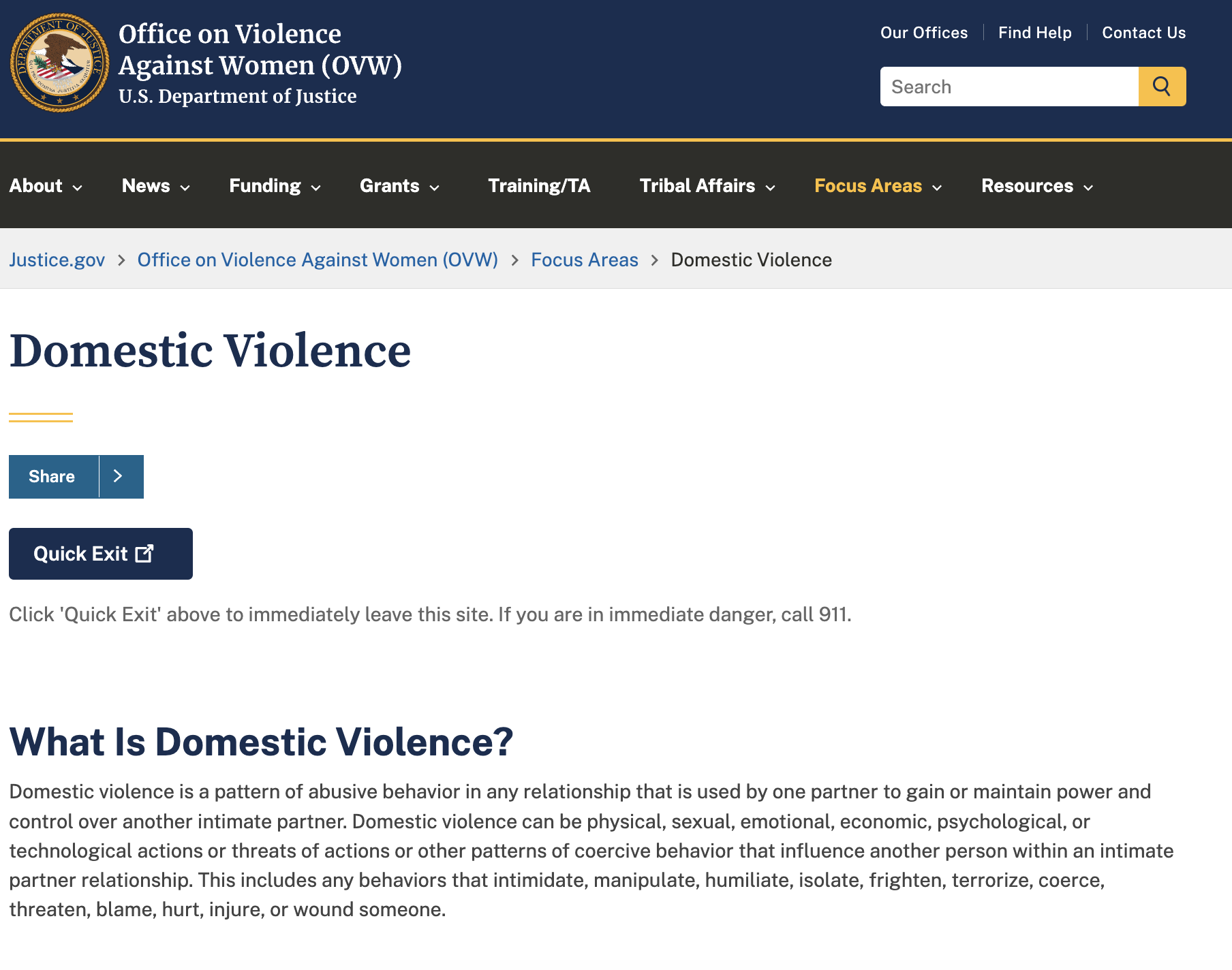
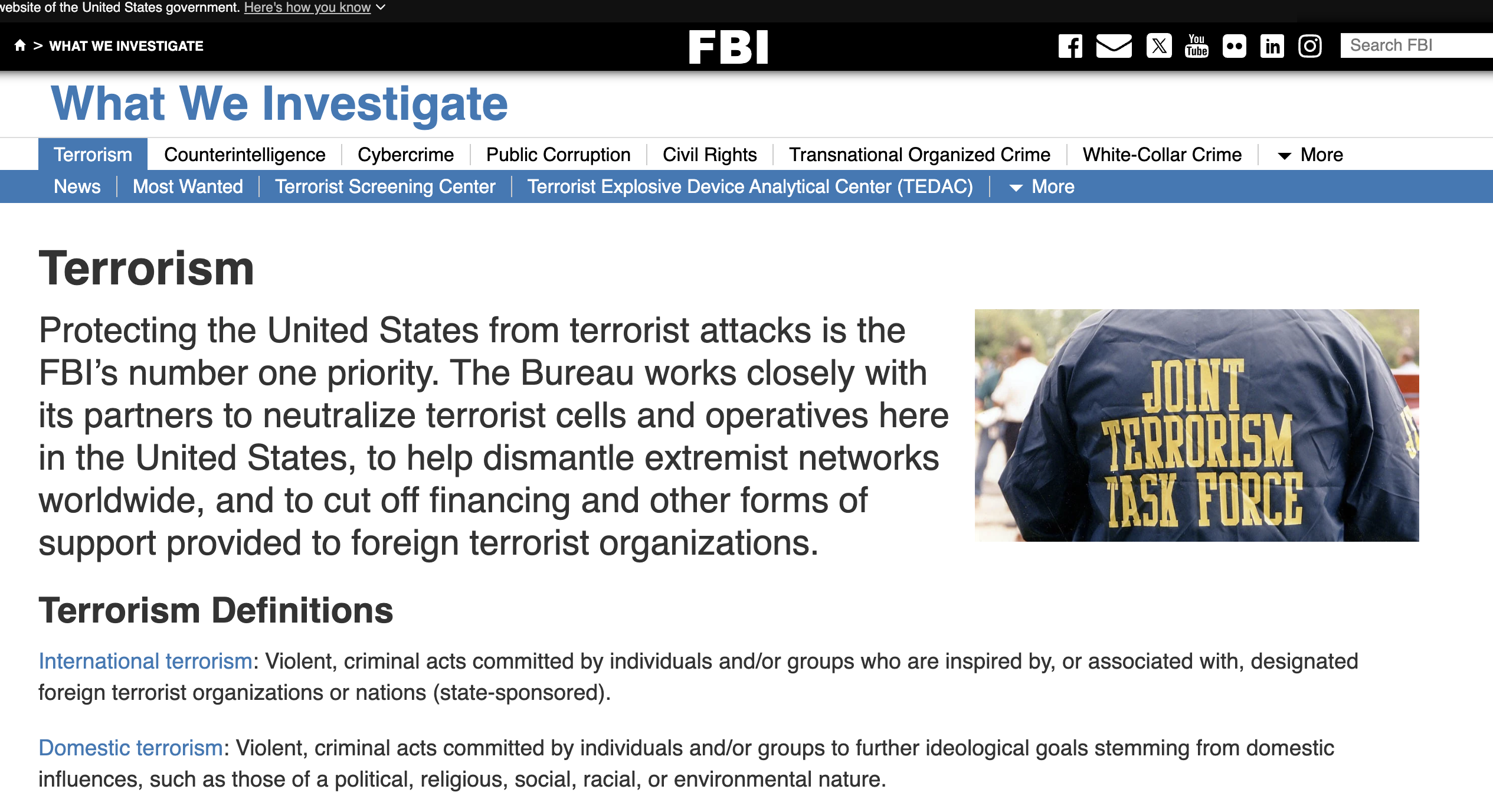
And also at the time of writing, the definition of terrorism from the FBI before inevitably Trump 2.0 changes it, again with a screen shot to help future us remember ‘the way we were’:
International terrorism: Violent, criminal acts committed by individuals and/or groups who are inspired by, or associated with, designated foreign terrorist organizations or nations (state-sponsored).
Domestic terrorism: Violent, criminal acts committed by individuals and/or groups to further ideological goals stemming from domestic influences, such as those of a political, religious, social, racial, or environmental nature.
The domination of men over women in abusive relationships is absolutely a “violent, criminal act committed … to further ideological goals stemming from domestic influences, such as those of a political, religious, or social … nature.” In fact, keeping women in line with rigid gender roles in which men reign supreme is one of the chief outcomes of domestic violence. It’s an ideological goal absolutely supported by a toxic culture. I’d argue the only reason why this no-brainer isn’t already recognized is because of, you guessed it, systemic sexism that has permeated societies for literal ages.
Which brings me to the latest news of Pete Hegseth, that allegedly alcoholic and misogynistic (both allegations backed by piles of eyewitness accounts and unsavory quotes that have been reported in the media!) television anchor who has never managed a large, sophisticated organization. He is incredibly unqualified to run the Department of Defense, and in normal times within our democracy, when both parties had a commitment to vetting nominees regardless of how much power they held, his nomination would not remain a going concern.
But these are not normal times within our democracy.
Now Mr. Hegseth’s former sister-in-laws says he abused his second wife. The other disqualifications were disqualifying. This is even more disqualification, and perhaps the most of the most disqualification. The Department of Defense is intimately engaged in the battle against terrorism. If we accept that domestic violence is terrorism (as we should), then it follows that these allegations, if true, mean that Mr. Hegseth has no place in a position that is at least supposed to fight for the ideals of freedom, justice, and security.
I Actually Have No Idea How Fast I Am Going
I write about running a lot, because I run a lot. Perhaps too much. It is entirely possible that my running is detracting from my writing. It used to be the case that when I got up early, I would write. Now when I get up early, I run. Or I start working on my job so that I have time to run when it gets light outside. If I’m being honest, I have too many [waves hands] hobbies.
But running gives me energy. That feeds my ability to write. And my ability to give my best thwack to fighting the hateful ideas behind gender-based oppression, which, tbh, is not an easy nutcracker to ballet.
I work out many ideas on my feet.
I am a middle-age recreational lady runner. For that demographic, I take it seriously. For years I’ve kept a daily journal noting time, distance, pace. I schedule my runs. I compete against myself like whoa. (The only person you’re ever really competing against is yourself, I’ve learned. All these lessons are for running and so much more.)
One thing I’ve been focusing on is my speed. Training myself to run faster is fun. In this process, I have realized that I actually have no idea how fast I am going. Sometimes, I look at my device and realize I’m going like a minute per mile faster than I thought I was. Much more often, I think I’m going fast, and I’m like slo-mo runner in actuality.
I think to the times in my life when I’ve crashed or burned out, and how this lack of self-awareness about self in relation to time and space chases me. Me chasing me without realizing I’m doing it. But also how there are times that I think I’m going fast when actually, it’s an illusion and I need to buck up to hit the mark.
To know oneself in relationship to an actual measurement of velocity is somewhat akin to the experience of seeing yourself on video. This is how I look from outside the blinders of my body? Really?
Sometimes I think I can understand others better than I can myself. And to be clear, I’m constantly confuzzled by others. Who is this me in the sneakers? How fast is she going? I dunno.
 Erin Matson