A Trip To Paris With Pictures And My Commonplace Book

During my first semester of my MFA program, one of my instructors assigned us to keep a commonplace book over the course of the semester. A commonplace book is a file of quotations. It had to be at least 25 pages, so I had to be a bit of a bunny with our assigned reading. I couldn’t slough it off until the last minute.

More than three years later, I’m still going strong, although I’m no longer doing it in a document in exchange for class credit. I now have a small Moleskin notebook. I write in it by hand. No one is assigning me this. I just love to do it.

Please meet my commonplace book, as it records my readings during my stay in Paris over the past week.

“I always say that you can not tell what a picture really is or what an object really is until you dust it every day and you cannot tell what a book is until you type it or proof-read it. It then does something to you that only reading can never do.” – Gertrude Stein, “The Autobiography of Alice B. Toklas”

I picked up a copy of Gertrude Stein’s “The Autobiography of Alice B. Toklas” at Shakespeare and Company, just behind Notre Dame. I read it in one day. Admittedly, this is the day we flew home from Paris, so I had time on my hands. Let’s talk about the above quote, because not only is it the ultimate validation for my quest, it’s fascinating. I reread it several times as I transmitted it to paper. She really spelled “can not” as two words the first time, and “cannot” as one word the second time. This was a woman of great intentionality. I refuse to believe she made this choice casually. What does she mean?
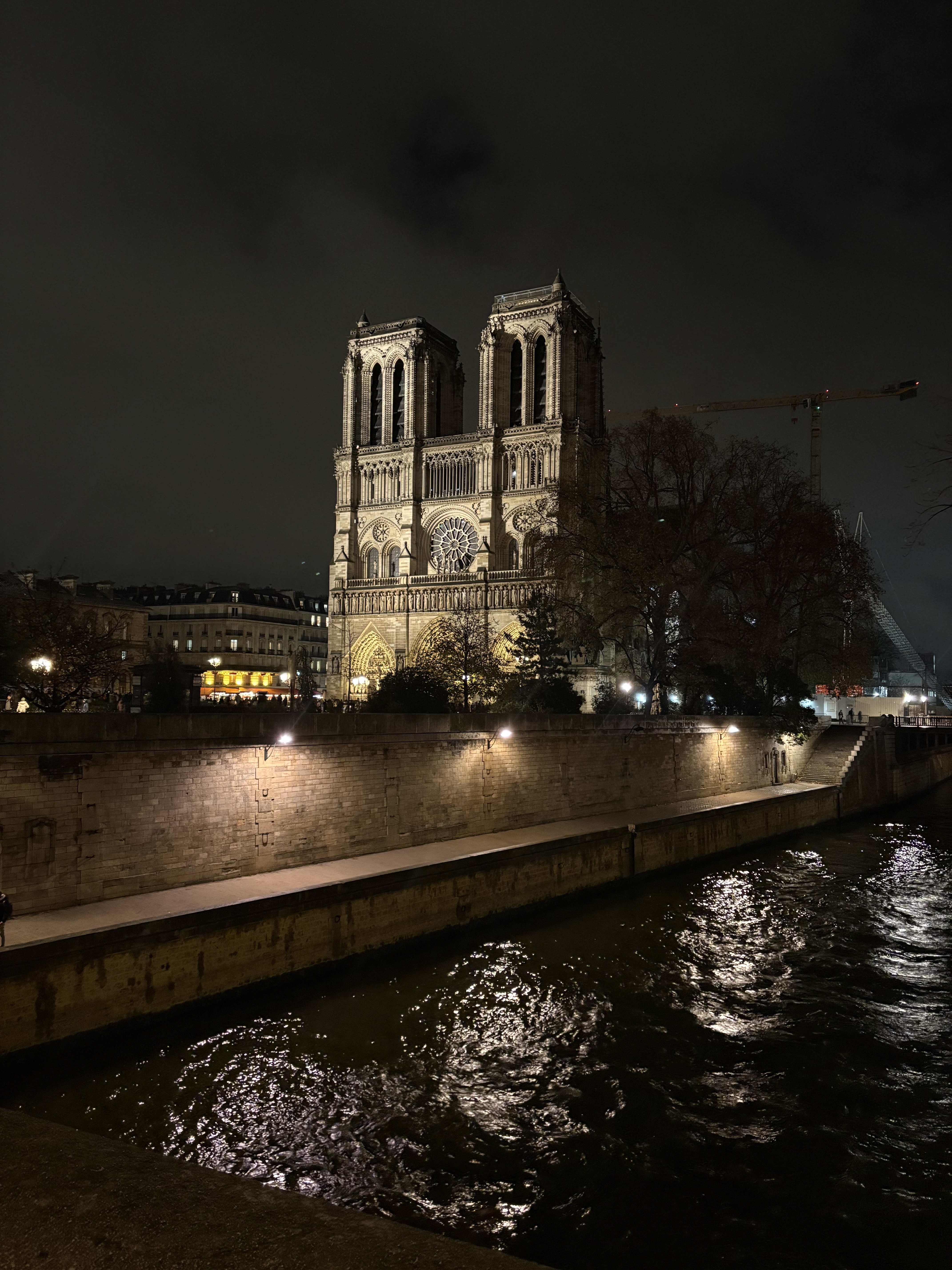
Notre Dame at night. We stayed at an apartment so close by, sometimes you could hear her bells.

I read Gertrude Stein’s poetry, if you can call it that, during the course of my program. It was inscrutable. It made me want to craft shoe leather out of the roof of my mouth, anything, anything to get away from her words. But “The Autobiography of Alice B. Toklas” was pretty good. I’m glad I gave it a try.

“A little artist has all the tragic unhappiness and the sorrows of a great artist and he is not a great artist.” – Gertrude Stein, “The Autobiography of Alice B. Toklas”

Ouch, Gertrude. A little close to home, yes? Me and my tragic unhappiness and sorrows, and sloppy prose. Alas. We went to Musee D’Orsay and the Louvre. There are no little artists featured there. I’m not much of a picture-taker, though. I delegate that to my husband. He loves a camera. Thus I took no pictures in the Musee D’Orsay or the Louvre. But I did take this photograph of a coaster at Les Deux Magots, where James Joyce used to drink.
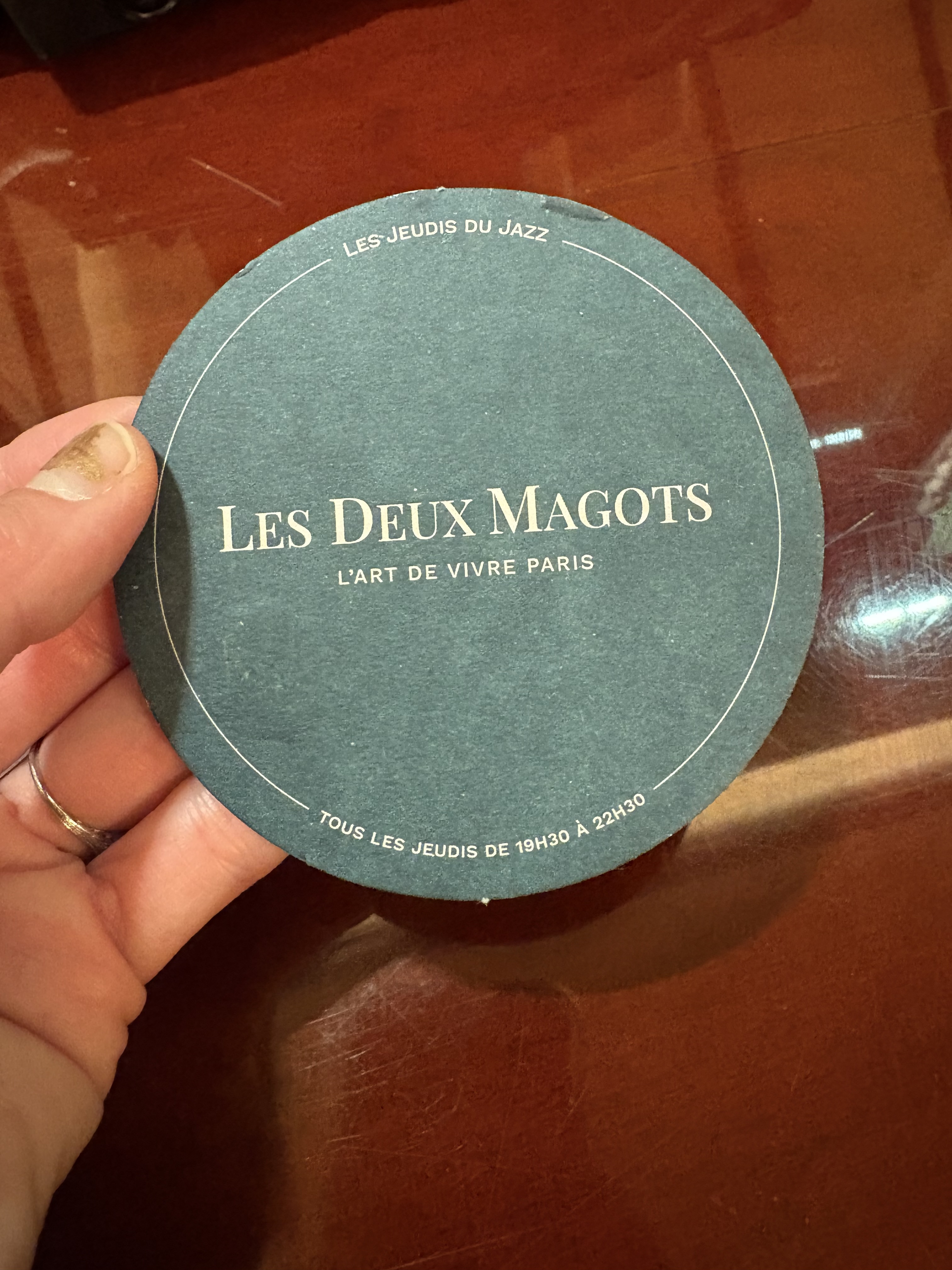
What kind of idiot looks at fine art for several hours on two separate days, and takes no pictures, but does take a picture of a used coaster presented with her glass of red wine? Alack, a little artist.

I read two other books during the trip. Haruki Murakami’s “1Q84,” and Jean-Paul Sartre’s “What Is Literature?” Technically, I started Murakami at home, but the book is bigger than the telephone directories they used to give you for free. It was totally genius. The two quotes from the trip that I’ve put in my commonplace book I’ll withhold for now, as I may use them in a project I’m working on.

I also still have a bit to go with “What Is Literature?” Perhaps 70 pages remaining. Maybe 60. I read that immediately after finishing “The Autobiography of Alice B. Toklas.” I never got up from my window seat during that Air France flight. Why worry about blood clots when there is the threat of brain clots? These are the two books I purchased at the Shakespeare and Company bookstore. I worry that, like the maracrons purchased at the airport, I shouldn’t let Sartre go more than a few days if I hope to get back into it. It will be hard to finish that book in a not-captivity situation, but I’ll do it.
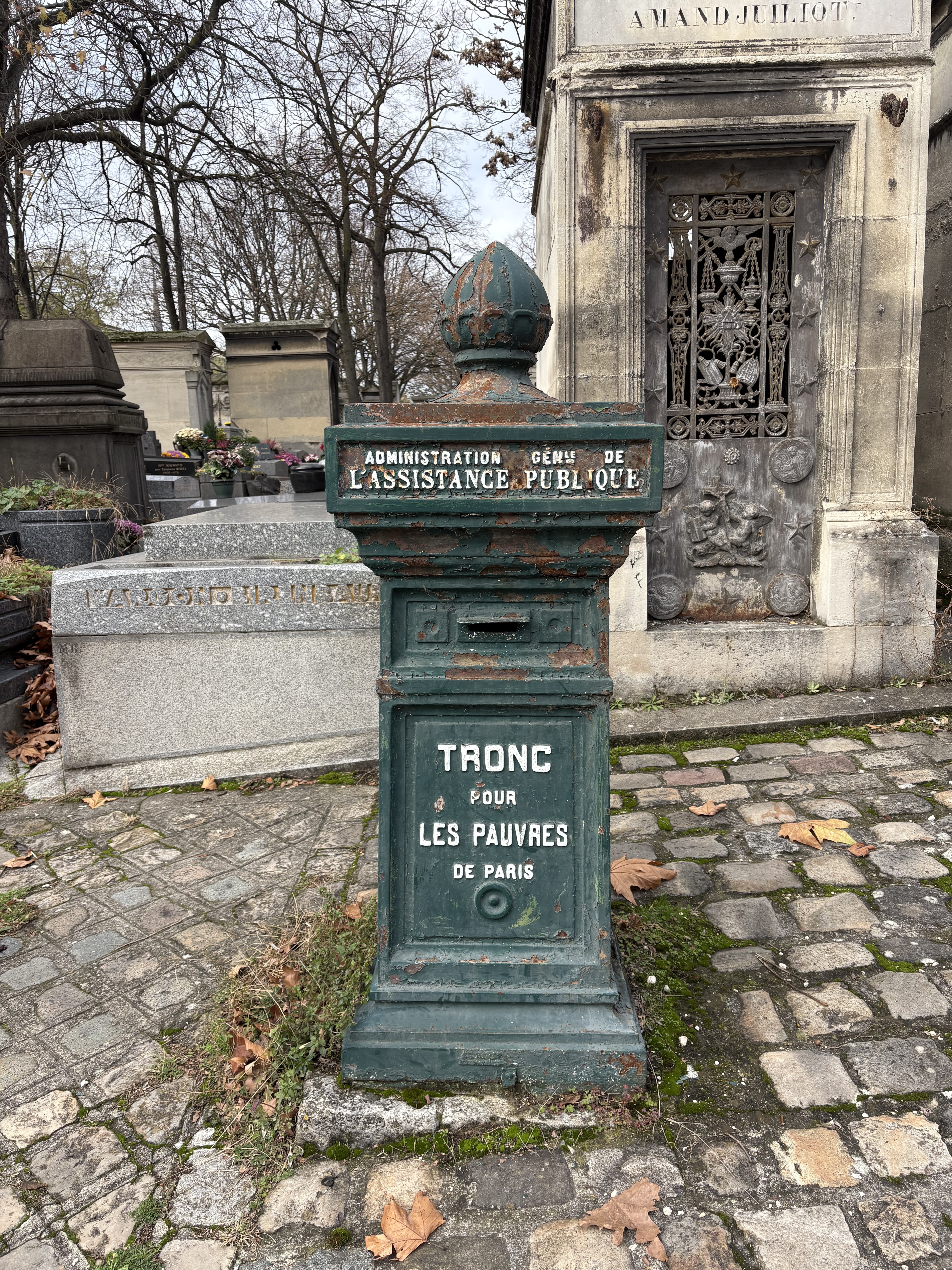
Things they do better in Paris, beyond the accurate “EVERYTHING” include public toilets and a genuine encouragement to give to the poor. This encouragement to donate sits inside the front gates of the Pere-Lachaise Cemetery. I didn’t take photos of these graves visited: Oscar Wilde, Jim Morrison, Edith Piaf, Frédéric Chopin. I was too busy looking at them.

Cemeteries are among my favorite places. I go in a cemetery a half dozen to a baker’s dozen times a month, and have been doing this for years. They are great places to still the mind, to explore, to run. Thus, Pere-Lachaise is the place we visited that was my favorite. No contest. I can’t believe how packed together everything was. Rotting grandeur is my favorite vibe. This one had it.

“You must have deep down as the deepest thing in you a sense of equality. Then anybody will do anything for you.” – Gertrude Stein, “The Autobiography of Alice B. Toklas”

It is possible to lean on one another in life, and in death. This is what I see in this image.

Reviewing my phone, I took seventeen photographs during my seven days in Paris. The first photograph was of kohlrabi for sale in a market. My small-town Minnesota grandmother loved kohlrabi. As they say, wherever you go, there you are.

And that was me. Reading my books. Writing down quotes. Not taking many pictures. Eating croissants every day. Never looking once at social media (oh my God, yes). Drinking copious quantities of red wine. Not having Thanksgiving dinner because our family is vegetarian anyway. Rather, some nice wine and cheese.
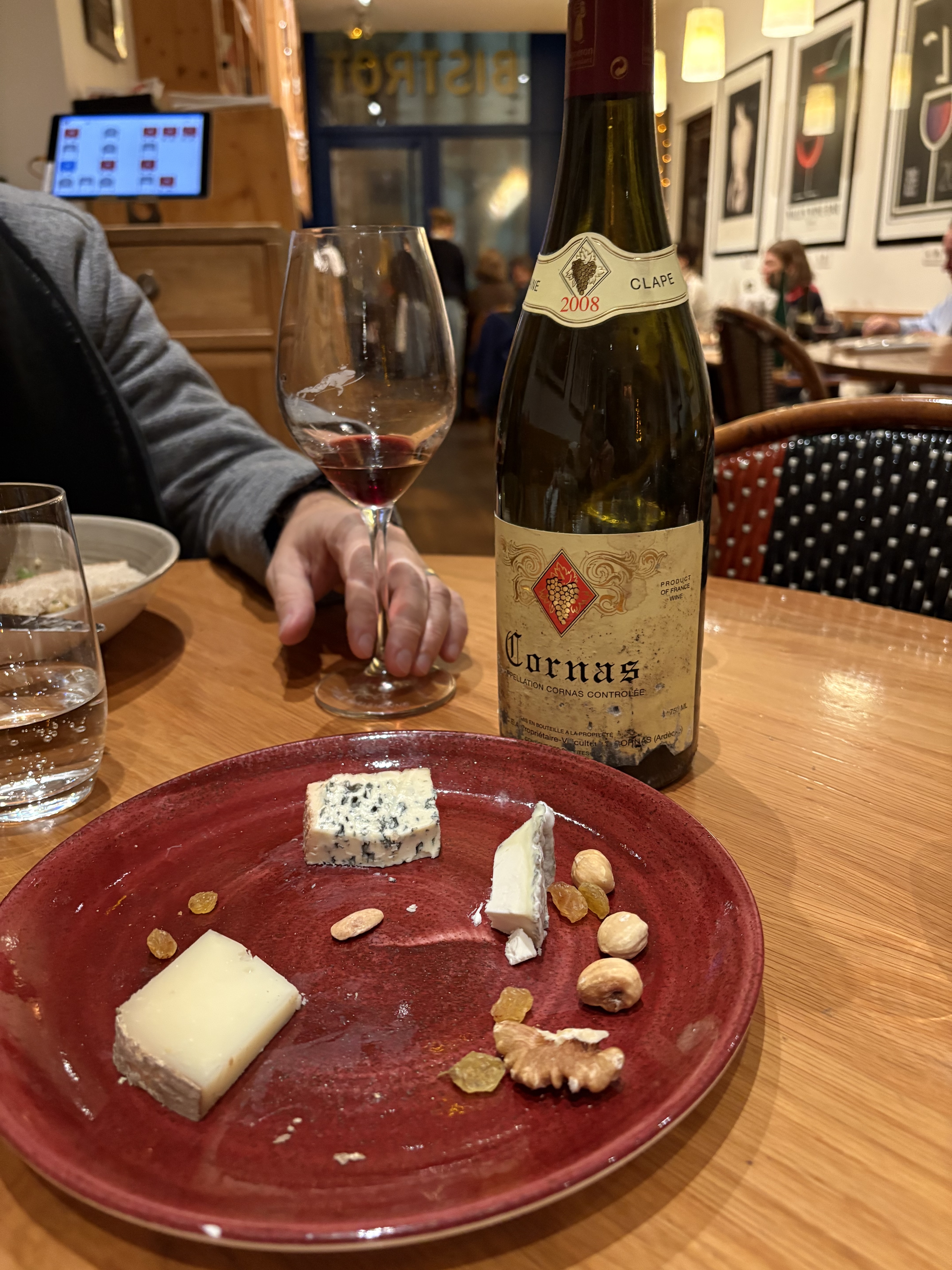
This is what a nice Thanksgiving meal in Paris looks like when no one in your family eats flesh.

I was struck, landing at Charles de Gualle, and walking through customs, how different it felt to be in a country without fascist leadership. I felt much freer and safer than I did walking through U.S. customs on the way home. You never know what kind of shit they’re going to pull on the abortion people, and when.

But in Paris? I didn’t have to think about it.
What I’m Really Getting From My MFA Degree

I’m about to graduate with my MFA in creative writing.

I enrolled in my program because I wanted to become a better writer. On that level, I think I have succeeded. Here is what I’ve gained:

More rigor toward my own writing. When I turned in my thesis novel, I instantly knew that I needed another big project of that scale, or I would lose my mind. I have realized I like having something substantive to work on, and enough structure to make real. My program has taught me that big projects don’t just happen. I need to outline, have daily writing goals, have reading goals, and a game plan.

Acceptance that I need to revise things over and over. And over. Any first draft that I love, that I feel is on fire? It’s likely shit. My MFA program has helped me to understand that I am a horrible writer. Like, truly terrible. That I am only as good as my willingness to keep rewriting. Rewriting. Then rewriting, again.

An eye toward craft while reading. I’m a different reader than I was when I entered the program. I now am far more interested in how choices around point of view, voice, and narrative arc shape a story. I have grown obsessed with the choices authors make.

Reverence for the literary community. I now understand literary magazines, and what treasures they are. I understand how much work goes into editing. Publication. I’ve been a professional writer in much of my career, and with a fair degree of success, but I was not a literary writer. I now have appreciation for this whole other world, on the literary side.

Friends. Making new friends is no trivial matter when you’re 45! It’s been a rare gift to make a handful of close friends from my program. Friends who write! I read their stuff, they read mine. But the friendships are deeper than that. These relationships are life blessings.

An MFA degree is a degree no one cares about. As for me, it does nothing to advance my career or earning potential. I have already been a professional writer and communicator. Thus, this degree opens no doors for me. It could matter if I wanted to go on and teach at the university level. But I don’t.

Still, I’m super glad I did this. I’m proud. Though I admit I have senioritis. I’m ready to say, “it’s over.”

Soon. Three weeks, to be exact.

Fact Check After Texas A&M Censors Race And Gender Studies: I Have A Women’s Studies Degree, And I Am Successful

Texas A&M censored gender studies last night. According to The New York Times, the regents have spoken with a unanimous vote: courses are not able to “advocate race or gender ideology, or topics related to sexual orientation or gender identity” without direct approval of the university president. One regent, Sam Torn, said:

“Curriculum is created and approved based on the accepted body of knowledge needed for our students to be successful in their chosen profession. It is unacceptable for other material to be taught instead.”

I hold a bachelor’s degree in women’s studies, and thus am in a position to speak from direct experience. (Technically, I hold an interdisciplinary studies degree with a concentration in women’s studies, because that was the closest Georgetown let its women’s studies program get to recognition.)

I consider myself to have had a great deal of success in my chosen professions. I have written for Fortune 500 companies, landed and held competitive advertising creative jobs, started an organization that I have led for 10 years, served as an executive officer of the national organization for women, published work in a variety of local, national, and literary publications, and in less than a month, I’ll complete my MFA in creative writing.

I have been blessed to have a varied and rich career path, and the foundation of what I learned toward my women’s studies degree is a direct contributor to my success — I took courses in English, history, linguistics, law, psychology, and sociology that counted toward my degree. I have learned that everything counts, and that critical thinking skills are the key tool to success. The real world is multidisciplinary, too.

Academic censorship of gender studies (and race studies) has nothing to do with preparing students for meaningful careers. Rather, it’s a reflection of the authoritarian environment in which we live. The government is placing enormous pressure on our public institutions, in order to control what we think.

The goal is total control. It’s terrifying. And yes, authoritarian governments always come for the women, the sexual minorities, and the people of color first.

Unpopular Opinion: Erika Kirk Is Off-Limits

Recently, photographs of Erika Kirk and J.D. Vance embracing went viral. Seemingly everyone had something to say about where the hands were, what she was wearing, and the future of the vice president’s marriage.

STOP. Let’s be human beings, shall we? This. Woman. Is. Grieving.

Erika Kirk is undergoing an intense trauma with few parallels. Imagine having your husband murdered, on camera. Imagine those images going around the web. Imagine having young children and knowing that no matter what you do, you can’t protect them from the fact that those images are out there. Waiting for them.

Yes, J.D. Vance is a spineless, morally bankrupt tool. A chaser of the wind and wherever it blows. An authoritarian sell-out. He deserves all the criticism. All the time.

But you know what? Get those jokes about that hug out of your mouth. They are tasteless. The last thing this woman needs right now is criticism for normal behavior–a hug with a friend while she’s going through the wringer. And critiquing her clothes? No. I haven’t been in feminism for a few decades to go along with demonizing women based on their wardrobe choices.

It has been less than two months since the murder. Erika is allowed to grieve, to be. She deserves our grace. No matter where you fall on the political spectrum.

The Marathon Where I Let Go And Had The Time Of My Life

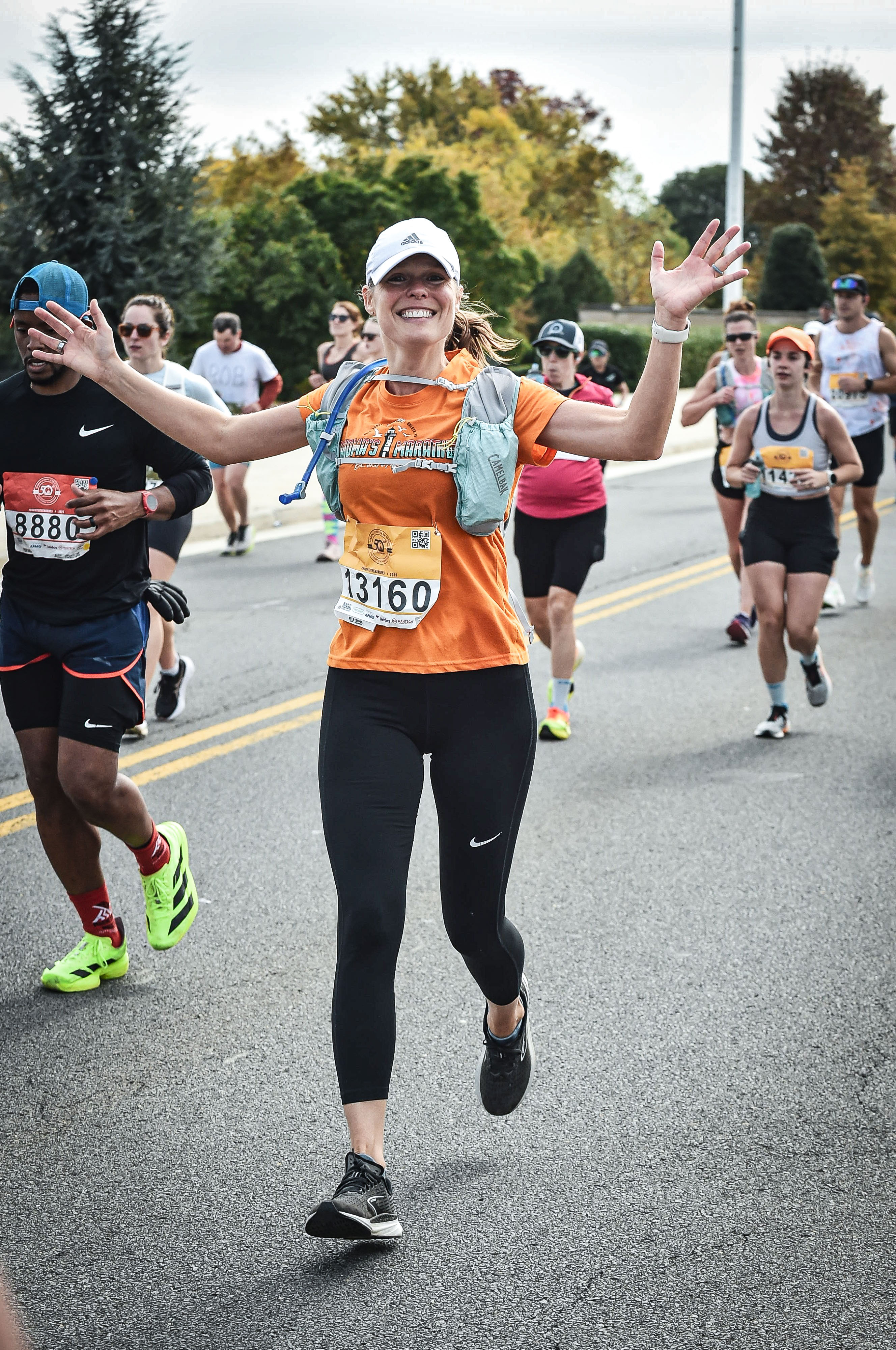
I ran the Marine Corps Marathon over the weekend. It was my fourteenth marathon completed. I am incredibly proud of this one. It represents an evolution in my hobby-level distance running career. This marathon was grounded, joyful, and while I wouldn’t say it was effortless, it was light. Airy, even. Don’t believe me? This is me somewhere around mile giganti-thousand:

I am extremely attentive to my running. For several years I’ve kept a daily running journal in which I track my time and pace. As I’ve rolled deeper into my forties I’ve started to pay more attention to things I used to ignore, namely what I’ll call The Big S’es: Strength Training, Stability Work, Stretching, and Sleep. There is no question, I’m a better runner now than when I started. Whereas injuries used to be a constant battle, I barely ever get them now. My body is in better shape.

But earlier this year, I started to slow down. A lot. Inexplicably.

It wasn’t like I lost energy. Rather, what felt like the same effort became a minute to a minute and a half slower per mile. Pretty insane, actually.

Through a routine health care appointment this summer that had nothing to do with running, I discovered that my iron levels have plummeted. My doctor put me on iron pills. I’ve also been working on an iron-heavier diet. Pretty quickly my usual pace came back. For most runs. But I’m not totally back to normal yet, and still figuring it out.

So I truly had no idea what would happen at the Marine Corps Marathon this year. In my natural state my body likes to do a marathon in about 4:10 (I’ve clocked this or something within a minute or two of it several times). Every now and then I bust out something faster. Sometimes I fall the hell apart and go much slower.

Surrendering any pretense of a time goal/prediction was freeing!

I’m especially proud of this marathon for two other reasons:

First, two years ago I ran the first 18 miles of the Marine Corps Marathon and dropped out. This is the only marathon I haven’t finished to date. That was devastating for me, which I wrote about here. I’m thrilled to have finished this time around, but also for every stride before I finished. I did not fall into the headspace of ‘doom,’ ‘sad,’ ‘revenge’ self-punishment whatever. This weekend’s success proved to me that trying again is a worthy pursuit.

Second, I have finally figured out fueling. Remember my Big S’es from before? Fueling should have been on the list. Maybe fueling is even more important than the physical stuff. This training cycle I realized that I needed to stop grinding it out, and just eat a hell of a lot more when I’m running. It worked. I never got tired. I never walked. Score one for a training run this summer that I decided to cut short and label a failure (which I had never done). That became the impetus for me to really experiment with fueling. Win!

I will never be a professional runner. I’m getting older and, with the input of funky blood, slower.

But I love this sport. I learn things from it every day. I am thinking so much about fueling and failure and patience. Consistent effort. Letting go of outcomes. How I can apply it to other areas of my life. And find more joy!

    This Is A Lola Young Appreciation Post

    Fam, I’m going to keep this short, but I’m a huge Lola Young fan. She’s a wickedly talented artist. For the past year her music has been the soundtrack of me writing my thesis novel about an unlikeable woman experiencing domestic violence. I’ve listened to her song “Messy” on repeat until I’ve cried (and I love that she gets beaucoup royalties for this, please take all my money, girl)!

    She is open about having experienced a variety of mental health and substance issues. A few days ago, she collapsed on stage at a music festival. She has since said that she is taking a break and will “cancel everything for the foreseeable future.”

    I already loved the crap out of her. Now it is only more. People dealing with their demons, period, much less in public, get ALL of my praise. Everyone has demons. Everyone, dude. But only some are brave enough to admit they have them.

    Do what you need to do to be well, girl! We love you.

    This is a Lola Young appreciation post.

    Failure, The Great Teacher

    I ran my first marathon in February 2019, and have run 13 total since. In all of these training cycles, I have never not finished a training run. (Though I did drop out of one marathon race because I was going slow and my daughter had somewhere to be, which I wrote about here. That made me freak the freak out.)

    But yesterday I did a new thing. I stopped my 20 mile training run at 17.66 miles.

    I have finished absurd runs under all manner of absurd circumstances. Driving rain, with motorists pulling over to see if I need a ride? I’ll keep going, thanks. Upchuck in my mouth because of dietary decisions that, in hindsight, were rather obviously not compatible with running (dinner as four slices of jalapeno pizza with jalapeno poppers on the side, and beer, the night before)? Finished the damn run.

    But yesterday I bonked. This is a phrase that means, “run out of energy.” I have certainly bonked before. What I have not done is stop a run because I bonked. Instead, I drag myself. It’s torture but I know how to finish when this happens.

    But yesterday I didn’t do that. I just stopped. It was about to become 80 degrees, and climb another five or six, and I didn’t want to mess with that. Not after 17.66 miles of sweating in the sun.

    There was a mental chaos, a psychiatric falling through gravity that resulted from this rather unprecedented decision. I always finish my runs. What happens if I don’t finish my run?

    Turns out? Nothing.

    Except that I feel like a better runner today than I did yesterday. I learned something profound:

    I need to fuel myself more. I’d already known this, but turns out what I was telling myself was “more” was not enough.

    Additionally, if it’s hot out, I’m better off switching to treadmill, or rescheduling. Period.

    This is a life lesson indeed, to invest in myself more than I think I need to, and to take external conditions at least as seriously as I take my goals.

    Yesterday’s training run taught me more than so many others where I have bonked and kept going. I know how to perform superhuman. What I didn’t know was if I could accept a failure and learn.

    Turns out I can.

    And feel great!

    In Praise Of The Elderly White Hippies

    Following the Trump takeover of Washington, D.C., my regular morning runs have become an inventory of the missing unhoused people, gone from their usual places.

    She’s gone. She was by the Washington Monument.

    He’s gone. He sat in a wheelchair, by the Metro.

    Gone, gone, gone. So many gone. Have they been shipped to El Salvador? Sudan? Louisiana? They have committed no crime, no crime but homelessness. Poverty. Mental illness. In no true reading of a law book are these actually crimes. They simply have nowhere else to go.

    Until the troops came. God, the troops are so young. I see them on my runs, early in the morning. I study their faces. Do they know what this country was, not so long ago? A democracy. An imperfect democracy where you could work on making it more of a democracy.

    So this is the context in which White House hatelord Stephen Miller sneered at pro-democracy protesters shouting down his press conference as “elderly hippies,” “stupid white hippies,” who “all need to go home and take a nap because they’re over 90 years old.”

    My dear elderly white hippies, please keep it going. We love you so much. Take all the naps you need, friends. We all should. This will be a long fight and we’re best served by people willing to take care of themselves and fight to the end.

    And if you think calling us names is going to make us go away? You’re wrong.